Rainbow Feather Canary With A Retro-Style Bowl Cut Hairdo Is Turning Heads Everywhere

Barry, a Gloster canary with a dramatic feathered fringe, is getting plenty of attention for all the right reasons. His retro-style bowl cut makes him look like he stepped straight out of another era, and that unusual look is exactly what has people stopping to stare.
Gloster canaries were bred in Gloucestershire, England, and later became popular in the United States for their color, feathers, and songs. Barry’s owners found him at a pet shop, then came back the next day convinced he was the one, and now he is the tiny star of the story.
With his fringe, his singing, and his love of outings, Barry is hard to miss. Read on.
That hairdo...
“I’m the bird with the fringe!”

“On the 26th of July, we went to a pet shop to look for the perfect bird.”

“We came back on the 27th and thought he was definitely the one,” said Barry’s owners.

“We believe he is one and a half years old, but we have no proof (Glosters can live 7 – 12 years).”

“There are two types of Gloster canaries: one being consorts, which are the ones without the fringe, and the others are coronas, which have the fringe. It’s pretty obvious which category Barry falls under...”

“Barry absolutely adores going out in his bird carrier. We walk around parks and fields, and he tweets and hops with excitement.”
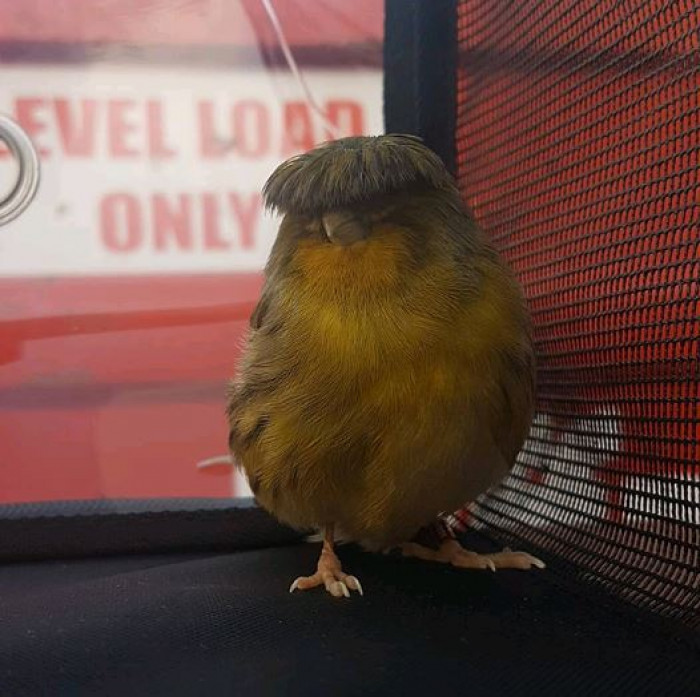
“He also loves sitting on the windowsill and singing.”

Common Health Problems
These birds hate drafts, so avoid exposing them to drastic temperature changes. Such changes can cause unwanted respiratory issues.
Gloster canaries are prone to air sac, feather, and red mites. They should be kept away from mosquitoes to prevent them from catching canarypox, which is transmitted through mosquitoes.

Diet and Nutrition
These cute little birds should be fed a diet rich in seeds, fruits, vegetables, and millet to provide them with the nutrition they need to thrive.

Any pet needs exercise, and the same applies to Gloster canaries. A large enclosure can provide them with ample space to fly, but if they have a small to medium enclosure, they should be allowed to safely fly indoors to get the daily amount of exercise they need to remain healthy. Along with a large enclosure, your bird will appreciate a sturdy perch and a few toys to help them entertain themselves and those who are mesmerized by their beauty!
For another heartbreaking pet goodbye, read about the woman’s last goodbye to her parrot, Sinbad.
Share this article: