
Man Harasses Family Who Adopted His Dog, Says They're Not Allowed To Rename Him

One dog adoption turned into a full-blown feud when a man decided his former pet still belonged to him, even after the dog had a new home.
In a Reddit post, he explained that he had to rehome his German Shepherd because his future stepson is allergic to dogs. He carefully chose the family who adopted the dog, stayed in contact, and seemed fine with the arrangement, until he found out they had renamed him.
That was enough to set him off, and things got messy fast. Here's how a simple name change turned into a very public argument.
The man decided to bring the issue before the Reddit community

His future stepson is allergic to dogs, so he had no choice but to put Willy up for adoption
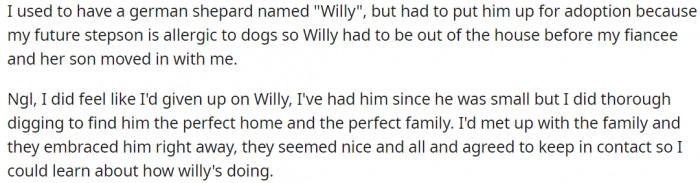
Willy's new family changed his name to Rudy, and now OP (original poster) is furious

Pets, particularly dogs, can evoke strong emotional attachments, similar to human relationships. The bond between dogs and their owners is characterized by attachment behaviors such as proximity-seeking and distress upon separation. This attachment can be profoundly affected by changes in the pet's environment, including changes in their name, which might be perceived by the dog as a challenge to their established identity. Research published in the Journal of Veterinary Behavior shows that familiar cues, like names, play a critical role in maintaining the emotional security of pets, indicating that consistent naming may help reduce anxiety and confusion in dogs during transitions.
This insight underscores the need for sensitivity when adopting pets, particularly in how their names and identities are handled, to support their mental well-being during what can be a stressful time.
The adopter's insistence on the dog's name suggests a desire to maintain continuity and connection, reinforcing the idea that names carry emotional weight and significance in our relationships with pets.
The recent incident involving a man harassing a family who adopted his dog underscores the complex emotional dynamics surrounding pet ownership. When a dog is adopted, the name given by the previous owner can carry deep sentimental value, reflecting their bond and memories. This case illustrates how the desire of new owners to rename a pet can clash with the lingering emotional attachments of the former owner.
This scenario brings to light the multifaceted nature of ownership, where it extends beyond mere possession to encompass emotional investment.
The post, which has since gone viral, garnered 12.2k upvotes and 5k comments. Here's how the Reddit community reacted to the story:
"You gave up any rights and control over their dog when you gave him up."

"You gave up any claim you had to that dog when you turned him over to his new family. Leave them alone, he’s not your dog anymore"
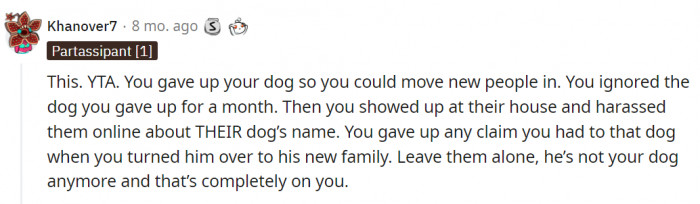
"OP, get this through your head: You. Do NOT. Have. A. Dog. You used to. Now you don’t. YTA."

The conflict described in the article reflects broader psychological principles regarding identity and ownership.
The situation surrounding the dog adoption raises important questions about the significance of a pet's name. In this case, the original owner insists that the new family cannot rename the dog, suggesting that names carry deep emotional weight. When a name is changed, it can evoke feelings of loss for both the animal and the new family, who may feel their connection is being challenged. This underscores the importance of recognizing that names serve as more than mere labels; they are reflections of the shared history and emotional ties that develop between pets and their owners.
Research in family dynamics suggests that the emotional bond between pets and their owners can evoke feelings of possessiveness.
Studies indicate that possessiveness can sometimes stem from unresolved attachment issues in human relationships, where individuals struggle with the idea of sharing or letting go of their emotional connections.
This possessiveness can lead to conflict, particularly when new family dynamics arise, such as adopting a pet.
"You better apologize profusely OP, or you’re never going to see Rudy again."

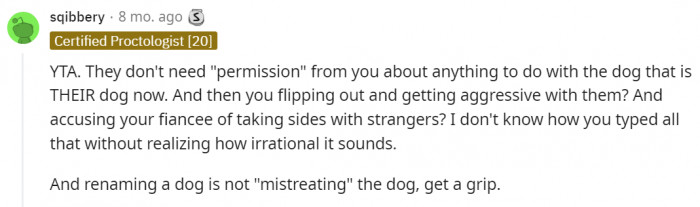
"YTA. They don't need "permission" from you about anything to do with the dog that is THEIR dog now"
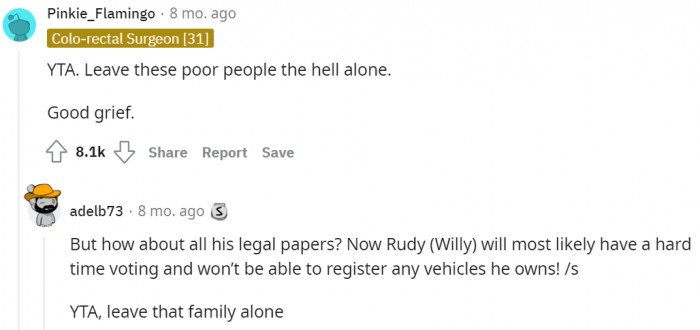
"YTA. Leave these poor people the hell alone"
The behavior exhibited by the original owner may stem from a defense mechanism against perceived loss.
This insight can help us better understand the underlying motivations behind the man's reaction, suggesting that his behavior is less about the name itself and more about a deeper fear of losing his connection to the dog.
This also echoes the Redditor furious because his friends kept calling his dog Jerry after renaming him.
To navigate the emotional conflict stemming from pet adoption, open communication is crucial. Engaging in discussions about the significance of the pet's name can help clarify emotional attachments.
Couples or family members should express their feelings about the name, ideally leading to a compromise that respects both the old and new owners' sentiments.
Therapeutic interventions can also assist in mediating these discussions, helping family members articulate their feelings constructively.
"You sound like a crazy person. I’d be terrified of you if I were that family."

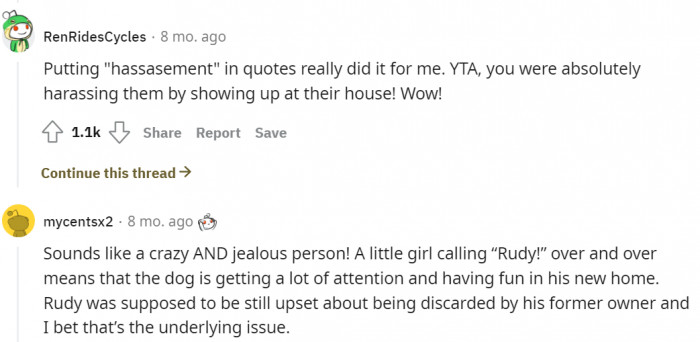
"YTA, you were absolutely harassing them by showing up at their house!"
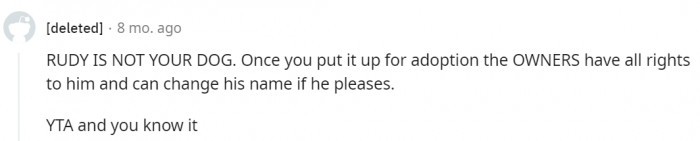
"RUDY IS NOT YOUR DOG. YTA and you know it"
From a behavioral perspective, the original owner's reaction can be viewed through the lens of cognitive dissonance theory. Cognitive dissonance occurs when an individual's beliefs and behaviors are inconsistent, leading to psychological discomfort. For the original owner, the dissonance between their emotional attachment to the dog and the reality of the adoption may trigger defensive behaviors, such as harassment.
To address this, techniques such as reframing thoughts or seeking cognitive-behavioral therapy (CBT) can help the individual reconcile their feelings of loss with the reality that the dog has a new home. Encouraging self-reflection and emotional regulation can aid in reducing the intensity of these reactions, fostering greater emotional resilience.
To address these tensions, it’s vital for both parties to engage in open communication about their feelings toward the pet.
Creating a dialogue about the dog's name might not just be about the name itself but about acknowledging each other's emotional investments in the pet. This can help both parties feel valued and heard, ultimately fostering a more positive cohabitation dynamic.
Conflict between previous and new pet owners often reflects deeper issues of control and power dynamics within relationships.
"YTA, you gave up all rights when you re homed him."

"You had no right to lose it on them, he is no longer your dog."

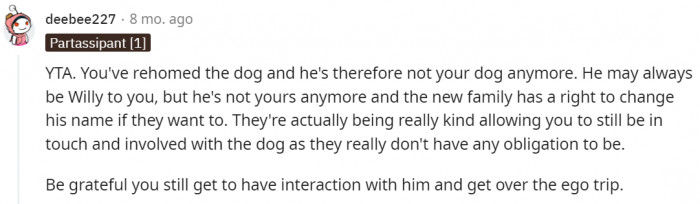
"Be grateful you still get to have interaction with him and get over the ego trip."
The rise of social media has transformed how conflicts like the one described can escalate.
Moreover, understanding the emotional implications of pet care can lead to more considerate interactions among pet owners. This applies directly to pet ownership, where both parties must feel validated in their experiences and emotions surrounding the pet.
Developing a mutual agreement regarding the pet's care and identity can cultivate a shared sense of responsibility, reducing conflict and enhancing emotional connection.
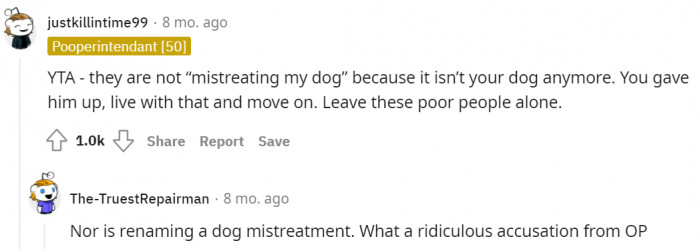
"You gave him up, live with that and move on"
This story is a sad one all around.
But his reaction to the new family renaming the dog could put him in hot water. It's one thing to be sad about losing a pet, but it's another thing entirely to lash out and try to cause problems for the people who took him in.
At the end of the day, what's important is that the dog is in a good home where he will be loved and taken care of. That's all any dog lover could ask for.
How would you react if you were in OP's shoes? Let us know in the comments!
The incident involving a man harassing a family over the renaming of a dog they adopted highlights the intricate emotional dynamics that often accompany pet ownership. This situation underscores the importance of recognizing personal attachments and communication methods in such scenarios.
By encouraging open dialogue, families can better navigate the complexities of ownership disputes, as seen in this case where the man's strong emotional ties to the dog clashed with the family's right to make the pet feel at home. Effective communication can foster respect among all parties involved, promoting a harmonious environment not only for the humans but also for the dog.
Ultimately, a stable and supportive atmosphere benefits the pet's well-being, reinforcing the notion that pets thrive in conditions where their owners can communicate openly and resolve conflicts amicably.
Ultimately, approaches that emphasize understanding and compassion can pave the way for healthier interactions among all parties involved.
Want more dog-related drama, check out what this owner did during job interviews after bringing his pet everywhere.
Share this article:





