
Insensitive Redditor Refuses To Give Up Beloved Giant Water Bug Despite Roommate's Fear Of Insects

A 28-year-old woman brought home what she called a “beloved” giant water bug, and her roommate immediately lost it. The aquarium became a daily jump-scare, and every apology afterward felt too little, too late, because the OP didn’t just surprise her once, she kept the thing that terrified her friend.
Now the relationship is basically frozen over, and the roommate is left wondering how anyone could choose a pet over trust in the same apartment.
The OP brought home a pet that scared the socks off her roommate and long-time friend.
The OP made a decision that caused a rift between her and her roommate-slash-friend.

The incident involving the giant water bug highlights the stark differences in personal comfort levels when it comes to pets, especially those that many may find unsettling. The roommate's visceral fear upon encountering the insect in the aquarium underscores how deeply ingrained these reactions can be. This situation illustrates that what one person finds intriguing and even endearing can be perceived as a source of distress for another, particularly in shared living spaces where boundaries and personal space are crucial.
Furthermore, the potential for desensitization to such fears is contingent upon the willingness to engage with these fears in a supportive environment. However, in the context of the Redditor's home, where the presence of a beloved giant water bug is a constant reminder of the roommate's discomfort, the feasibility of this desensitization process becomes questionable.
Despite being aware that her roommate is afraid of bugs, the OP didn't inform her friend that she had brought home a giant water bug.

She simply can't let go of the bug because she has developed an extreme attachment to it.

This bug brought happiness to the OP's life, but at what expense?

The OP can't see her friend eye-to-eye.

The second the giant water bug showed up in the aquarium, the roommate’s fear turned from “maybe annoying” into “can’t breathe in this room.”
Instead of giving her friend a heads-up, the OP kept the bug secret, then acted like the fallout was just bad timing.
Strategies for Coexisting with Differences
To foster a more harmonious living environment, open communication about fears and comfort levels is essential.
This feud echoes the girlfriend who drew a hard line over a boyfriend’s high-maintenance fish tank history.
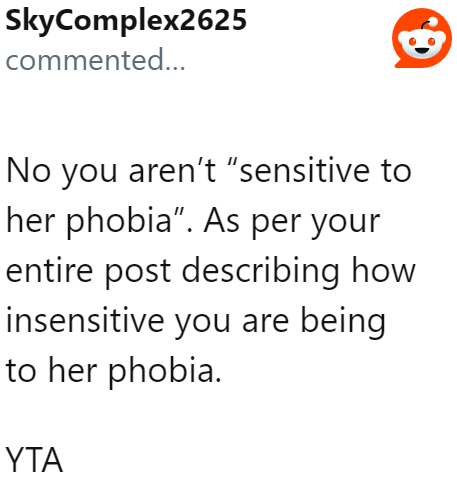
She claims that she's been sensitive to the roommate's phobia.

The OP has apologized, but to no avail.

After the roommate finally confronted her, the OP apologized, but the trust was already cracked by the whole “you didn’t know, but I did” situation.
If the OP wishes to save what's left of her relationship with her friend, it may be time to move out. She has already shattered the trust by bringing home something that her friend can't stand—without her friend's knowledge, to boot.
She can keep her beloved pet, but she needs to understand that her friend can't instantly address her fear of insects.
You can see the persistence in the OP as she continues to try to reason with her friend.

Some people have no idea what a giant water bug is.
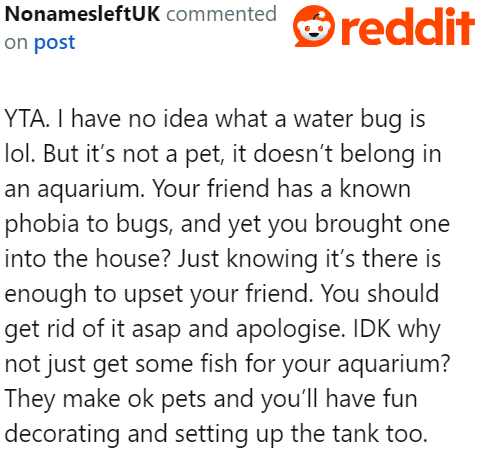
This video will give you an idea of how terrible this bug's bite can be.
It's like a big cockroach. It's definitely something you wouldn't consider keeping as a pet.

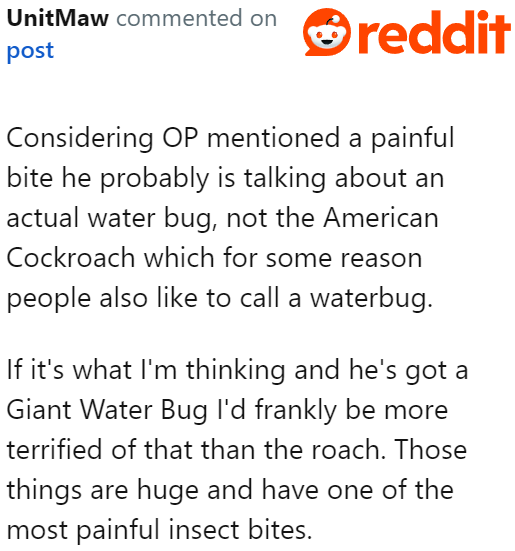
Other people would be terrified if someone in their home kept it as a pet.
The OP isn't as sensitive to her friend's phobia as she's claiming.
It's better to move out than strain the relationship further.

The OP can’t let go of the bug that makes her happy, while her roommate can’t live with the constant reminder that she’s scared.
In this situation, the clash between personal attachment and a roommate's phobia underscores the delicate balance of shared living arrangements. The presence of the giant water bug in the aquarium not only represents a beloved pet for one roommate but also serves as a source of distress for the other. This scenario highlights the necessity for open communication about fears and preferences in shared spaces. Acknowledging each other's comfort levels can pave the way for a more harmonious coexistence, even when it comes to something as seemingly innocuous as an aquarium inhabitant.
At this point, they might both be happier if the aquarium went with the OP and the roommate got her peace back.
Want another roommate-level standoff? See how she reacted after her patio waswasps.
Share this article:





