Debating Dog Custody: Ex Wants Full-Time Care For 7-Month Job Abroad

A 37-year-old woman thought she was planning a clean break, then her ex’s Alaska job turned it into a full-on dog custody standoff. They broke up four years ago, but they still share custody of their eight-year-old Akita, and that dog is basically a human-dependent creature, stressed when left alone and trained to hold everything until walk time.
Now both of them are about to leave the country. She’s moving abroad to Germany, he’s heading to Alaska for a firefighter-related contract, and the timeline is brutal: the rabies certificate can take up to 60 days, and neither of them has relatives or friends in Brazil to step in. To make it worse, he gets mad when she asks if he’s actually prepared, and she’s still stuck being the one doing three daily walks.
Here’s how a rabies certificate, an angry ex, and a 25k Akita turned their “shared custody” into a fight over who gets to keep the dog’s routine alive.
Original Post
My ex (37M) and I (37F) were together for 7 years and ended 4 years ago. Since then, we have shared custody of our now 8-year-old dog.
Last year, he decided to take a job in Alaska, leaving in April and returning in October. I was in charge of our dog full-time.
When my ex got back, I specifically told him that if he was planning on taking the same job again, he would need to either take the dog with him or find other means because I wouldn’t be available as I’m moving abroad (which is something I’ve long been planning and looking forward to). I’m Brazilian, and he’s from the USA; we both currently live in Brazil, by the way.
Now the time approaches (both for me to leave - May/June to Germany, and for him April/May to Alaska), and he says we need to talk about our future plans regarding the dog. A few notes: Our dog is used to always having humans around him.
He gets super stressed if left alone. Also, he requires three daily walks, as we both live in apartments; he’s a big dog, and he actually trained himself to only do his necessities during his walks.
I made sure to repeatedly remind him to look in advance for all necessary documentation in case he decided to take the dog with him, and he would always say he was aware and that I had nothing to worry about. It got to the point where he would get angry if I asked whether he had things prepared… now, apparently, there’s an issue with getting the rabies certificate, as it takes up to 60 days to be issued. We have no relatives or friends who could take care of our dog.
He’s a 25k Akita, a big dog. Also, I believe it is both my ex's and my responsibility to figure this out without relying on other people, which we don’t have anyway.
My ex says if he doesn’t apply this year again, he will never be able to get this job again because of his age (he’s applying to work as a firefighter under a set/temporary contract).
I am pursuing a doctorate degree (still need to be admitted, so I’m not 100% sure yet), but I have been working for the same company in Brazil for 10 years now, and I absolutely need a change in my life. I am not willing to postpone my plans any further; if I am not admitted to the doctorate, I will still leave and take German classes while looking for a job there under a specific visa for that purpose. Am I the a*****e here for not being willing to negotiate who stays with the dog this year again?
Because I know that this will be the topic of the conversation he wants to have, I just wanted to go ahead and hear some thoughts from other people, as my friends side with me, and my family does as well, but I’m sure the same happens on his side. EDIT: Ok.
As I expected, we talked today.
My ex can’t take the dog with him to Alaska. Seeing everyone here saying things like we both don’t want the dog or that the dog is a burden is just too much, I guess. My dog is not disposable.
You guys are absolutely misunderstanding me here. He is not disposable to me or my ex, and the reason why we have shared custody is that we love our dog too much to just leave him.
My dog has both my ex and me as his parents, so he is our shared responsibility.
I haven’t mentioned bringing him to Germany because my future is now uncertain, at least for this year, especially financially. I’m still looking for jobs; I might go back to university. There’s a lot I need to figure out, and I’ll be sharing a place with other people, people I don’t know, whom I won’t meet until I’m there.
My ex knew this all along. He was aware of my moving abroad, and he agreed to take the dog with him to Alaska. He is going to his country; he’s an American citizen, so I see it would be easier for him.
At the same time, I understand that the type of job he will be doing there would make things difficult, as he will work as a firefighter and be away from time to time. But the thing is that I took full-time care of my dog last year while my ex was away for 7 months so he could take this job, and this year I expected he would do the same for me until I’m settled, which should take about the same time (6/7 months). Then I would absolutely be okay with having full custody of the dog if it comes to that.
I firmly believe that our dog must be included in our plans, as he is also our family, and he is not disposable. But I respect your points of view, and I appreciate you taking the time to respond to my post.
The ongoing dispute over dog custody reveals striking parallels to child custody battles, underscoring the emotional stakes involved.
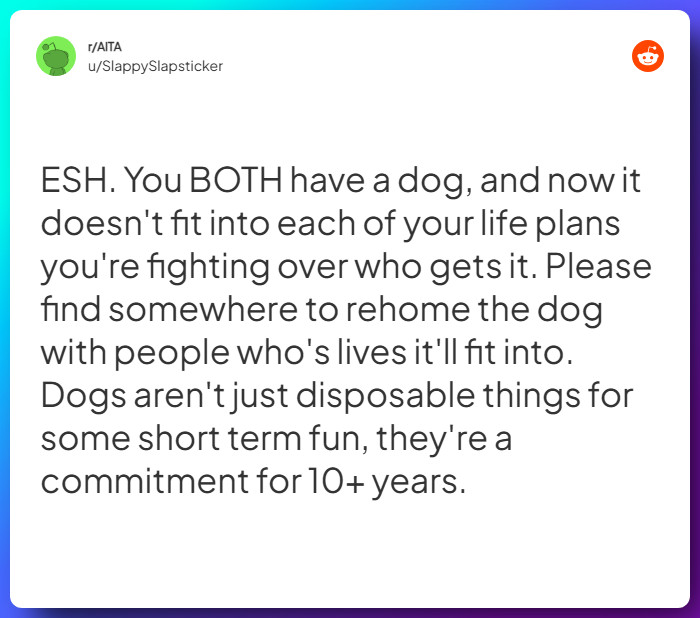
Comment from u/SlappySlapsticker
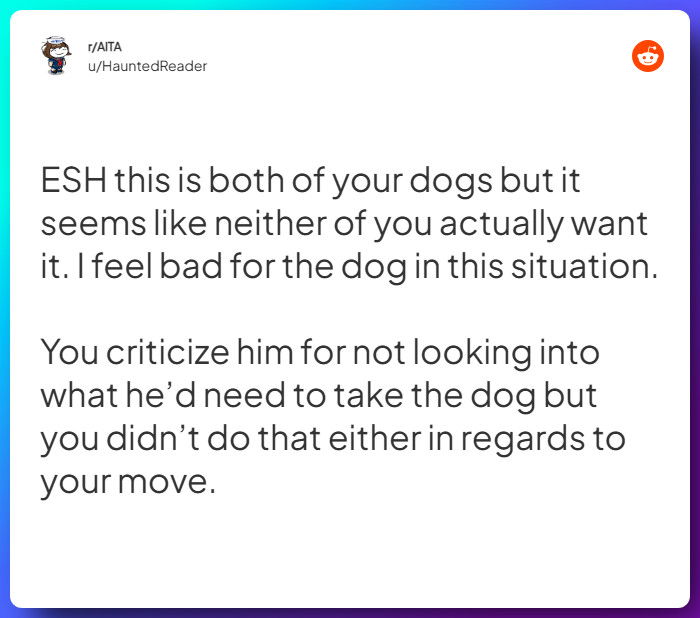
Comment from u/HauntedReader
That’s when the ex’s Alaska schedule starts colliding with the OP’s Germany plans, and suddenly “shared custody” doesn’t feel shared at all.
A recent study published in the Journal of Family Psychology reveals that disputes over pets can lead to heightened levels of stress and conflict in relationships.
Conflict resolution strategies become essential here, as effective communication and negotiation skills can help to mitigate emotional distress and promote a cooperative approach.
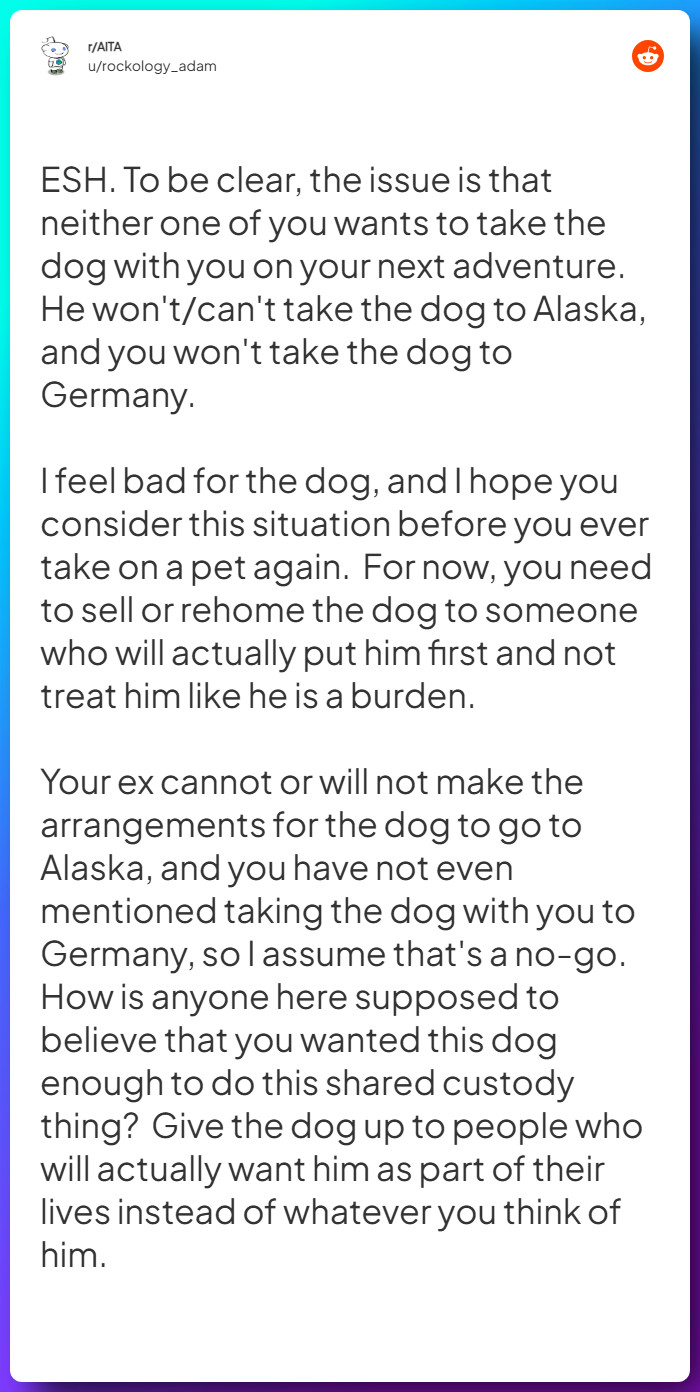
Comment from u/rockology_adam
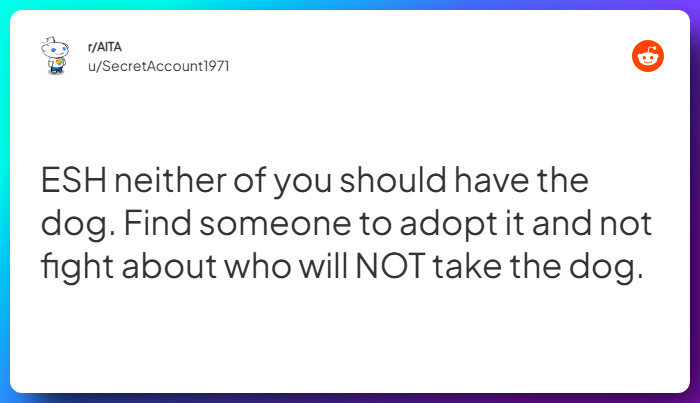
Comment from u/SecretAccount1971
The dog’s three-times-a-day walk routine, plus his stress when nobody’s around, makes the “just leave him somewhere” idea impossible.
This is similar to the ex-girlfriend who tried to share her ex’s dog after the breakup, and Redditors warned her it was a bad idea.
Creating a shared pet care plan, which includes who feeds, walks, and attends to medical needs, can foster a sense of partnership and reduce tension.
Studies show that when both parties feel equally responsible, it can lead to improved emotional outcomes and satisfaction in the arrangement.
Comment from u/shenme_
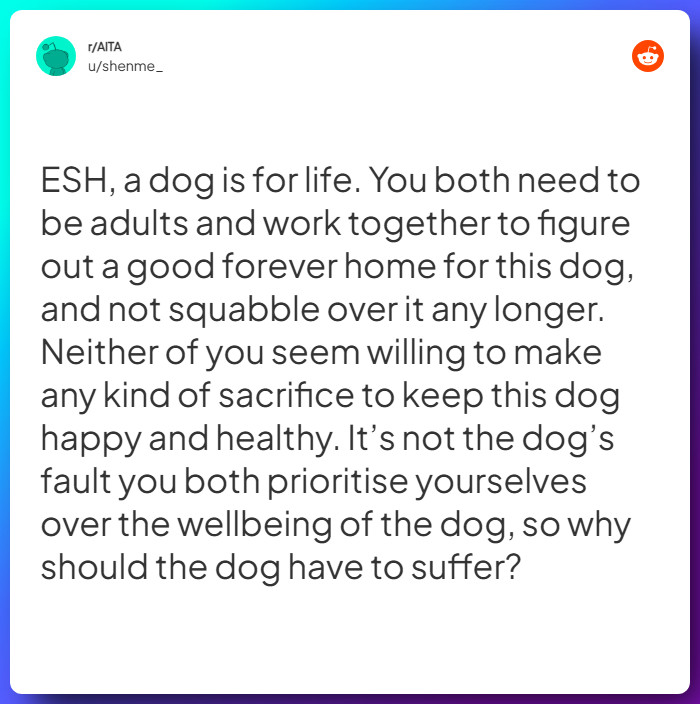
Comment from u/Shortestbreath

Then the rabies certificate delay shows up, and the ex’s attitude about being “aware” flips into full-on defensiveness when OP keeps asking about paperwork.
Moreover, the concept of 'attachment theory' plays a crucial role in understanding these custody disputes.
When individuals experience attachment disruptions, they may react defensively when they perceive threats to their emotional bonds, including those related to pets.
Recognizing these attachment patterns can provide insights into the underlying motivations for their behaviors and enhance empathy in negotiations.
Comment from u/lightinmydark

Comment from u/JurassicParkFood

With no relatives or friends available and a big 25k Akita who needs humans, the custody talk stops being theoretical and turns into a real deadline problem before either of them leaves.
What are your thoughts on this situation? Share your perspective in the comments below.
Comment from u/kalirella_loreon
Navigating pet custody disputes, such as the one surrounding the eight-year-old dog in this case, demands a thoughtful balance of emotional awareness and practical considerations. The complexities of this situation are intensified by one party's upcoming work commitment abroad, which echoes a past scenario where the other was left to care for the dog full-time during a previous job in Alaska. This history underscores the need for effective communication and empathy to resolve such conflicts.
Recognizing the deep emotional bonds people share with their pets is crucial. It can motivate both parties to engage in the discussion with a spirit of collaboration rather than conflict. As they move forward, fostering understanding will be key to finding a solution that respects the needs of both the dog and its caretakers.
Now he’s wondering if he really is the problem, because the dog’s routine cannot wait for his paperwork.
Wait until you see the man who stayed home with his sick dog instead of joining his wife and kids. Read his choice here.
Share this article: