Coworker's Untrained Dog At Work - Redditor Asks For Solutions

A coworker brings his dog to work sometimes, and at first it sounds harmless. Then the “sometimes” turns into a daily ritual, and the office delivery process starts getting derailed by a young dog that barks at every stranger like they’re personally threatening it.
OP works the front door and deliveries at a warehouse-style job, so when the dog goes into full fear mode, it becomes a real problem fast. OP even starts locking the front door when his coworker is out, because he can’t always hear people coming in and he has no idea how the dog will react. Meanwhile, the boss barely shows up, is fine with dogs in general, and OP is stuck wondering whether he should confront the coworker directly.
Here’s the full story of how a scared puppy turns into a workplace power struggle.
The OP's coworker informed him that he occasionally brings his dog to their office/warehouse job.

After a week, his coworker started bringing in his young dog, which barks loudly at strangers due to fear, making it challenging to handle deliveries at the office.

The behavior exhibited by the coworker's dog clearly highlights the issues that can arise from fear-based responses, particularly in untrained or inadequately socialized animals. The article emphasizes that such fear can manifest in various disruptive ways, including barking, growling, or even aggression, making it essential for coworkers to be aware of these signs. Acknowledging the dog's emotional state is vital for maintaining a safe and harmonious work environment, as it not only impacts the well-being of the dog itself but also affects the comfort of other employees. This situation underscores the importance of proper training and socialization for pets in office settings.
OP starts locking the front door when his coworker is out because he can't always hear people coming in and doesn't know how the dog will react to strangers.

The boss, who rarely comes to the office and is okay with dogs, could resolve the issue, but OP wonders if he would be wrong to address it directly with the coworker instead.

OP’s delivery routine goes sideways the moment the dog starts barking loudly at strangers, right when people are trying to drop off packages.
This situation also reflects the psychological concept of habituation, where an animal learns to become desensitized to stimuli over time. Training and gradual exposure to the work environment can help the dog feel more comfortable and reduce fear-induced behaviors.
Using positive reinforcement techniques can be highly effective in this process, encouraging desired behaviors while building the dog's confidence.
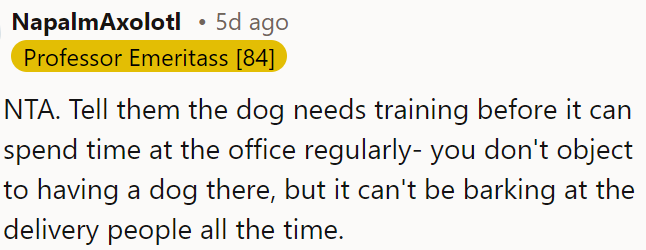
The dog can be at the office once trained not to bark at delivery people.
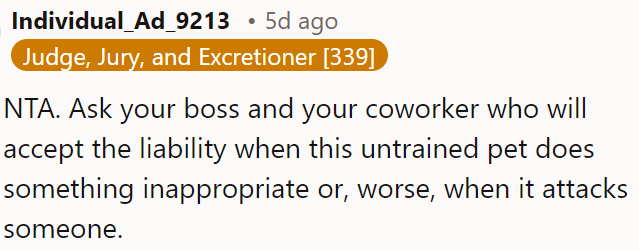
OP should ask his boss and coworker who will be responsible if the untrained pet misbehaves or attacks someone.
That’s when OP starts locking the front door when the coworker is out, because the dog’s fear makes every incoming knock feel like a gamble.
Environmental factors significantly influence animal behavior. A study published in the Journal of Veterinary Behavior highlights how changes in surroundings, such as new people or noises, can trigger stress responses in pets.
Creating a calm and predictable environment can help alleviate anxiety for both the dog and its owner, promoting a better experience at work.
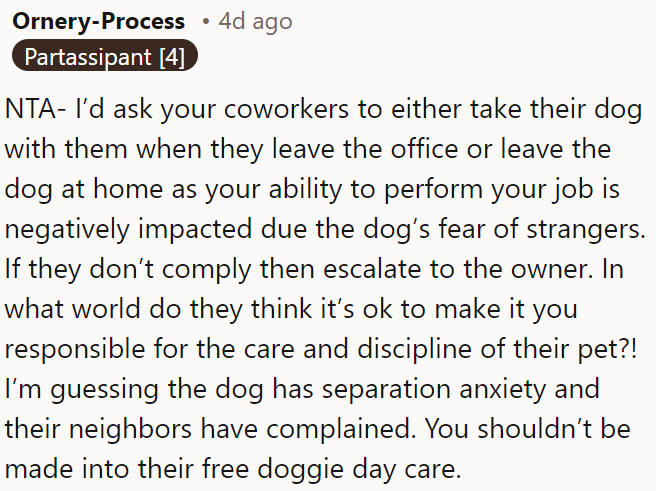
OP should ask his coworker to take his dog home or with him, as it's affecting his work.
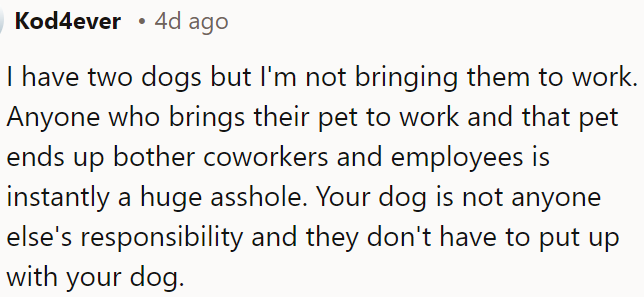
Bringing a pet to work and expecting others to deal with it is inconsiderate.
OP then has to decide whether to bring it up to his coworker, even though the boss is usually around and seems okay with dogs.
Implementing structure and routine can also benefit dogs in new environments.
OP can ask him to take the dog with him or train it to avoid bothering visitors.
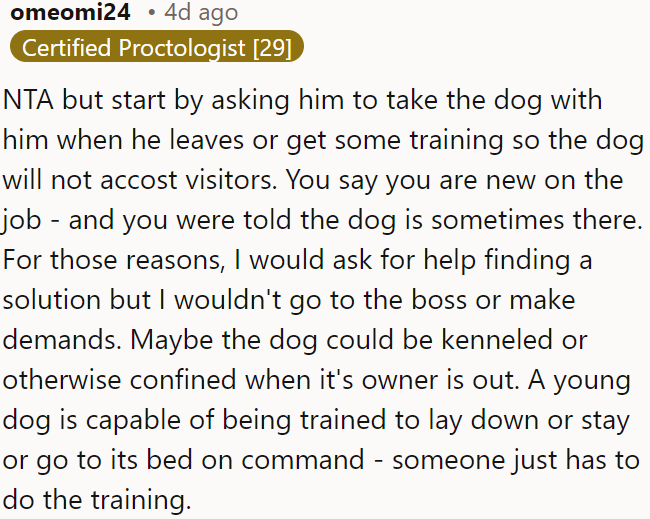
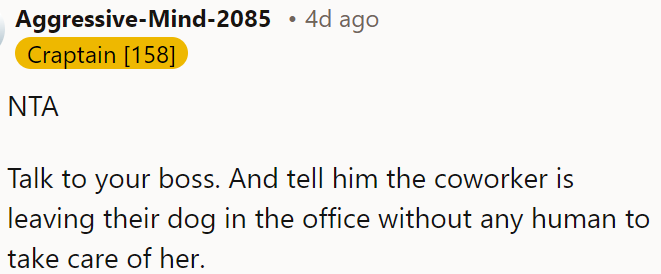
OP must inform his boss that his coworker is leaving his dog unattended in the office.
Having pets at work can be great, but it shouldn’t cause problems. In this case, the dog needs to be trained to behave around strangers. Until then, the coworker should bring the dog home or make other arrangements when he is not there.
OP should calmly talk to his coworker and boss about how the dog’s behavior affects their work and suggest clearer pet-friendly rules. It’s fair to ask for changes so the work environment remains productive and comfortable. OP is not being unreasonable; he is just trying to keep things running smoothly.
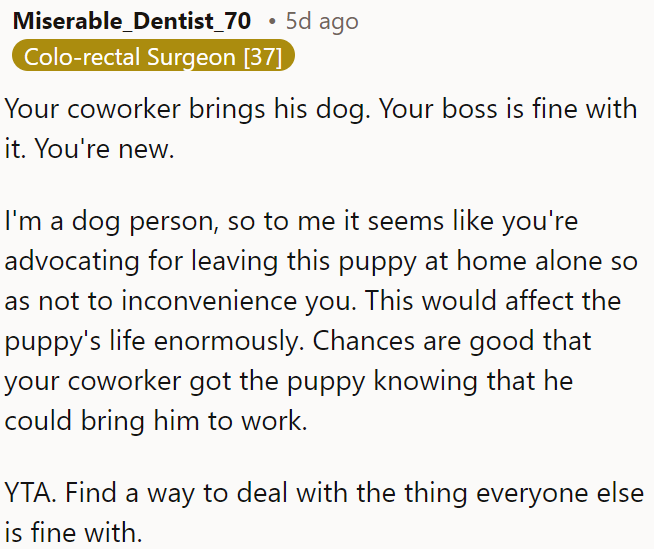
OP should accept that his coworker brings his dog to work since everyone, including the boss, is okay with it.
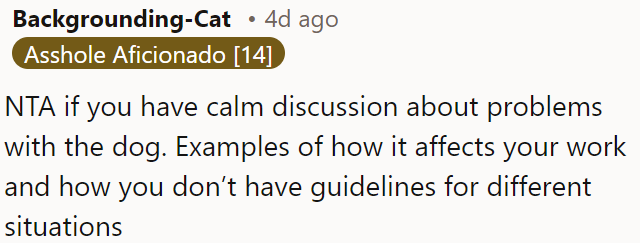
OP is not the antagonist if he calmly discusses the issues the dog is causing, explaining how it impacts his work and the lack of guidelines for handling various situations.
The whole thing lands on the big question of who gets blamed if that untrained dog finally escalates beyond barking, like growling or an attack.
Addressing Workplace Concerns
Creating a pet-friendly workplace can come with challenges, particularly when it involves unfamiliar animals.
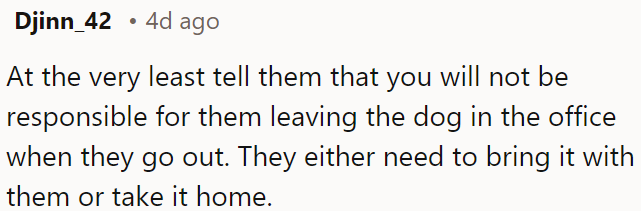
OP should inform his coworker that he won't be responsible if he leaves the dog in the office when he goes out.
Understanding the fear responses of dogs and the influence of their surroundings on behavior is crucial for navigating the complexities of workplace dynamics where pets are present. As the article highlights, the introduction of untrained dogs into office settings can lead to unexpected challenges. By fostering a supportive atmosphere for both animals and employees, companies can create a more inclusive and enjoyable work environment.
OP might be the only one treating this like a safety issue, and now he’s wondering if the real problem is him.
For a much grosser workplace issue, see how a lab employee handled the coworker who let her dog pee around the facility.
Share this article: