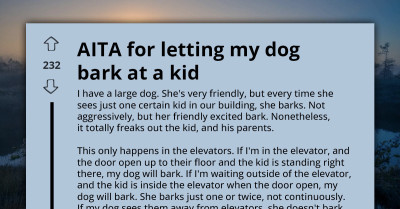
Redditor Refuses To Get A Dog For Disabled Mother Living In Their Home, And Their Reasons Make Sense

A 28-year-old woman refused to get a dog for her disabled mother who lives in their home, and the way she explained it made the whole thing feel less like drama and more like a slow burnout collapse. It was not a tantrum, it was a boundary, delivered calmly, right when the request finally stopped being “small” in her mind.
Her mother wanted companionship and mobility help, and at first it sounded sweet. But the family routine had already been reshaped by long-term caregiving, constant adjustments, and the kind of living arrangement where “just one more thing” quietly becomes another full-time job.
By the time guilt entered the conversation, the real question was no longer about a dog, it was about what everyone expects the same person to absorb.
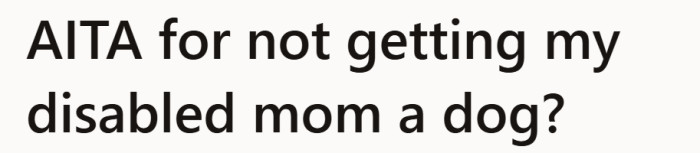
A single line that hints at a much larger story about boundaries, burnout, and family obligation.
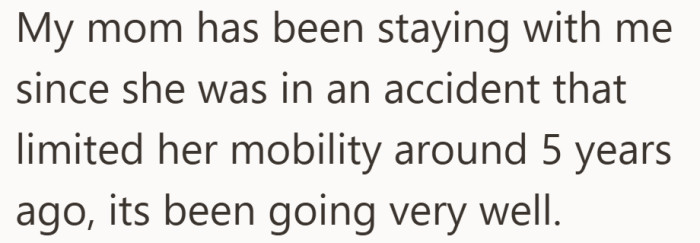
A long-term situation framed calmly, which makes what comes next feel less like a fight and more like a breaking point.
Holding a line feels different once guilt enters the conversation.
Wanting comfort on one side, and protecting sanity on the other, with no easy overlap.

This is where past caregiving stops being abstract and starts sounding like survival mode.
When caregiving crossed into total confinement, and never fully let go.
Support does not always look like saying yes, especially when burnout is already paid for in full.
Motivation sounds inspiring, until it turns into another task that cannot be shared.
The practical details that make the plan sound much less workable in real life.
Wanting to ease someone’s loneliness without repeating the same sacrifice.
Also, this mirrors the woman whose family pressured her after she chose expensive daycare over Mom’s dog help.
When empathy does not erase exhaustion, and doubt becomes the final question.
A blunt reality check that reframes the request as responsibility, not companionship.
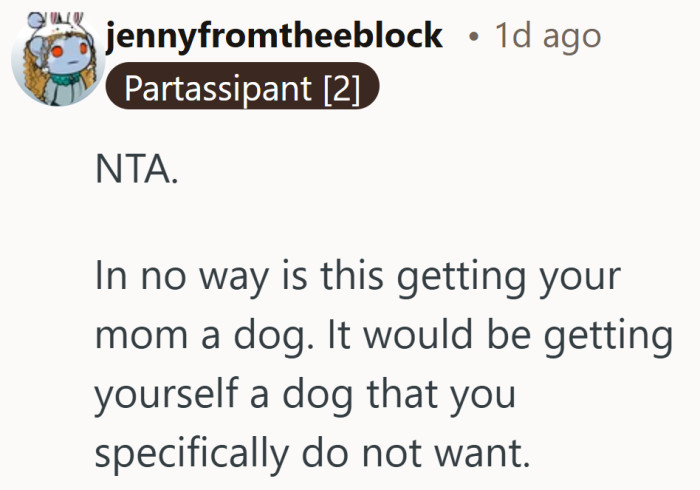
The dependency question gets named plainly, which is often where these arguments circle anyway.
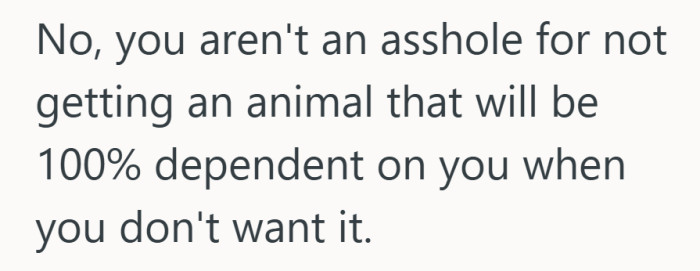
A moment of validation for anyone quietly carrying more than their share already.
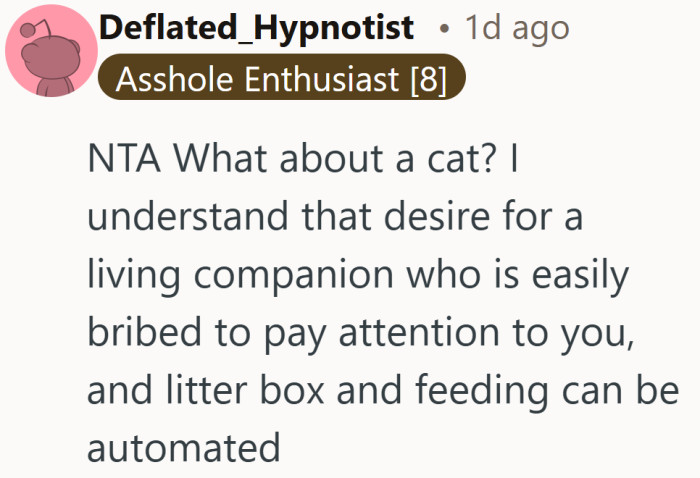
The suggestion gently shifts the focus from emotional want to daily logistics.
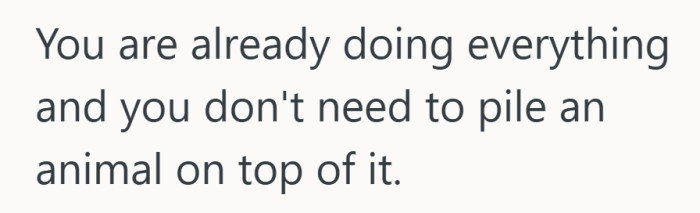
Living together already changed the balance, and this comment asks how much more can reasonably be expected.
Wanting companionship does not erase the toll it already took the first time around.
Care is already being given generously, and this reaction asks that it be recognized.
Sometimes the kindest answer protects everyone involved, including the animal.
A reframing that treats mobility and care as human needs, not motivational tools.
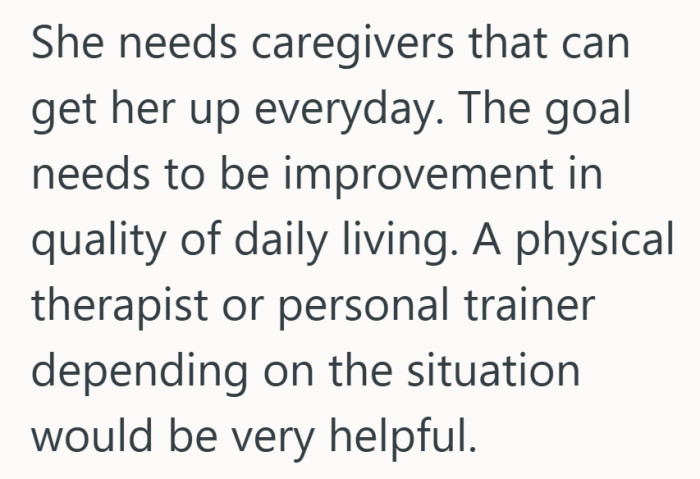
Stripping the emotion away reveals the very real cost behind the idea.
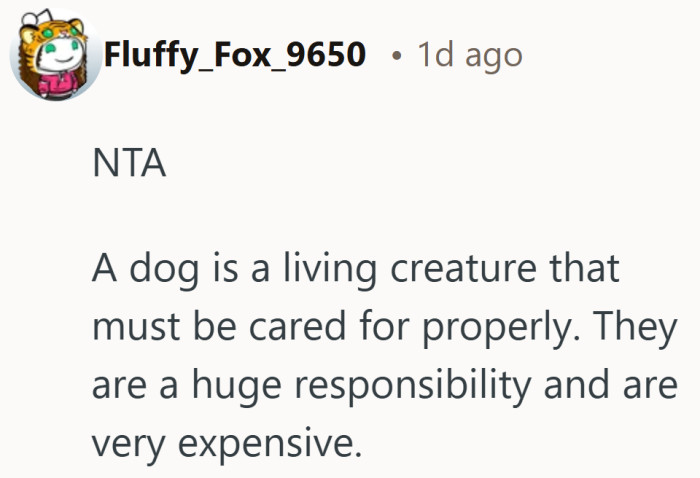
When the mother’s loneliness came up during daily life at their shared home, OP’s refusal stopped sounding petty and started sounding like survival.
That’s when the conversation shifted from “a dog would help” to “how much care are you already doing,” and everyone suddenly remembered the dependency question.
After OP pointed out that living together already changed the balance, the request to add a dog felt like another task nobody could swap or share.
By the end, the family dinner vibe was gone, replaced with a blunt reality check that treated mobility and care as needs, not emotional bargaining chips.
This story sits in the gray space where empathy and exhaustion meet.
Nobody wants to keep paying the same caregiving bill forever, especially for a dog that would not fix the real problem.
For more family pressure over a high-energy dog, see what happened when she refused her mom.
Share this article: