
Man Financially Supported By Mother As Adult Wonders If He's A-hole For Not Helping In Return

Some people don’t recognize a favor. This one started with money, then turned into a full-blown family boundary showdown when a man’s mom asked for help right when she was in trouble.
The OP says his mom supported him financially while he was building his adult life, and now she’s dealing with chaos back home in Europe: local authorities are involved, her dog situation got bad enough that a vet suggested euthanizing the pet, and she refused. On top of that, she has a puppy she can’t manage alone, so she wants her son to take in her pets while she figures things out.
He can’t take a dog right now, and now he’s stuck wondering if refusing makes him the a-hole.
The OP feels bad, but he feels that he has to refuse his mom's request.
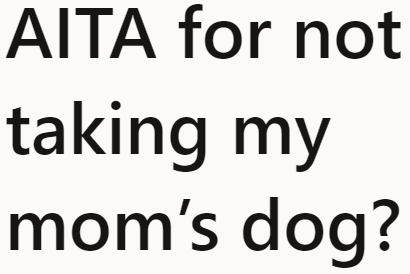
The OP's mom helped him financially before. Now, it looks like his mom is expecting him to help in return.

The complex dynamics of adult family relationships often evoke deep feelings of guilt and obligation, particularly in scenarios involving financial support. The Redditor's situation highlights a common struggle faced by many adult children who must navigate the fine line between asserting their independence and meeting familial expectations. In this case, the man has received financial assistance from his mother, which raises the question of whether he has a responsibility to reciprocate when she finds herself in need.
This internal conflict is exacerbated by the overlapping roles of caregiver and recipient, where emotional ties can distort the sense of obligation. The Redditor's contemplation of his actions not only reflects personal dilemmas but also resonates with a broader audience who grapple with similar familial dynamics, emphasizing that the challenge of giving back can often lead to feelings of inadequacy and uncertainty.
The OP tells the community that his family and mom live in Europe. The way vets handle animals where they live is different.

The vet suggested the OP's mom euthanize the dog. She refused.

His mom already helped him before, so when the request comes again, the guilt hits way harder than a normal “can you watch my pets?” ask.
In this scenario, the man's reluctance to take in his mother's pets reflects a struggle with boundary-setting in familial relationships.
Studies show that when individuals fail to set boundaries, they often experience higher levels of stress and burnout.
Now, the OP's mom is having trouble with local authorities. On top of that, she has a puppy to deal with.
She asks the OP to take her pets in while she figures out her life.

The OP's current situation doesn't allow him to get a dog.

The dog drama is the real landmine, since the vet in Europe recommended euthanizing the dog and his mom still refused.
Family dynamics play a significant role in shaping how responsibilities are perceived and managed. Research in family systems theory suggests that unclear boundaries can lead to confusion and conflict among family members.
When adult children feel obligated to care for their parents' responsibilities, it can create a sense of entrapment and hinder personal growth.
Now, the OP's mom thinks he's ungrateful. His family is on his side, though.

It is an unfortunate situation to be in, but considering he has children, he would have to refuse taking the dog in.
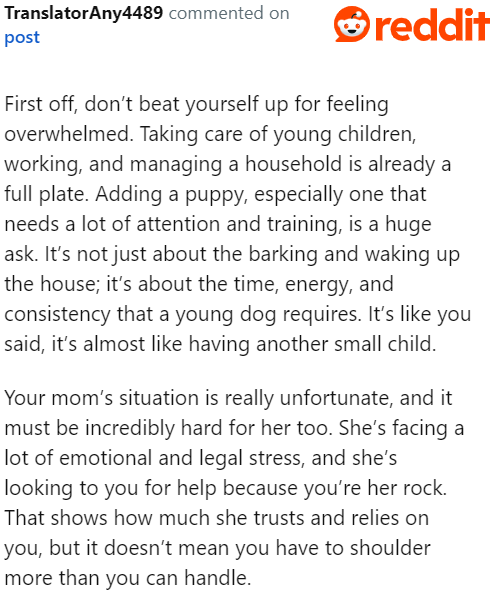
Then the puppy shows up in the middle of everything, and suddenly it’s not just one animal, it’s the whole mess landing on OP’s doorstep.
To address these issues, it's essential for families to engage in open dialogues about expectations and responsibilities.
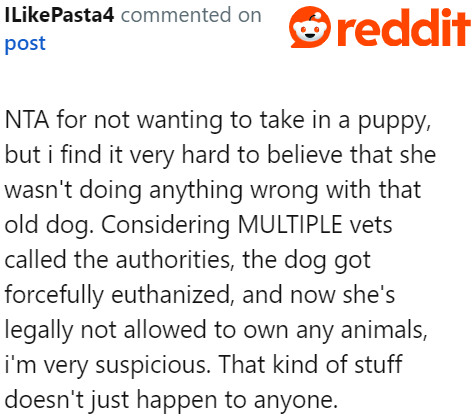
One Redditor points out that something feels off about the mom.
They feel that if multiple vets have called the authorities about the dog, then there must be something she's doing to her dog.
Even if she did help the OP before, expecting help of this nature would be unfair to the OP.
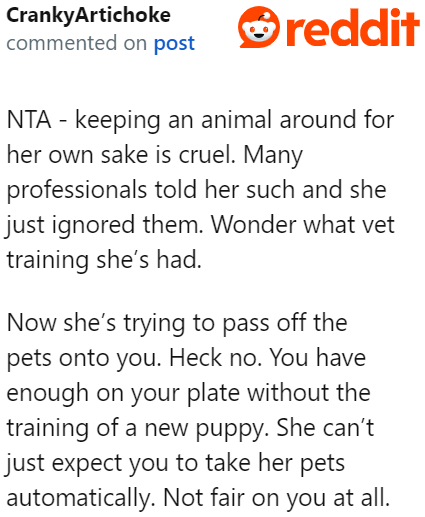
If the OP's mom is truly a dog lover, she will think about what's best for the dog. Why would she want to leave it under the care of a family that won't be able to care for it to the fullest?
It's best that she rehomes the dog rather than force her son to take it in. It's also not fair to expect this kind of help when the OP is clearly not in the best situation to care for a dog.
It's not fair to the puppy to be taken in by an unwilling family.
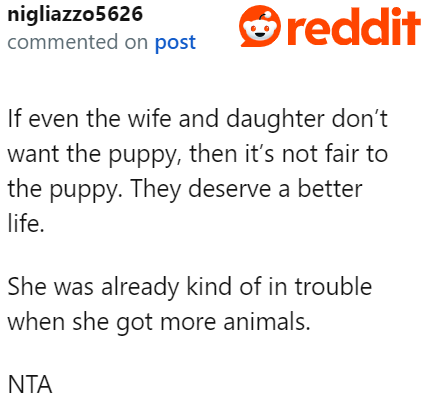
It would probably be best to rehome the dog while it's still a puppy.

With his current living situation not letting him get a dog, OP has to choose between helping his mom and keeping his own boundaries intact.
The story of the Redditor grappling with the dilemma of not helping his financially supportive mother illuminates the complex dynamics of familial relationships. It challenges the notion of emotional independence, which is essential for adults to carve out their own identities while balancing familial obligations. In this case, the Redditor's struggle reflects a broader question about what it means to support family members without compromising one’s own well-being.
This situation underscores that prioritizing personal needs does not inherently make one selfish. In fact, individuals who can maintain their own stability are often better positioned to offer genuine support to others. The Redditor’s contemplation of his role within the family dynamic invites readers to consider the fine line between gratitude and obligation, ultimately questioning whether true support can thrive without personal sacrifice.
The dilemma of balancing familial obligations with personal needs is at the heart of the Redditor's story.
Encouraging adults to prioritize their emotional health can significantly improve family dynamics.
Nobody wants to be guilted into adopting a whole household’s worth of trouble.
For another family guilt battle, see what happened when he refused to stop caring for his sister's dog.
Share this article:





