
Cunning Tenant Retaliates Against Unfair Landlord Who Keeps Their Security Deposit Because of a Dying Tree on the Property

A 28-year-old woman called her deed “catty revenge,” and honestly, it’s hard to argue with the level of petty creativity. The whole thing started when her evergreen tree situation turned into a security deposit nightmare.
OP and her husband rented the property, then the evergreen on the premises was suddenly dying. When it came time to get their security deposit back, the landlord kept the money, blaming an occurrence they had no control over. No confrontation, no back-and-forth, just a decision to hit him where it would sting most, his love of a cat-free yard.
That’s when the catnip seeds entered the chat, and the comments lit up.
The OP calls her deed a "catty revenge."
The plan she executed was as sly as a cat's.
According to the OP, the evergreen tree on the property they rented was suddenly dying.
The OP and her husband never received their security deposit back due to an occurrence they had no control over. It was simply unfair on their part.

OP didn’t even bother confronting the landlord about the dying evergreen and the missing deposit, she just quietly planned her next move.
The Dynamics of Tenant-Landlord Relationships
Tenant-landlord dynamics often reflect power imbalances that can lead to conflict. When landlords fail to fulfill their obligations, tenants may resort to creative forms of retaliation as a means of asserting their agency. This perspective aligns with the notion that such actions can be seen as coping mechanisms in situations where tenants feel vulnerable. Mindset Works highlights that tenants who perceive oppression are more likely to engage in retaliatory behaviors, which can escalate conflicts and create a cycle of animosity.
The couple decided not to confront the landlord about it.
Since the landlord was being unfair, the OP decided to take petty revenge on him. She placed some catnip seeds on the property of the cat-hating landlord.

Redditors were entertained by the story.
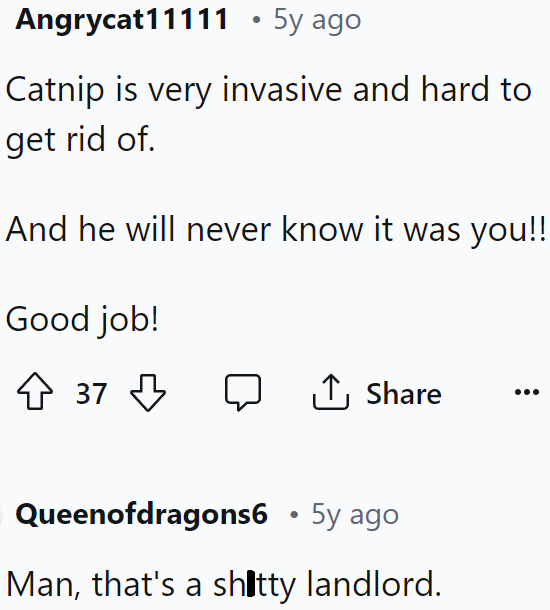
While everyone focused on the landlord “withholding” about 300 bucks, OP was busy thinking about how to make his property feel like a cat magnet.
This also echoes the group home resident arrested for trying to kill a cat and assaulting the landlord’s wife.
Some people just can't let unfair treatment slide. The OP felt she needed to teach this guy a lesson, and you can't help but feel that her action is justified.
The landlord is probably in a better financial position than the OP and her husband. And yet, he decided to take advantage of his tenants who were leaving his property.
One of the Redditors is right — he is indeed a greedy landlord. His attempt to squeeze more money out of people he can no longer profit from is despicable.
We can only hope that those catnip plants flourish and attract feline visitors to the property. He might even have to spend the 300 bucks he withheld from his tenants.
This story is not just about revenge.
Do your friends and family love satisfying revenge stories like this? Share this post!
The revenge wasn’t loud or messy, it was strategic, she planted catnip seeds on the land of a guy who apparently hates cats.
In the realm of tenant-landlord relationships, the saga of a cunning tenant reclaiming their security deposit highlights the often overlooked emotional undertones of these conflicts. When a landlord unjustly retains a security deposit over the condition of a dying tree, it ignites not just a financial dispute but also a profound sense of injustice. The situation reveals that open communication is not merely desirable but essential. By addressing grievances with empathy and clarity, tenants can not only advocate for their rights but also foster healthier interactions. The successful navigation of such tensions often hinges on recognizing and managing the emotions at play, which can lead to more constructive resolutions rather than retaliatory impulses. In this case, the tenant's clever response serves as a reminder of how perceived injustices can evoke strong reactions and the importance of approaching disputes with a mindset geared towards resolution rather than revenge.
From a conflict resolution perspective, it’s essential to recognize that retaliation often serves as a form of self-defense. When individuals feel threatened or wronged, their instinct can be to push back in any way possible. This reaction is often rooted in a need to restore balance and assert one’s rights. Understanding this dynamic can help both landlords and tenants approach conflicts with greater empathy and a willingness to negotiate.
Redditors started cheering as if the landlord himself might have to watch the catnip take over the exact spot where he kept their security deposit.
Effective Conflict Resolution Strategies
To navigate conflicts effectively, both landlords and tenants should prioritize open communication.
One practical recommendation for tenants facing unfair treatment is to document all interactions with landlords and keep records of grievances. This can provide a solid foundation for addressing issues in a constructive manner. Additionally, seeking legal advice or support from tenant advocacy groups can empower tenants to assert their rights without resorting to retaliatory actions.
Educating tenants on their rights and responsibilities can also promote healthier landlord-tenant relationships.
Now he has a dying tree problem and a new cat problem, and OP still got the last laugh.
Want more payback with a side of “justice is my favorite,” check out the dog who got its territory stolen by marking it after the neighbor’s passive-aggressive pup.
Share this article:





