Redditors Discuss Why A Random Baby’s Cry Sounds Annoying But A Random Cat’s Cry Sounds Pleasing

Some sounds are just harder to ignore than others, and this Reddit thread leans all the way into that strange little difference. A random baby crying can feel grating, while a random cat meowing can sound oddly charming, even fun enough to answer back.
The post asks why that reaction feels so automatic, and the comments quickly turn into a mix of jokes, personal takes, and a few attempts to explain the contrast. Between babies, cats, and the way people react in public, the thread ends up being more relatable than it first sounds.
And once the Redditors start weighing in, the comparison gets even more entertaining.
And the question pops up:

The Reddit community shares their unfiltered responses to the above question. Let's have a look, shall we?
The whole point of a baby's cry...
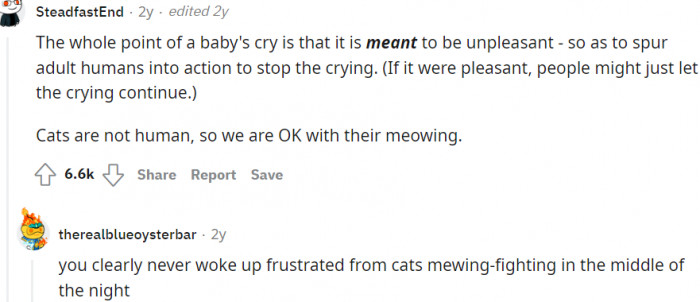
Baby's cries trigger a biological response
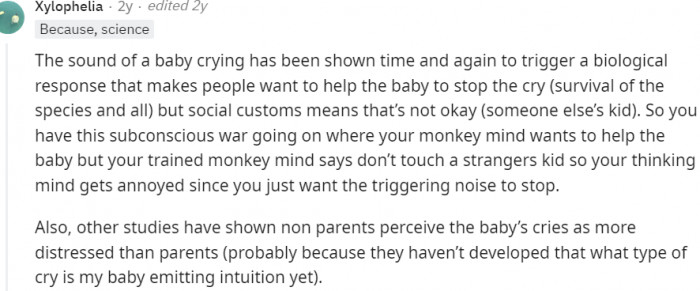
The emotional disparity between the cries of babies and the meows of cats is a fascinating reflection of human perception and our evolutionary past. Babies, with their frequent and often piercing cries that can last for several hours each day, tap into deep-seated instincts tied to survival and caregiving. The article notes that these cries can emerge from a variety of needs, such as discomfort or hunger, which demands immediate human attention. This innate response is not merely anecdotal; studies have shown that our brains react more strongly to the sound of a baby crying, activating reward centers that prompt caregivers to respond swiftly.
In contrast, the soothing meows of cats elicit more pleasant emotional responses. As the article points out, these sounds often signify companionship and affection, creating a more relaxed atmosphere. The interplay between these two sets of vocalizations underscores the distinct yet significant roles that different animals play in our lives. While the urgency of a baby's cry compels action, a cat's meow invites connection and comfort, illustrating the varied dimensions of our relationships with these creatures.
The contrasting responses to a baby's cry and a cat's meow reveal much about our psychological wiring and emotional conditioning. In the article, the daily reality of babies crying for hours underscores the inherent urgency that these sounds provoke in adults. This immediate association with a baby's needs is deeply rooted in our survival instincts, compelling caregivers to respond swiftly to ensure the child's well-being.
In stark contrast, the soothing nature of a cat's meow elicits feelings of warmth and affection. The article highlights how this sound is often received with pleasure, showcasing our behavioral responses shaped by our interactions with pets. These differing reactions illustrate not only the importance of sound in human emotion but also how our experiences influence our perceptions of different cries.
Crying back to a baby works sometimes...

A few commenters are already taking the comparison in a very different direction.
A positive noise versus the rest

Lol...
A candid piece of advice to the OP from a concerned Redditor.

From a psychological perspective, the differing perceptions of these sounds can be linked to conditioning and reinforcement.
Interestingly, a study from Yale University found that the frequency range of a cat's purr can trigger a calming response in humans, further explaining the allure of this sound.
These findings suggest that our emotional responses to different animal sounds are not only instinctual but also shaped by our experiences and societal conditioning.
We are all smart predators

Here's a straight answer

And there is a name for it...

Behavioral Conditioning in Pets
The phenomenon of cats responding positively to their owner's calls or sounds can be attributed to behavioral conditioning.F. Skinner's principles of operant conditioning, behaviors that are reinforced are more likely to occur. Research from the Journal of Animal Behavior demonstrates that cats who receive positive reinforcement for responding to certain sounds will continue to respond positively in the future.
This means that when cat owners use specific sounds or phrases, such as 'pspspspsps,' and consistently reward their cats, they can condition their pets to respond more readily, creating a delightful interaction.
The Social Influence of Animal Sounds
Our perceptions of animal sounds can also be influenced by social and cultural factors.
For instance, in many cultures, cats are seen as symbols of comfort and companionship, which may enhance our positive reception of their vocalizations.
Social psychologists argue that our emotional associations with these sounds play a significant role in how we respond to them.
This is supported by research that highlights the importance of context in shaping emotional responses.
It also echoes the family that dismissed a sister’s cat death as “nothing compared” to losing a child.
Baby cries are hard to ignore

Someone agrees with the OP

Here's another angle...

Moreover, the concept of 'neural coupling'-the brain's ability to synchronize with the sounds and expressions of others-plays a significant role in how pets and owners relate to one another. Research suggests that when a cat hears familiar sounds or voices, it may create positive associations that enhance their emotional bond. This neural synchronization can lead to increased trust and responsiveness, making interactions more enjoyable for both the cat and the owner.
To leverage this, owners can create a unique sound that their cat associates with positive experiences, reinforcing this bond through consistent interaction.
Additionally, the context in which we hear these sounds matters greatly.
A baby's cry often signifies distress, triggering a protective response, whereas a cat's meow typically indicates a desire for attention or companionship, leading to a more relaxed emotional state.
This dynamic illustrates the broader psychological principle that context shapes perception and reaction.
Cats are better than humans?

It all depends on the scenario

Someone prefers the cat meow to a baby's cry...

Understanding Emotional Responses
Reflecting on personal experiences with animals and childhood can help illuminate why certain sounds evoke specific emotions.
This self-awareness can foster a deeper appreciation for the complexity of our relationships with animals.
That'll be terrifying...

Babies cries everywhere...
You'll know the true meaning of these "high-pitched screams" when you hear a baby cry in a serene and quiet place...

Babies can't process emotions

Ultimately, fostering a positive emotional connection with animals can enhance overall well-being.
As research indicates, nurturing these relationships can lead to increased happiness and reduced stress.
Being aware of our emotional responses can also guide us in creating environments that support these connections.
The reason why is being explained
The "form most of our opinions by what others around us think" really hits hard.

Lol...
"I hear a cat meow, and I meow back."

A biological wiring...

It's ingrained in the DNA...

There's a difference
When a cat meows, it's talking to you, but a baby's cries are an alarm.

wow! wow!! wow!!!
This is pretty intense...

Taking care of a baby is a difficult task because their cries can drive you insane, especially when they cry at night. But then, they’re only babies, and we need to attend to them 24 hours a day, 7 days a week.
If you didn’t know why the cries of babies annoyed you, now you do. And if your reason differs, let us know by dropping a comment below.
The article highlights how our reactions to the cries of a baby versus those of a cat are shaped by both psychological and social influences. The irritation felt when hearing a random baby’s cry contrasts sharply with the pleasantness associated with a cat's meow. This difference opens a window into our emotional connections with animals and how these relationships can positively affect our well-being.
Furthermore, the cultural context surrounding these sounds adds another layer to our understanding. Acknowledging why we find some cries more appealing can foster greater empathy toward animals and enhance our interactions with them. This insight not only enriches our perceptions but also deepens our bonds with both pets and the wider world of animal life.
The juxtaposition of reactions to the cries of babies and cats reveals a fascinating aspect of human psychology. While the article highlights the frequent and often distressing nature of a baby's cry, triggered by a range of needs from discomfort to hunger, it contrasts sharply with the soothing sounds of a cat's meow, which many find pleasing. This difference is not merely anecdotal; it reflects deeper evolutionary instincts and learned behaviors that shape our responses.
Understanding these reactions can significantly enhance our relationships with pets. By recognizing the calming effect of a cat's cry, owners can cultivate a more profound bond with their felines. Positive reinforcement techniques can further enrich this relationship, allowing for a harmonious coexistence that benefits both human and animal.
That contrast is exactly why the thread keeps getting more relatable as it goes.
For a mom-versus-son showdown over sleep, read about the woman offended when her adult son wouldn’t sleep beside her 20+ cats and a baby.
Share this article: