
Diver Meets Giant Jellyfish Off England's Coast

Off the coast of Cornwall, a dive turned into a full-on underwater jump scare for 28-year-old biologist Lizzie Daly. She went in expecting the usual mix of sea life, then spotted something that looked like it belonged in a deep-sea nightmare.
There, floating above her like a gelatinous ceiling, was a barrel jellyfish, Rhizostoma pulmo, one of the biggest jellyfish in the northeast Atlantic. Its bell can reach up to 90 cm, and in some reports even bigger, meaning this wasn’t just a “cool sight,” it was a giant presence. And the weird part is, despite that intimidating size, it feeds mainly on tiny plankton, has no tentacles, and its sting is considered relatively harmless, while still playing a major role in the food chain.
Daly’s encounter is a reminder that the ocean’s scariest-looking things can be the most important ones, too.
While diving, biologist Lizzie Daly encountered an enormous jellyfish.
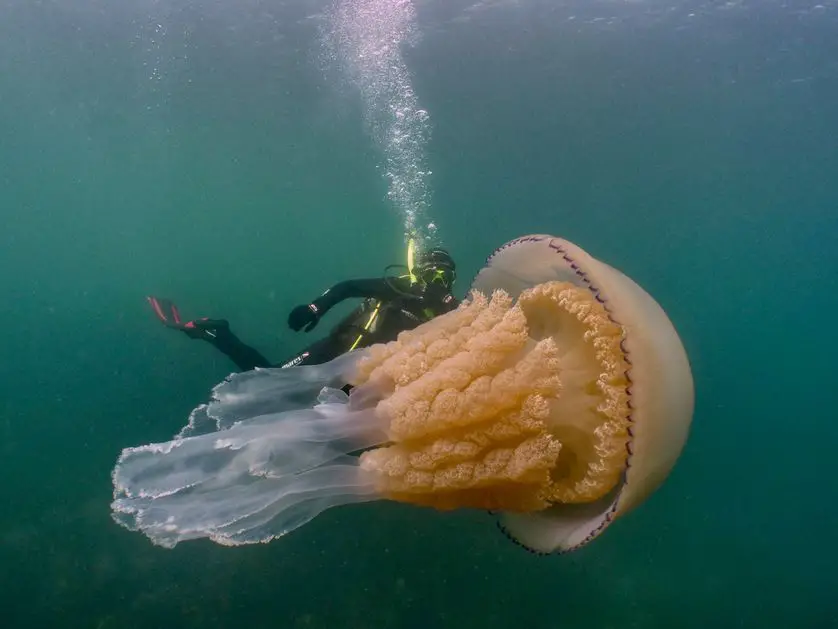
Lizzie Daly’s first glimpse of the jellyfish off Cornwall is what makes this story feel unreal, because it’s already massive before you even get close.
Barrel jellyfish, also known as Rhizostoma pulmo, are fascinating creatures often found in the northeast Atlantic, the Mediterranean Sea, and the Black Sea. One of the most intriguing aspects of these jellyfish is their size; they are among the largest jellyfish species in these regions, with a bell that can grow up to 90 cm (35 inches) in diameter.
Despite their imposing size, barrel jellyfish mainly feed on tiny plankton, which they capture using their eight frilly arms that dangle beneath their bell. These arms are not just for feeding but also help the jellyfish swim, propelling themselves through the water.
Unlike many other jellyfish, barrel jellyfish don't have tentacles, and their sting is considered relatively harmless to humans. Another interesting trait is their role in the marine ecosystem.
They serve as a significant food source for leatherback turtles, which are known to migrate specifically to areas where barrel jellyfish bloom in large numbers. This highlights the critical role of barrel jellyfish in marine biodiversity and the broader oceanic food chain.
The encounter Lizzie Daly had with the barrel jellyfish off the coast of Cornwall is a reminder of the complexity and significance of these remarkable creatures. Often misunderstood, barrel jellyfish can grow to impressive sizes, reaching diameters of up to 1.5 meters. Their presence in the ocean is not just a spectacle but a vital part of marine ecosystems where they serve dual roles as both predator and prey.
Understanding the behavior and habitats of jellyfish is essential for their conservation. As Daly's experience highlights, increasing public awareness about these organisms can foster greater appreciation and support for efforts aimed at preserving their natural environments. Educational initiatives focused on jellyfish can play a pivotal role in bridging the gap between public perception and ecological reality.
Lizzie Daly expressed her happiness.
"Jellyfish as big as a human spotted off Cornwall coast"
The moment you learn barrel jellyfish can have bells up to 90 cm, the “harmless” part stops sounding like a consolation prize and starts sounding like a plot twist.
This feels like divers spotting a rare giant squid near Japan, captured on video.
Then comes the double-duty problem, the jellyfish is both a predator for plankton and a snack for leatherback turtles that show up when blooms hit.
The encounter with the giant jellyfish is just one of the wonders that lie beneath the ocean's surface. It highlights the importance of exploring and understanding our marine ecosystems, as well as the need to protect and conserve them for future generations.
As Daly's extraordinary adventure demonstrates, there is still so much to discover and learn about the ocean and its inhabitants. Each encounter with creatures like the giant jellyfish adds to our knowledge and appreciation of the beauty and complexity of marine life.
In the end, the ocean remains a realm of endless fascination and discovery, where even the most unexpected encounters can leave a lasting impression on those who dare to explore its depths.
By the time you connect Daly’s dive with how these blooms shape the marine food chain, you realize the ocean’s spectacle is also its schedule.
Lizzie Daly's extraordinary encounter with a giant jellyfish off the coast of Cornwall serves as a powerful reminder of the ocean's rich biodiversity and the urgent need for enhanced marine protected areas. This experience not only captivates the imagination but also fosters a deeper understanding and appreciation of marine life. Such moments in the water can galvanize community interest in local species, highlighting the importance of conservation efforts.
Encouraging community dive events centered around local marine ecosystems could significantly raise awareness about the unique species inhabiting our waters, like the barrel jellyfish. These grassroots initiatives have the potential to inspire individuals to advocate for policy changes that safeguard marine environments, reinforcing the interconnectedness of human actions and ocean health.
The encounter between biologist Lizzie Daly and the giant jellyfish off the coast of Cornwall serves as a poignant reminder of the delicate balance within marine ecosystems. As we delve deeper into the complexities of ocean life, it becomes evident that human activities pose significant threats to these environments. The decline in jellyfish populations, which Daly's experience highlights, can disrupt marine food webs and lead to unforeseen consequences for various species.
This incident underscores the importance of sustainable practices and the role that education plays in marine conservation. By raising awareness and supporting initiatives aimed at preserving marine habitats, we can help ensure that encounters like Daly's become more common, rather than a rarity. Protecting marine life is not merely about conserving individual species; it is about safeguarding the intricate web of life that sustains our oceans.
That giant jellyfish didn’t just steal Lizzie Daly’s dive, it quietly ran the show.
Before you dive away, see how a diver confronted a 30-foot “sea serpent” in England.
Share this article:





