Reddit Thread Reveals Why Dogs Are Not Intimidated When Humans Snarl And Show Their Teeth

Dogs and humans have spent so much time around each other that even the weird little things we do can become part of the conversation. One Reddit thread recently put that on display after people started comparing what happens when they snarl, bare their teeth, or make faces at their dogs.
The reactions were a mix of confusion, amusement, and a few very relatable stories from pet owners who swear their dogs know the difference between a joke and a threat. That is what makes this thread so fun, because the same toothy expression can mean one thing to a person and something totally different to a dog.
And once the comments started rolling in, the whole thing turned into a surprisingly entertaining look at how dogs read us. Read on.
How the whole discussion started out...

The dogs don't seem to care when my son does same

The reddit thread was upvoted 4k times with over a thousand comments. We’ve gathered some of the best and most upvoted comments below, so go ahead and read through.
That was enough to get the comments section moving fast.
1. It's all about the intention and consequence
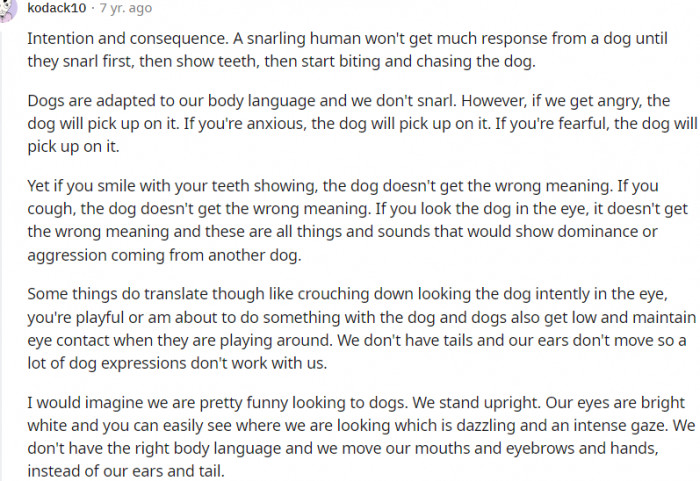
The close-knit relationship between dogs and humans is a testament to the extensive socialization that these animals undergo from an early age. This capability allows them to navigate complex social cues, including the way humans display aggression through snarling or baring teeth.
Studies show that dogs often rely on visual and auditory signals more than on the emotional context of these signals. For instance, a dog might see a human showing their teeth and interpret it as a non-threatening behavior if it is accompanied by a calm demeanor or familiar scent. This suggests that dogs have developed a nuanced understanding of human emotions, one that is based on their experiences rather than instinctual fear reactions.
The findings from the recent Reddit thread highlight a fascinating aspect of the human-dog relationship. Dogs have honed a remarkable ability to decode human emotions through non-verbal signals, which is essential to their social intelligence. As dogs have evolved alongside humans, they have developed a keen sensitivity to our emotional expressions. This insight sheds light on why some dogs remain unfazed when a human snarls or shows their teeth. Rather than viewing this behavior as a threat, dogs may interpret it as a non-verbal cue, particularly if they have been socialized to recognize playful interactions. The ability of dogs to read our body language and facial expressions illustrates the profound bond that exists between our species, underscoring the unique relationship that allows for such understanding.
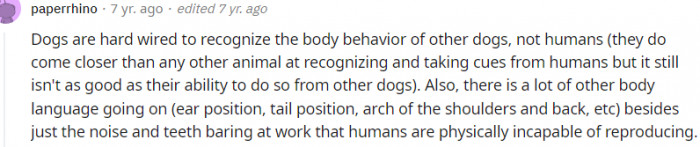
2. There is a lot of other body languages
3. This Redditor does growl and snarl at the dog when she deserves it

4. This also works on door to door sales men

Research indicates that domesticated dogs have evolved alongside humans for thousands of years, leading to a mutual understanding that goes beyond mere survival instincts. For example, dogs can differentiate between playful snarls and genuine aggression, which informs their reactions.
Understanding this can help dog owners foster better relationships with their pets by encouraging positive interactions that reinforce trust and reduce anxiety. Training sessions that reward calm behavior when humans display their teeth can help dogs learn that such gestures are not a cause for alarm.
Behavioral scientists have found that the bond between humans and dogs is one of mutual understanding and emotional attunement. Their findings underscore the importance of positive interactions in developing a dog's ability to interpret human emotions, suggesting that dogs raised in environments rich with varied human interaction are more likely to remain unfazed by aggressive facial expressions.
This posits that the emotional climate in which a dog is raised plays a pivotal role in its emotional responses, which is a crucial component for pet owners to consider when training or socializing their dogs.
5. They stood there trying to talk to me again

6. My dog looked very concerned so I checked on him

7. It's really gross but kind of endearing

Research from the University of Cambridge indicates that dogs possess a cognitive ability to comprehend complex human behaviors, including social signals like facial expressions. This cognitive processing allows dogs to assess the context in which a human bares their teeth. For instance, dogs may recognize that a playful growl differs from an aggressive snarl based on the owner's body language and vocal tone.
Additionally, studies in animal cognition suggest that dogs utilize a form of social referencing, where they look to their human companions for cues on how to react in uncertain situations. This means that if a dog observes a human displaying 'teeth' in a non-threatening context, they may feel more comfortable approaching rather than retreating, showcasing their adaptive social learning capabilities.
That is where a lot of these comments start to make sense.
Socialization during a dog's developmental stages significantly affects its behavioral responses to human expressions. This is akin to attachment theory in humans, which states that early experiences shape one's ability to form healthy relationships later in life.
Research indicates that dogs can exhibit signs of attachment similar to those seen in human children, where they seek comfort and reassurance from their owners. Consequently, training methods that foster positive experiences, like using positive reinforcement, can help dogs remain calm and relaxed in response to a variety of human expressions, including those that might typically be perceived as aggressive.
8. Check out this very short dog story

9. It kept barking as it ran

10. They never lived with each other

Owners who invest time in training their dogs to recognize and appropriately respond to various social cues can reduce unnecessary stress for both parties. For example, teaching a dog to associate human smiles or relaxed body language with positive experiences can create a sense of safety and trust.
Practical training techniques, such as positive reinforcement and socialization with both humans and other dogs, can further enhance a dog's ability to navigate complex social situations. This approach not only leads to better behavior at home but also promotes a deeper emotional connection between the dog and its owner.
One interesting aspect of canine-human interaction is how dogs perceive our emotional states through body language and facial features. This indicates that dogs have evolved not only to live alongside humans but also to tune into our emotional states, helping them gauge our intentions. Understanding this ability can help pet owners communicate more effectively with their dogs.
11. A dog knows when you mean business and when you are bluffing

12. Humans can't tear them to shreds

13. Guess cats have a different kind of wiring

Empathy plays a crucial role in the interactions between dogs and humans. Dogs have been shown to exhibit empathetic behaviors, responding to human emotions with appropriate reactions, which can include comfort or playfulness. This capacity for empathy is grounded in their evolutionary history, where bonding with humans provided survival advantages.
Research suggests that dogs are particularly attuned to human emotions, often mirroring the emotional state of their owners. This means that if a dog senses that a human is relaxed and happy, they are less likely to perceive a snarling gesture as a threat. This mutual emotional exchange reinforces the bond between dogs and humans, allowing for smoother social interactions.
Interestingly, dogs have been found to possess a form of emotional intelligence, which plays a critical role in their interaction with humans. Research from the University of Veterinary Medicine in Vienna has shown that dogs can exhibit empathy, responding to their owner's emotional distress with comforting behaviors. This mutual emotional awareness allows dogs to interpret human expressions in a context-specific manner, helping them remain unphased by intimidating gestures.
In practical terms, this means that fostering an emotionally supportive environment can enhance a dog's well-being. Owners can encourage this by engaging in activities that promote bonding, such as playtime or training exercises that not only reinforce obedience but also strengthen the emotional connection between pet and owner.
14. Dogs will react if they don't know you

15. It all depends on how old your son is...
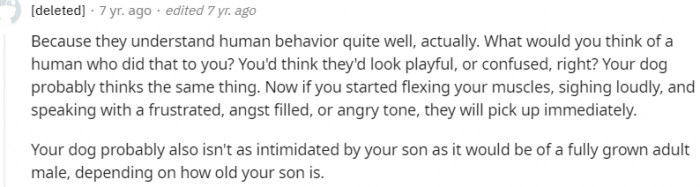
16. They have learned to recognize our facial expressions

Understanding how dogs perceive human expressions can inform better training methods.
For instance, dogs that have been exposed to harsh training methods may react differently to human expressions than those that have been treated with kindness and patience. This highlights the significance of humane training practices in shaping a dog’s emotional response patterns. This approach not only benefits the dog's emotional health but also enhances the overall human-animal bond.
17. A similar thought pattern in dogs

18. I would have to explain that he was just smiling

19. You probably already know and do this

Building trust is essential for effective communication between dogs and their owners. Dogs that receive consistent positive reinforcement are more likely to respond favorably to their owners’ expressions, including those that may initially appear aggressive. This trust facilitates a deeper understanding of social cues, allowing dogs to navigate human behaviors more effectively.
Engaging in activities that promote trust, such as fetch or agility training, can enhance the bond between dog and owner. By creating a positive association with their owner's demeanor, including snarling or showing teeth during play, dogs are less likely to react with fear or aggression, thus fostering a healthier relationship.
That trust is doing a lot of the heavy lifting here.
Given the insights from dog behavior research, pet owners can cultivate a positive environment that supports their dog's emotional development. Training methods grounded in positive reinforcement have been shown to yield better long-term outcomes in behavior modification than punitive approaches. This aligns with findings from various behavioral studies emphasizing the benefits of rewards-based training. To implement this, owners can start with basic commands and gradually introduce more complex tasks, always rewarding the dog for desirable behavior. This fosters a sense of safety and trust, enabling dogs to feel more secure in their interactions with humans, regardless of the expressions being displayed.
20. He will watch me from the corner of his eyes

As long as there have been humans and dogs, dogs have occasionally noticed and reacted to human teeth. Dogs improved in reading our physical clues as they got more perceptive of our demands and behaviors, and that also applies to our teeth.
What are your thoughts about this post? Drop your thoughts in the comments section below.
The dynamics of the relationship between dogs and humans reveal a rich tapestry of emotional intelligence and social interaction. The recent Reddit thread sheds light on how dogs perceive human expressions, particularly when faced with snarling or teeth-baring. It appears that dogs have developed an acute ability to read human emotions, which could be attributed to their long history of domestication and close companionship with people.
Understanding these nuances is critical for enhancing our training methods and everyday interactions. When we adopt positive reinforcement techniques and remain aware of our own emotional signals, we empower our dogs to navigate the often perplexing realm of human emotions. This not only fosters confidence in our pets but also strengthens the bond we share, creating a more enriching experience for both dogs and their owners.
The dynamics of the relationship between dogs and humans reveal a fascinating interplay of social understanding and emotional intelligence. As highlighted in the article, dogs possess an impressive ability to interpret human behaviors, from facial expressions to vocal tones, which allows them to navigate situations that might appear daunting to the average observer. This skill is particularly evident when dogs remain unfazed by human snarls or teeth displays, showcasing their unique emotional attunement.
Moreover, cultivating a positive and trust-filled environment is crucial for enhancing a dog's adaptability and responsiveness. The article emphasizes that training methods focused on empathy and consistency yield better behavioral outcomes. By applying these psychological insights, dog owners can foster a more harmonious living environment, ultimately strengthening the bond shared with their canine companions. This understanding not only benefits the dogs but also enriches the human experience, reinforcing the deep connection that has developed over time.
For another showdown, see how a staffy owner got called out for a “But-face” after bringing it near a young child.
Share this article: