
Parent Shares How Their Interesting Volcano Backyard Science Project Turned Their Puppy’s Paws All Blue

One backyard science project turned into a very blue surprise, and the whole thing is honestly hard not to laugh at.
A parent let their child set up a baking soda volcano in a shared yard, while the neighbors’ puppy was nearby doing what puppies do best, getting into everything. When the volcano erupted with blue “lava,” the little dog ended up with bright blue paws, and the neighbors were not amused.
The story has all the ingredients of a classic Reddit mess, a kid, a puppy, a shared yard, and a whole lot of food coloring. Read on, because the comments are exactly what you’d expect.
OP’s son wanted to build a volcano. And he wanted it blue. So his dad 3D printed one…

OP’s family experimented in the shared yard. It was also the neighbor’s puppy’s favorite location. OP tried to keep it away, but the puppy still managed to get its little paws all blue.
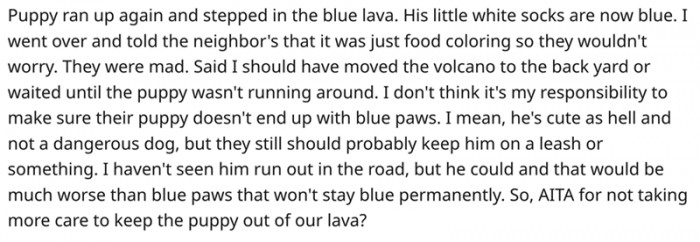
Redditors all agree, OP is not responsible for the dog

The excitement of children engaging in science projects often stems from their natural curiosity and desire for exploration, which is a fundamental aspect of childhood development. This kind of experiential learning not only fosters cognitive skills but also enhances creativity and critical thinking.
However, as parents, it’s crucial to balance this exploration with safety considerations. While engaging in hands-on science projects can be beneficial, it’s essential to establish boundaries and guidelines to mitigate potential risks, such as using safe, age-appropriate materials. This balance of freedom and safety can help cultivate both curiosity and responsibility in young learners.
To enhance the educational benefits of science projects while ensuring safety, parents can adopt several strategies. Engaging children in the planning phase not only empowers them but also teaches them the importance of preparation and safety.
Additionally, parents can create a structured environment that allows for exploration while minimizing risks. This could involve designating specific areas for projects, using protective coverings, and having appropriate cleaning supplies on hand. Furthermore, parents should encourage open discussions about the outcomes of experiments, emphasizing that unexpected results are part of the learning process. Such discussions can reinforce the idea that science is about inquiry, exploration, and, importantly, learning from mistakes.
Food coloring is harmless...

Redditors had similar experiences...

There are leash laws...

Parental involvement in children’s activities, such as science projects, plays a significant role in shaping their attitudes towards learning and exploration. Research indicates that when parents actively participate in their children's projects, it not only strengthens their bond but also enhances the child’s academic motivation and engagement (Gonzalez-DeHass et al., 2005). Through supportive interactions, parents can model scientific thinking and curiosity, which may inspire children to pursue further exploration.
Moreover, a study from the University of Michigan found that children who experience positive parental involvement in educational activities are more likely to engage in self-directed learning. It’s vital for parents to communicate openly about the objectives and safety precautions for these projects, reinforcing the idea that exploration is rewarding but must be approached thoughtfully. This can be a great opportunity for parents to teach their children about the importance of safety measures while still encouraging creativity and inquiry.
And it’s not the first time a dog-side choice blew up, like when a mom got called a “horrible mother” after punishing her teen for a skunked dog.
Just embrace the Smurf...

The neighbors should've been watching their dog
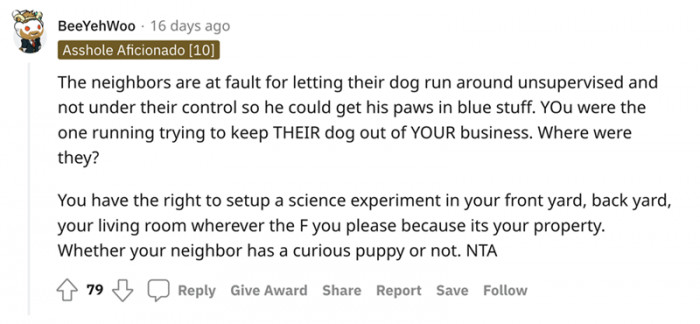
Shared yards mean everyone has access, but it also means everyone has responsibilities

Children's reactions to unexpected outcomes, such as a puppy’s paws turning blue from a science project, can provide valuable insights into their emotional and cognitive development. For instance, the concept of 'cognitive dissonance' explains how children may feel discomfort when faced with outcomes that contradict their understanding, prompting them to adjust their beliefs or behaviors accordingly (Festinger, 1957).
This is particularly relevant in situations where children might feel responsible for unintended consequences. By addressing these feelings and discussing the importance of trial and error in science, parents can help children develop resilience and a growth mindset. This approach is crucial in shaping how children perceive and respond to setbacks.
This kid is so lucky... Wish we had 3D printers when we were kids...

We are trying to imagine those tiny white socks covered in blue paint. And it kind of brings a smile to our faces.
Although we don't think the puppy's owners feel the same. We wonder if they will be able to look back at this and laugh...
The dog is probably feeling fairly perplexed as well, but because it's just food coloring, he won't get hurt. It definitely doesn't seem like the OP is the AH in this situation, in our opinion. However, one thing comes to our mind.
When were the blue paws discovered by the neighbors? We sure hope the puppy didn't get to the carpets or the couch...
The delightful story of a backyard volcano project gone awry, resulting in a puppy's blue paws, encapsulates the essence of childhood exploration. It serves as a reminder of the joys and unpredictability that come with scientific experimentation at home. This incident highlights the importance of parental involvement in children's learning experiences. Encouraging kids to dive into hands-on projects not only fosters their curiosity but also enhances their cognitive skills.
However, as this tale illustrates, the balance between exploration and safety is crucial. Parents must take proactive steps to ensure that while children engage in creative and messy science projects, they are also guided on how to navigate the unexpected outcomes. Such experiences not only build resilience in young learners but also instill a growth mindset that will benefit them throughout their lives. By promoting a safe yet exciting environment for discovery, parents can inspire their children to embrace the wonders of science and view the world as a captivating realm of possibilities.
Still think it was unfair? See how Reddit ripped into the “But*Face” staffy owner.
Share this article:





