How Bunny the Talking Dog Helped Alexis Devine Notice Something Wrong With Her Paw

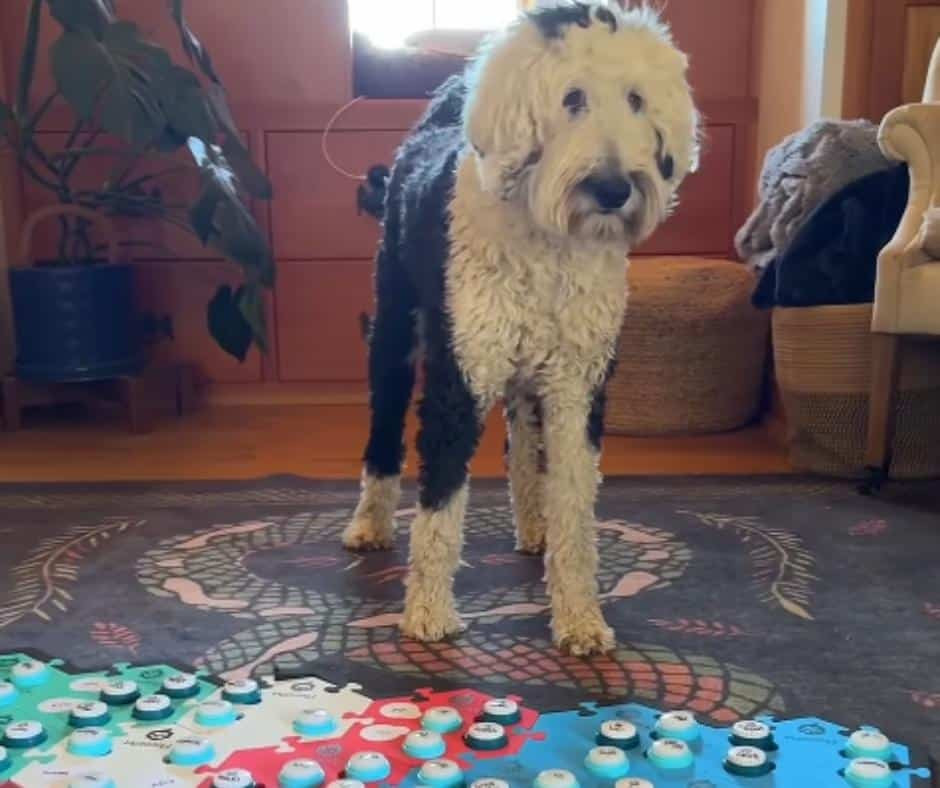
Bunny had a problem with her paw, and Alexis Devine knew the message was unusual enough to make her stop and pay attention. When the 7-year-old Sheepadoodle pressed “ouch,” “stranger,” and “paw” on her soundboard, it became one of the clearest examples yet of why their button-based communication matters.
Bunny does not rely on only barks, looks, or nudges to get a point across. Alongside all the familiar ways dogs communicate, she also uses a large board of word buttons, giving her another route to tell her person what she wants, needs, or seems to notice.
That mattered when she chose three words that Alexis did not hear as random. “Ouch,” “stranger,” and “paw” sounded like a specific concern, especially because the combination suggested that something about Bunny’s paw felt wrong. In the clip below, Alexis reflects on what years of communicating with Bunny have taught her.
The moment lands because it was never supposed to be a trick. For Alexis, the whole point of the buttons was to make room for more understanding between two companions who were already paying attention to each other.
A soundboard built for everyday life
Alexis started looking into communication buttons before Bunny even came home. She was drawn to the possibility of a closer human-animal bond, the kind of connection people often imagine in stories such as Lassie, and wondered whether a dog could use buttons as another way to express experiences.
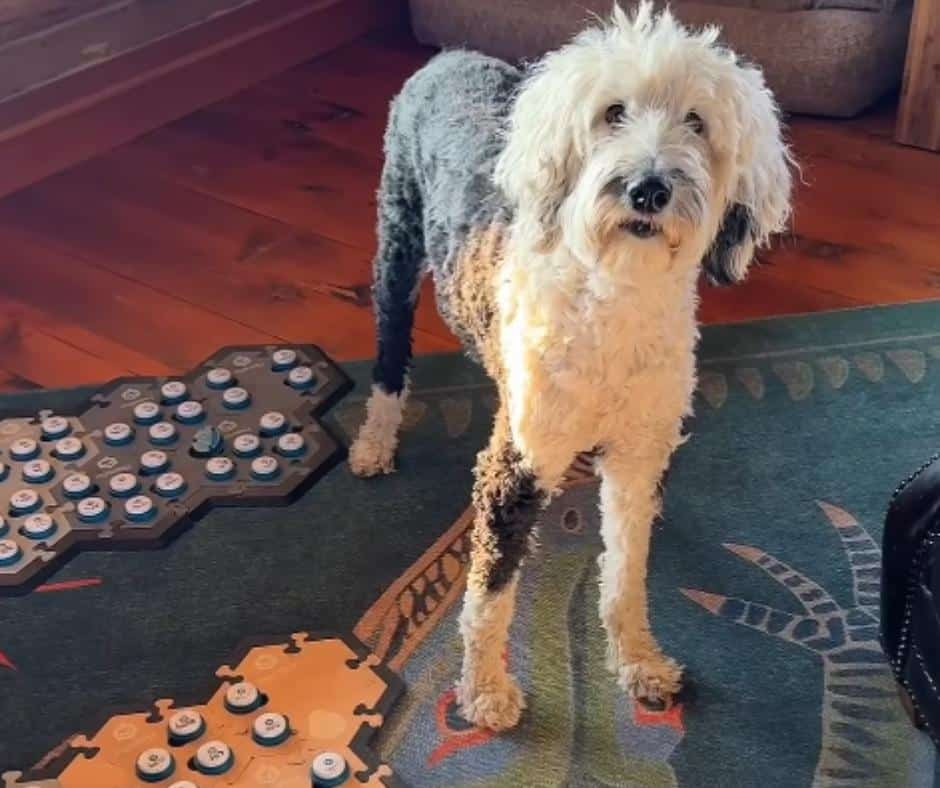
What followed became part of daily life rather than a one-off experiment. Bunny’s soundboard grew to about 110 buttons, each representing different words or ideas. Alexis consistently modeled those words during ordinary interactions, building the system into routines instead of treating it like a performance.
That distinction matters to the way Alexis talks about Bunny’s abilities. She does not frame the board as replacing normal dog behavior. Bunny still communicates with body language, movement, facial expressions, and vocalizations. The buttons simply add another layer, one that can give Bunny more agency and more choice in how she makes herself understood.

The message that led to a closer look
When Bunny indicated “ouch,” “stranger,” and “paw,” Alexis examined her more closely. She found a foxtail lodged in the webbing between Bunny’s toes.
Without the board, Bunny might still have shown discomfort in familiar ways, including licking, limping, or a change in behavior. But the button presses gave Alexis another prompt to investigate, and that extra signal turned out to be useful.
For Alexis, the discovery became one of the strongest reminders of what the system can do at its best. It did not prove perfect understanding, and it did not mean Bunny stopped being a dog first. It showed that careful listening, paired with close observation, can sometimes help a person notice a problem sooner or more clearly.
More than viral curiosity
Bunny’s button use has drawn scientific attention as well. She has taken part in the They Can Talk research project, which is associated with the Comparative Cognition Lab at the University of California San Diego. The project contributes data to research on how dogs interact with augmentative interspecies communication devices.
That research is still working through big questions, including what dogs understand and how individual button presses should be interpreted. Bunny’s participation gives researchers a chance to study those behaviors in a more systematic setting rather than depending only on viral clips.
At home, though, Alexis says the most important lessons are not just about vocabulary. Living with Bunny has made her more observant, more patient, and more aware of the emotions that shape their interactions. She has also said the process has helped her think about her own experiences with overstimulation and reactivity.
Bunny still has energetic stretches and reactive moments. The soundboard has not turned her into a perfectly predictable dog, and that was never the aim. What it has done is create another bridge between them, one that keeps growing as they learn.
That may be the most appealing part of Bunny’s story for dog lovers. Meaningful communication does not require flawless translation. Sometimes it starts with giving a dog one more way to be heard, then taking the time to listen when she uses it.

How talking buttons work
Sound buttons are a simple form of assisted communication. Each button plays a recorded word or short phrase, and a dog learns that pressing it can lead to something meaningful, such as going outside, getting water, starting play, or asking for help. The key idea is association, not human style language. Dogs learn best when the word is tied to a consistent action and when people model the button before the activity happens.
If you want to try buttons, start small. Pick a few useful words your dog already cares about. Keep the buttons in a quiet, easy to reach spot, and use the same word the same way each time. Watch for patterns, not one off presses. A button press matters most when it matches the dog’s body language and the situation. Repeated, consistent use is more meaningful than a single surprising moment.
What to know about paw problems
Dogs often show foot discomfort before people notice an obvious injury. Common signs include licking or chewing a paw, limping, holding a foot up, walking differently, hesitating on stairs, or pulling away when the paw is touched. Causes can be minor or more serious, including a torn nail, a cut pad, something stuck between the toes, a sting, irritation from heat or salt, or strain higher up the leg.
A quick paw check can be part of routine care after walks. Look between the toes, inspect the pads and nails, and feel for heat, swelling, or tenderness. Rinse off grit, salt, or mud, and keep fur around the paw tidy if it tends to trap debris. Avoid giving human pain medicine, which can be dangerous for dogs. Get veterinary advice promptly if there is bleeding, a bad smell, marked swelling, a lodged object, severe limping, or pain that does not settle.
Share this article: