
How to Tell If Your Cat Is Part Maine Coon

It starts the same way every time, someone posts a photo of their “definitely not a Maine Coon” cat, and then everyone in the comments starts losing their minds. The cat looks long, looks sturdy, and somehow has that regal, slightly lion-ish vibe that makes people swear they can see the whole Maine Coon silhouette in one frame.
But here’s the messy part, the owner is trying to figure it out based on whatever they have, awkward kitten pics, one blurry angle, and a few dramatic features like big ears or extra toes that could mean Maine Coon, or could just mean “domestic cat with great costume energy.” And if the body is long and the muzzle looks square-ish, suddenly every detail feels like evidence, even when it shouldn’t.
Here’s the full story of how to spot the pattern, not just the obvious clues.
1. Look at the whole body shape
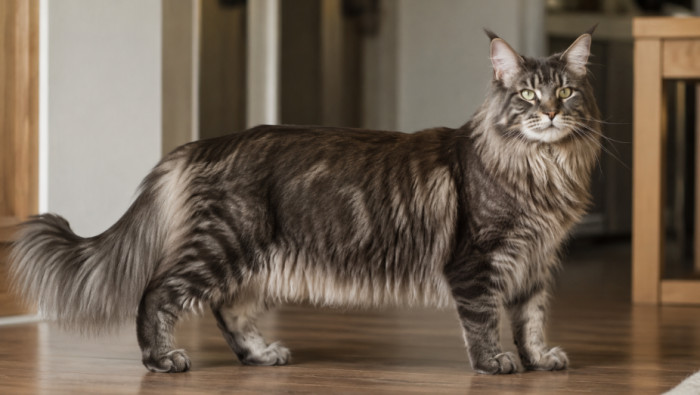
Maine Coons are long, rectangular cats with broad chests and substantial bone.
A suspected mix may inherit some of that structure. Look for a torso that feels long rather than compact, sturdy legs, and a frame that remains substantial even under the coat.
Do not start with weight alone.
A heavy domestic cat can be overweight. A lean Maine Coon mix can be long and muscular without setting any scale records.
Pupperish’s gallery of Maine Coon-like lion faces and frames gives a better sense of the overall silhouette than a checklist of isolated measurements.
2. Check the muzzle and head
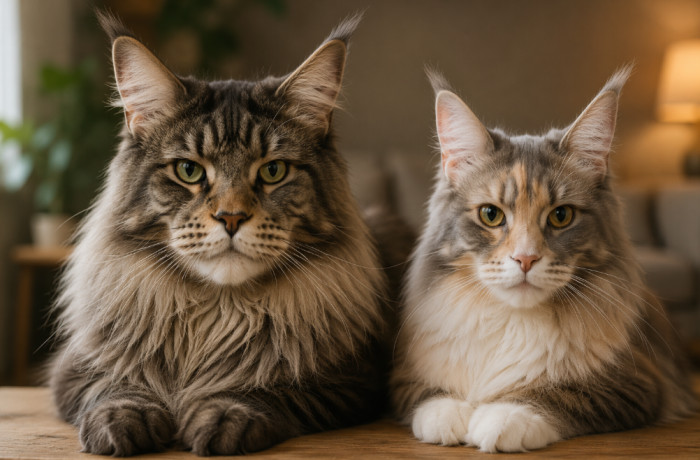
A classic Maine Coon has a relatively square muzzle rather than a sharply pointed or very round face.
The head is longer than it is wide, with high cheekbones and a distinct but gentle profile. A mix may soften those features, especially if the other parent has a rounder or narrower head.
This is one area where adult photos are more useful than kitten photos.
Young faces change.
3. Look at the ears, but do not stop there
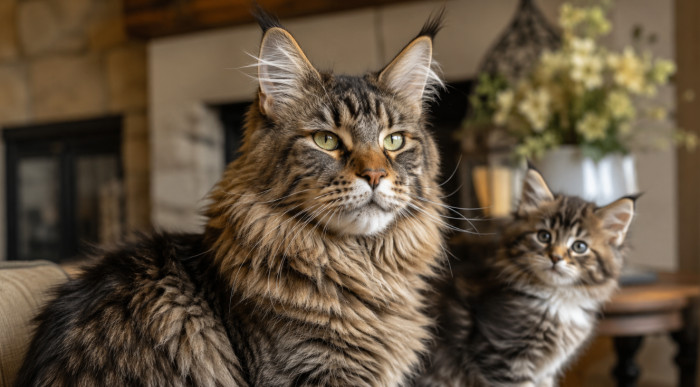
Large, tall ears with heavy inner furnishings and small tip tufts fit the Maine Coon look.
Other cats can have them too.
Pupperish’s ear-fur gallery is full of domestic cats with dramatic furnishings, which is exactly why ear tufts cannot function as a breed test.
Use ears as one point in a larger pattern.
4. Look at the paws
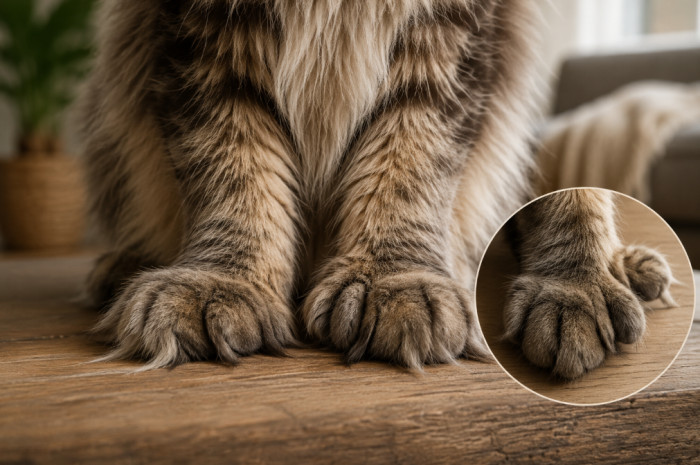
Maine Coon paws tend to be large, broad, and tufted.
Some Maine Coons are also polydactyl, meaning they have extra toes, but polydactyly occurs in unrelated domestic cats as well. A suspected mix with huge furry feet may look convincing, especially if the body, muzzle, and ears also fit.
Again, one feature is weak evidence.
Pupperish’s story about a cat with webbed-looking toes shows how unusual feet can appear in cats without telling you a complete breed history.
5. Consider the tail
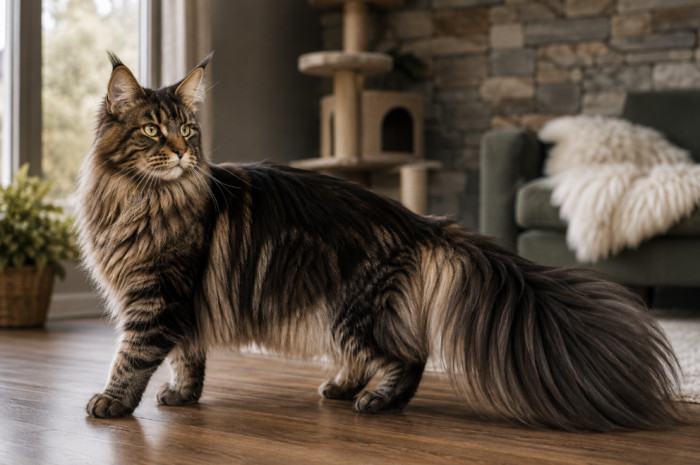
A Maine Coon tail is long, broad at the base, and heavily furnished. It should visually balance the long body. Mixed cats may inherit the full plume even when other features are less obvious.
A huge tail is one of the reasons suspected Maine Coon mixes get labeled quickly online.
Pupperish already has a story about a Maine Coon with an extraordinary tail, which shows how extreme the feature can become in a documented breed example.
6. Look at coat texture, not just coat length
“Fluffy” is too broad.
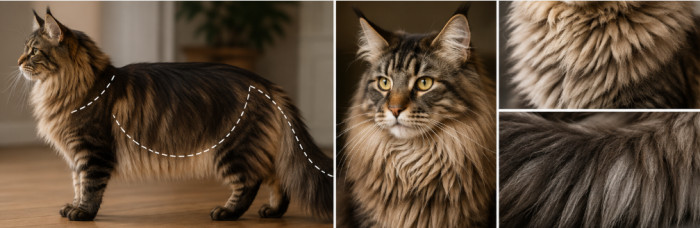
Maine Coon coats are shaggy and uneven in length, generally shorter around the shoulders and longer around the belly, hindquarters, and tail. A ruff may frame the neck, especially in mature cats.
Domestic longhairs can also have ruffs and full tails, so the coat should be considered together with body type.
Color tells you even less. Maine Coons occur in many traditional colors and patterns, including tabby, solid, smoke, silver, tortie, and combinations with white.
7. Size can support the case, not prove it
A genuinely large frame makes Maine Coon ancestry more plausible when the other features line up.
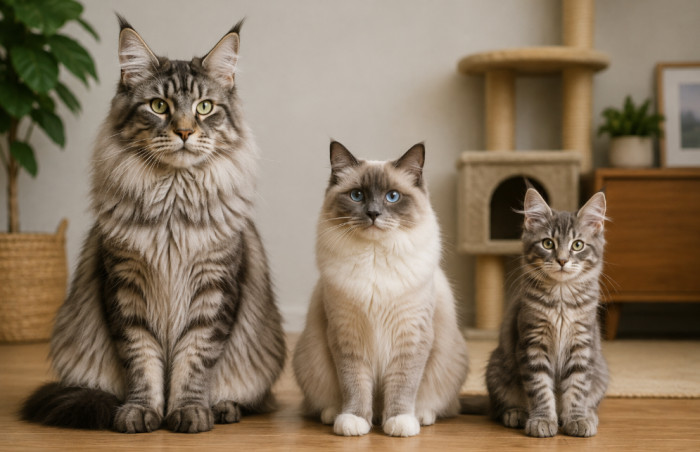
But plenty of mixed-breed cats grow large. Ragdolls, Norwegian Forest Cats, Siberians, and large domestic longhairs can also overlap visually.
If your cat is still young, size becomes even less useful because Maine Coons mature slowly. A lanky one-year-old can continue developing for years.
That’s when the conversation turns to the first giveaway, the body shape, because a long, rectangular frame is hard to ignore in a single photo.
For more on the classic Maine Coon look, check Maine Coon ears with lynx tips and ear tufts.
Then the owner flips to head photos, comparing the muzzle and cheekbones, hoping adult angles will tell the truth that kitten faces keep hiding.
After that, everyone fixates on the ears, tall and heavily furnished, even though the same ear drama shows up on non-Maine Coon cats too.
8. Personality is the weakest “test”
Maine Coons are often described as friendly, social, playful, and likely to follow people around. Those are appealing traits.
They are also common cat behaviors.
A cat that plays fetch, chirps, likes water, or waits outside the bathroom door is not revealing a pedigree through personality.
Behavior can make the resemblance fun. It should not make the conclusion stronger.
Finally, the thread circles back to the paws and tail, because huge tufted feet and a balanced, furnished tail can look convincing, even when one trait is all you’ve got.
Can a DNA test prove your cat is part Maine Coon?
It depends what question the test is designed to answer.
Parentage testing can establish whether known possible parents match genetically. Consumer ancestry products may estimate breed relationships using proprietary reference populations, but those estimates are not equivalent to a registry pedigree.
If your cat came from a breeder who says one parent was a Maine Coon, ask for the parent’s registration or pedigree records.
If your cat came from a shelter with no history, accept some uncertainty.
That is often the scientifically cleaner answer.
What should you call a cat that looks like a Maine Coon?
If ancestry is unknown, use language that leaves room for uncertainty:
“Maine Coon-like domestic longhair” works.
“Possible Maine Coon mix” works too.
What matters is not winning the breed-identification argument. It is describing the cat accurately enough that expectations about adult size, grooming, and behavior do not rest on a guess.
A cat can have the giant paws, shaggy tail, square muzzle, and social personality people love in Maine Coons without needing a certificate to be impressive.
Nobody wants to guess wrong about a cat this majestic, but the pattern matters more than any single “Maine Coon” detail.
Think your cat is “mostly” Maine Coon, see how Maine Coon mix traits can vary by ancestry.
Share this article:





