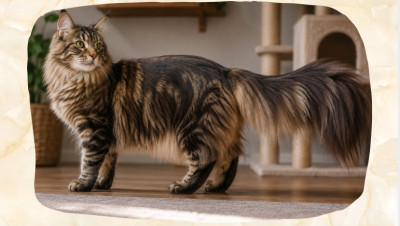
Norwegian Forest Cat vs Maine Coon: Size, Appearance, and Key Differences

It started the way these cat debates always start, with a scroll: one minute you’re admiring a Norwegian Forest Cat’s dramatic tufted ears, the next minute you’re convinced the photo is actually a Maine Coon. The mix-up is so common it feels like a running gag, because both breeds pull off that “big, fluffy, weather-ready” look with zero effort.
Then the real confusion kicks in, because the quick visual clues overlap. You’ve got triangular head vibes in one cat, squarer muzzle energy in the other, and long profiles that can look similar depending on the angle. Add to that the coat volume, the full tails, and even the fact that ear tufts show up in both, and suddenly your “at a glance” checklist feels like it’s lying to you.
So the only way to settle it is to zoom in on the details that actually hold up, not the ones that just look good in thumbnails.
Maine Coon vs Norwegian Forest Cat at a glance
The fastest visual checks are:
- Head: triangular in the Norwegian Forest Cat, longer with a square muzzle in the Maine Coon
- Profile: long and straight in the Norwegian, gently concave in the Maine Coon
- Body: strong and high-legged in the Norwegian, long and rectangular in the Maine Coon
- Coat: both are weather-adapted and semi-long, but texture and distribution differ
- Tail: both carry impressive long, full tails
- Ears: both can have large tufted ears, so tufts alone are a poor separator
Pupperish already has a feature on the Norwegian Forest Cat, which makes a useful visual companion because the breed can look very Maine Coon-like at first glance.
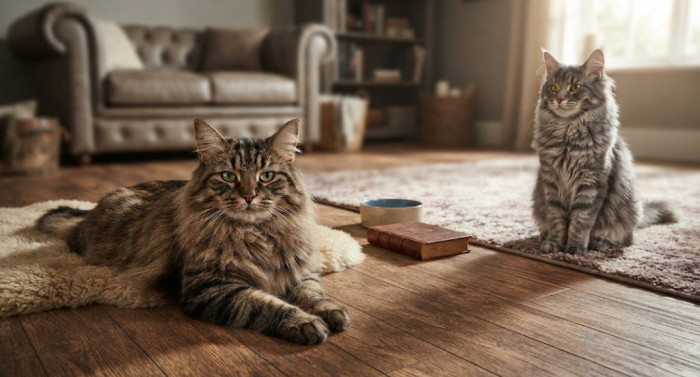
That’s when the “at a glance” comparisons in the Maine Coon vs Norwegian Forest Cat section start to feel like a cheat sheet you can actually use.
Which is bigger, a Maine Coon or Norwegian Forest Cat?
Both are large breeds, and the ranges overlap.
TICA currently lists adult Norwegian Forest Cat females at about 8 to 12 pounds and males at 12 to 18 pounds. Its Maine Coon page lists females around 12 to 15 pounds and males around 18 to 22 pounds in the at-a-glance section.
That gives Maine Coons the higher published average range on TICA’s current pages, especially among males.
Individual cats can still reverse the comparison.
A large Norwegian Forest Cat may outweigh a smaller Maine Coon. Coat volume and body length can also change which cat appears larger in photographs.
The head shape is the best visual clue
Look straight at the face, then look at the profile.
The Norwegian Forest Cat’s head forms an equilateral-triangle concept in the TICA standard, with a long straight profile. The Maine Coon’s muzzle is squarer and more projected, creating the blockier “lion-like” face people recognize online.
This is more reliable than ear tufts. Both breeds can have them.
Pupperish’s collection of Maine Coon faces shows the square-muzzle effect particularly well when multiple cats are viewed together rather than through one dramatic portrait.
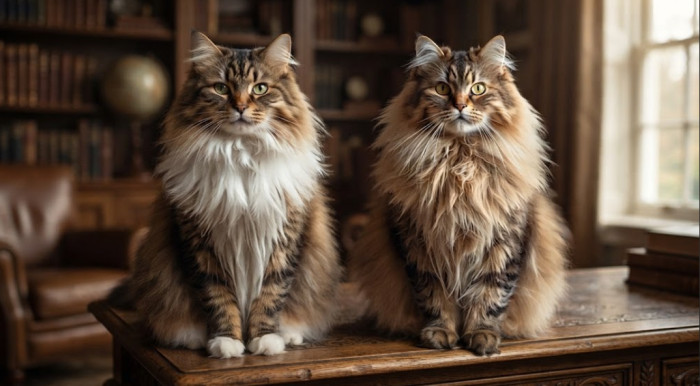
But then the size numbers muddy the waters, because a big Norwegian Forest Cat can still outweight a smaller Maine Coon even with TICA’s ranges.
Coat differences
The Norwegian Forest Cat has a dense water-repellent double coat developed for Scandinavian conditions, with a woolly undercoat and coarse guard hairs. The coat changes strongly with the seasons.
The Maine Coon also has a weather-resistant coat, but breed descriptions emphasize its shaggy, uneven length: shorter across the shoulders and longer along the belly, hindquarters, ruff, and tail.
In practice, grooming, season, and individual coat texture can blur this distinction.
A summer Norwegian may look far less fluffy than a winter one. A Maine Coon with a silky coat may look sleeker than the heaviest-coated examples in image searches.
It’s like putting a Maine Coon beside normal cats, dogs, and even a human, size jumps out fast.
Ears and lynx tips
Both breeds can have tall ears, inner furnishings, and visible tip tufts.
So if someone identifies a cat as “definitely Maine Coon” because it has lynx tips, the Norwegian Forest Cat is an immediate counterexample.
Ear placement works better when combined with head shape. Norwegian ears continue the triangular line of the head. Maine Coon ears sit on a head with a very different muzzle and profile.
This is why whole-body identification beats feature collecting.
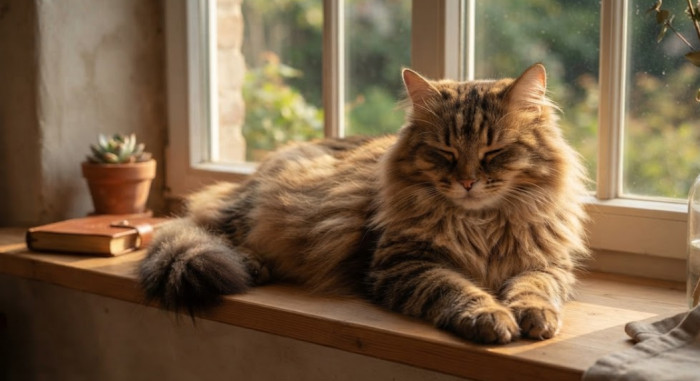
Next, the face check becomes the deciding moment, since the Norwegian’s long straight profile fights the Maine Coon’s squarer, more projected muzzle.
Personality: which breed is more affectionate?
Both are described as friendly family cats, but breed profiles suggest slightly different social styles.
TICA describes Norwegian Forest Cats as intelligent, independent, gentle, and loving, often preferring to stay near the family rather than functioning as constant lap cats. Maine Coons are described as social, gentle, playful, and likely to follow their people around while also retaining some independence.
There is plenty of overlap.
Individual personality matters more than choosing between two adjectives in breed descriptions.
Pupperish’s story about a Norwegian Forest Cat that survived a long disappearance is a useful real-world counterpoint to tidy temperament summaries. A cat’s lived behavior is always more complicated than a breed card.
Which breed matures more slowly?
Both take their time.
TICA says Norwegian Forest Cats may take up to five years to reach full maturity. Maine Coons are also slow-maturing, with the same organization noting that they do not typically reach full maturity until around four years and elsewhere describing development across several years.
That means adolescent cats of either breed can look lanky, unfinished, or out of proportion.
Do not compare a one-year-old Norwegian with a four-year-old Maine Coon and treat the difference as purely breed-based.
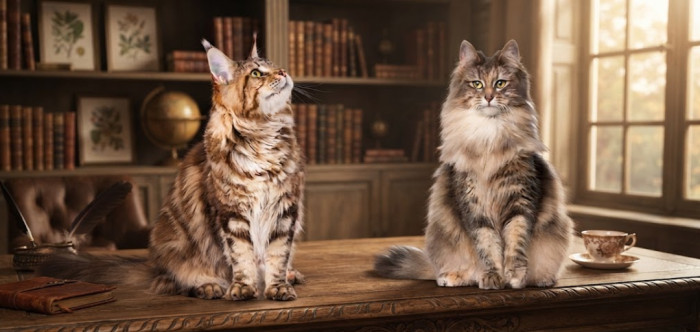
Finally, the coat and tail details finish the job, because both get that semi-long weather-ready look, but the texture and distribution are where the story flips.
Norwegian Forest Cat vs Maine Coon tail
Both tails are spectacular.
The Norwegian tail is long, flowing, and carried high. The Maine Coon tail is also long and heavily furnished, balancing the length of the body.
Tail length alone will not identify the breed.
The more useful question is what the tail is attached to: a high-legged triangular-headed Norwegian or a rectangular square-muzzled Maine Coon.
Which is the better pet?
Neither wins universally.
Both need enough space, play, grooming, and interaction for a large longhaired cat. Both can fit well into family homes when the individual cat’s temperament matches the household.
Choose based on the actual breeder or rescue, the cat’s health and behavior, and the type of interaction you want rather than on a “which breed is better” verdict.
Pupperish’s overview of popular cat breeds makes the broader point: breed labels help set expectations, but they do not replace meeting the animal.
For identification, though, the shortcut is strong: triangle and straight profile point toward Norwegian Forest Cat; square muzzle and rectangular body point toward Maine Coon.
If you judge by tufts alone, you’ll keep calling the wrong cat, and the photos will keep winning.
Think you have a Maine Coon lookalike? Check how to spot part Maine Coon cats by paws, ear tufts, and body.
Share this article: