How Ziggy the Beagle Got His Sight Back When a Rare Disease Threatened His Last Eye

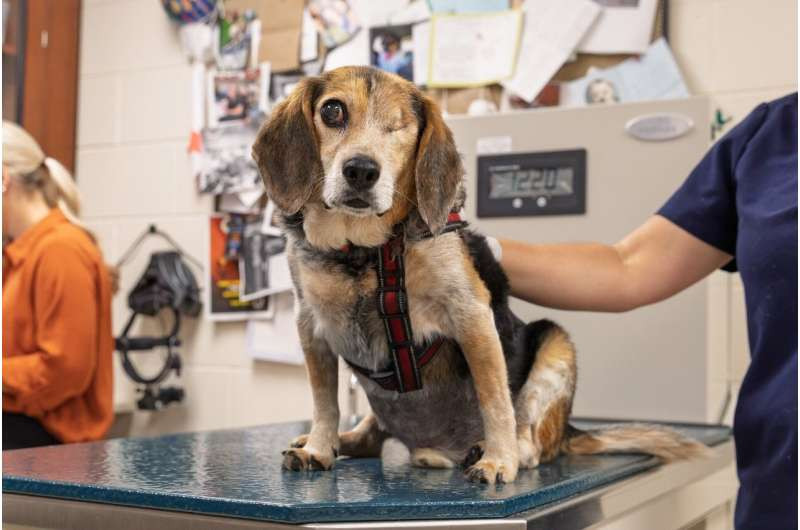
Ziggy started heading for the bathroom door instead of the bedroom door, missing turns in a room he knew by heart. For the 9-year-old bluetick beagle, that small mistake carried enormous stakes because he had only one eye left to lose.
By the time Ziggy began drifting toward the wrong corners of familiar rooms in May, his family already knew how quickly things could change. Aparna Shah and her husband, Ashwan Lewis, had seen one of the dog's eyes fail. Now the remaining eye was in trouble, and the problem was happening in the only place sight was left.
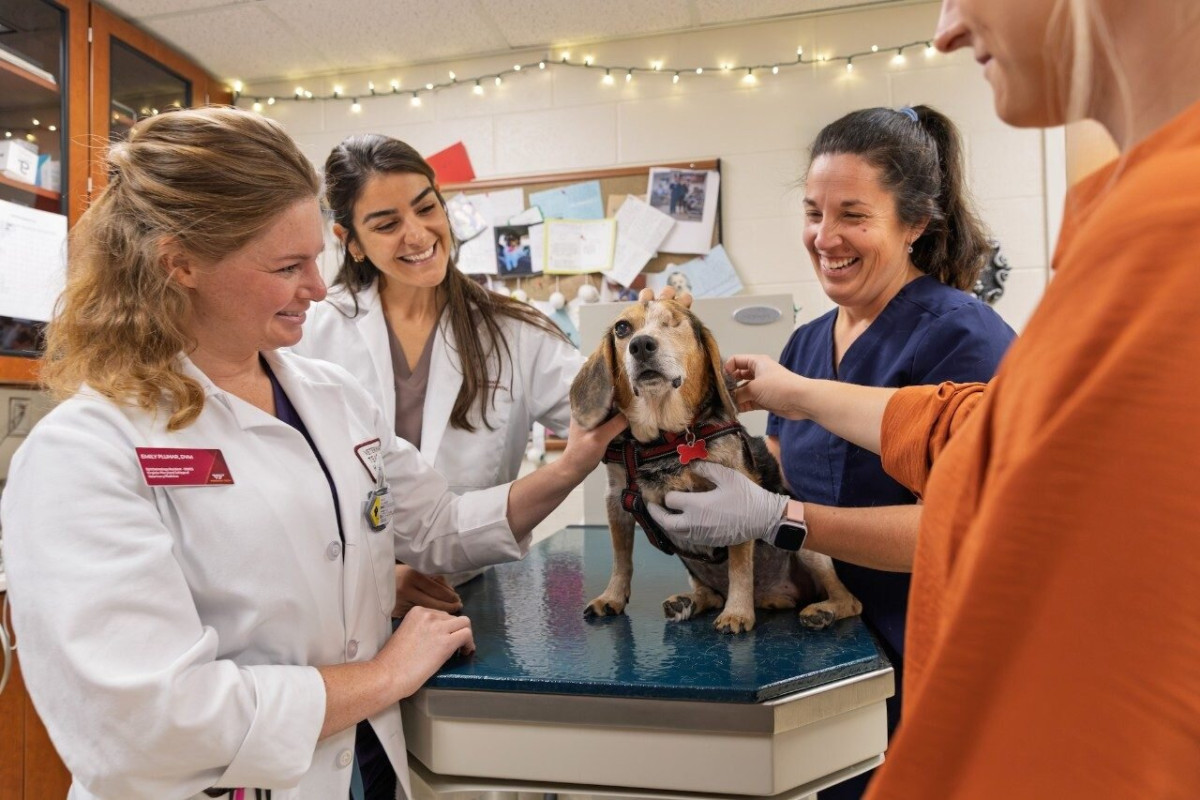
Shah teaches Virginia Tech students about how the eye turns light into vision. In her own dog, she was watching that process slip away. When Ziggy was examined at the Virginia-Maryland College of Veterinary Medicine's Veterinary Teaching Hospital, the ophthalmology team found that his retina was partially detached.
Within a day, he received a steroid injection placed into tissue next to the eye. A week to 10 days later, he could see again.
That result did not come from a routine case or a routine plan. It came from a difficult balancing act that had already forced his doctors to choose between treating one serious condition and possibly worsening another.
The eye problem that turned into something much bigger
Ziggy's medical trouble had begun just before Thanksgiving 2025. His third eyelid was protruding, and he was squinting. Because it was a weekend, Shah and Lewis took him to the teaching hospital's emergency service.
Clinicians there suspected uveitis, which is inflammation inside the eye, and prescribed medicine aimed at reducing swelling and pressure. After that, Ziggy's primary care veterinarian kept checking the pressure in his eye, adjusted his drops, and referred him to the hospital's ophthalmology service.
When ophthalmologist Ian Herring examined Ziggy, the picture had become much more serious. Vision in the left eye was gone because of severe glaucoma, and the eye was likely painful. It was removed for Ziggy's comfort and to help determine what had caused the damage.
Testing on that eye confirmed Herring's suspicion that Ziggy had uveodermatologic syndrome, a rare autoimmune disease in which the body's immune system attacks the eyes. Once that diagnosis was clear, the danger to the remaining eye was obvious. Herring knew the right eye could be affected quickly as well.
Under ordinary circumstances, dogs with this disease are typically treated with medication that suppresses the immune system throughout the body. But Ziggy's case did not allow for an ordinary approach.
Why standard treatment was risky
Before starting whole-body immunosuppressive drugs, the veterinary team needed to make sure there was not an infection elsewhere. X-rays revealed lesions along Ziggy's mid-back, findings that pointed to discospondylitis.
Richard Shinn, an assistant professor of neurology, explained that the term refers to inflammation involving the disk between the bones of the spine and the neighboring vertebrae. He said that kind of inflammation is almost always caused by infection, usually bacterial, though fungal infection is also possible.
The problem carried its own serious risks. Without treatment, Shinn said, the disk can eventually herniate and lead to neurologic weakness. Infection can also spread into the spinal canal and directly affect the spinal cord. In severe cases, the vertebrae can fracture and luxate.
Neurology prescribed six months of antibiotics.
That created the central dilemma in Ziggy's care. The autoimmune disease threatening his vision generally called for immunosuppression, but suppressing his immune system could also increase the danger from a suspected infection near his spine. Herring described the case as being between a rock and a hard place.
So instead of starting with the usual systemic treatment, he looked for a way to target the eye more directly while limiting effects on the rest of Ziggy's body.
A local treatment with high stakes
After consulting colleagues, Herring chose a local injection of triamcinolone, a steroid delivered into tissue adjacent to the eye. According to Herring, very little has been published on this method in dogs, but it offered a practical path in Ziggy's situation.
The disease was affecting the back of the eye, where ordinary topical medication alone would not be enough. Ziggy did receive topical steroids, but the local injections were what Herring credited with getting him through the most dangerous stretch.
The first injection controlled the disease for about five months. Then came the setback in May, when the retina in Ziggy's remaining eye detached.
At that point, Herring repeated the injection and added a short course of oral steroids. By then, Ziggy had already spent months on antibiotics, and Herring judged that step safe enough to try. The combination worked. Within a week to 10 days, Ziggy's sight returned.
For Shah and Lewis, the proof was not abstract. It showed up in the way their dog moved through space. He was no longer choosing the wrong doorway in a room he knew well.
The rest of his care remained tightly watched. Neurology rechecked Ziggy's spine with X-rays every three months. The lesions stayed stable, and he finished antibiotics in late May.
Buying time, and changing future cases
By August, neurology cleared Ziggy to begin cyclosporine, an oral immunosuppressant that is considered standard therapy for his autoimmune eye disease. At an ophthalmology recheck a month later, his right eye was stable and showed no active inflammation.
Herring said Ziggy's case is unique in the way it was managed and that it will influence how he treats similar cases in the future. In that sense, Ziggy's care may reach beyond one dog and one hospital visit. A rare disease, a second serious diagnosis, and an unusual treatment choice combined to shape a new reference point for the team that handled him.
Even with that success, no one involved described the long-term outlook lightly. Herring said this is a disease that veterinarians typically do not beat. In his view, it is relentless, and the best that treatment can do is control it for a time.
Lewis put the goal in simpler terms: the treatments are meant to buy time, letting Ziggy keep his vision as long as possible.
That makes his story feel both precarious and heartening. A bluetick beagle who had already lost one eye, then began missing familiar doorways with the other, got sight back because his veterinarians found a workaround when the standard playbook did not fit. It was not a cure, and no one called it one. But it was enough to return the world to view.
For dog lovers, the image that lingers is a small one. Not an operating room, not an X-ray, not a medical term. Just Ziggy moving through a known room again, heading where he meant to go.
Share this article: