Rescue Kitten Rex Takes First Steps in a Custom Lego Wheelchair

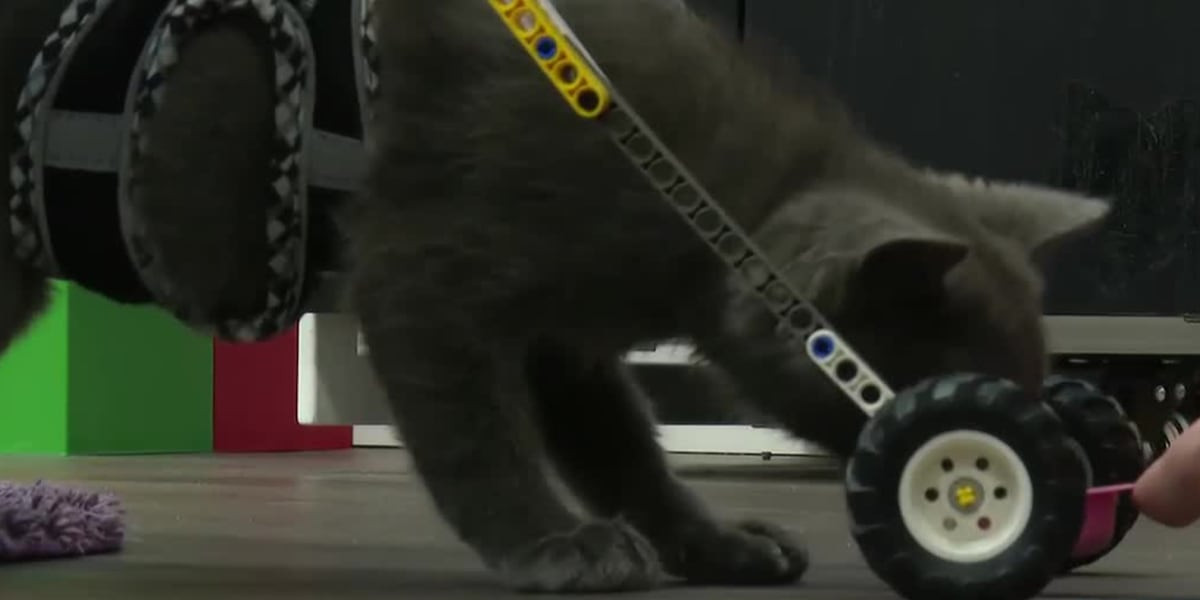
Rex had never been able to walk. Then the 4-month-old rescue kitten was set into a tiny wheelchair built from Lego pieces, and after a series of adjustments, he began learning how to take his first steps. The handmade device came together through a mix of rescue work, creative problem-solving and one builder’s personal connection to animals with mobility challenges.
A first chance to move on his own
For the people caring for Rex, the breakthrough was more than a clever construction project. It was a practical answer to a problem that had been hanging over the kitten’s future.
Rex, a rescued kitten in Wilmington, North Carolina, has cerebellar hypoplasia, a neurological condition often called wobbly-cat syndrome. Because of it, he had never been able to walk. Jennifer Witkowski, who was cat-sitting Rex and works with the rescue group Miles To Go, said he was barely responsive when he was first taken in. After treatment, she said, he slowly began to show more movement.
That progress made one thing clear. Rex needed extra support if he was going to keep working toward mobility. A wheelchair could help, but the usual kind posed a major obstacle. Witkowski estimated that a standard model would cost about $1,800. For a growing kitten, that was especially hard to justify, because Rex would outgrow it in roughly a month and a half.
Why Legos became the answer
The idea for an alternative came from seeing that another shelter had helped a rescue cat with a wheelchair made from Legos. Volunteers then contacted Bricks & Minifigs, a specialty Lego store in Wilmington, to see whether something similar might be possible for Rex.
At the store, employee Michael Hawley was ready to try. Working with Lego pieces is already part of his daily life, and he said his comfort with creative building goes back to childhood. He described some of his earliest memories as being tied to Legos and said he learned to invent his own designs when ready-made sets did not match what he wanted to build.
Hawley also had a personal reason for wanting to help. He previously had a dog named Mr. Wiggles who had the same condition. Mr. Wiggles died at age 3. When store owner Scott asked Hawley to come in and build a wheelchair, Hawley immediately agreed.
The project took some trial and error, but after a few modifications, the wheelchair appeared to do what everyone had hoped. Rex had a device built to fit his small body, and one that could be created without the price tag of a traditional pet wheelchair.
A moment of hope for Rex’s future
For Hawley, being able to contribute to Rex’s care was deeply satisfying. For the rescue volunteers working through Rex’s daily rehabilitation, it brought something just as important: relief.
Witkowski said one of the hardest parts of rehab is watching an animal continue to struggle while not knowing what its future will look like. Seeing Rex in the Lego wheelchair gave the people around him a different kind of moment, one that suggested he might have a chance at a more normal life.
Rex is not available for adoption yet, but he is expected to be listed soon through Rescue Connect. For now, the focus remains on helping a kitten who had never walked get used to the feeling of moving forward.
What makes Rex’s story stand out is not only the unusual wheelchair beneath him, but the chain of people behind it: rescuers who kept treating him, volunteers who looked for an affordable answer, and a builder who used familiar plastic bricks to give a small cat his first shot at walking.
What a pet wheelchair does
A pet wheelchair, sometimes called a cart, supports an animal whose back legs, front legs, or all four limbs are too weak to bear weight normally. The frame holds the body in a more natural position while wheels take some of the load. Soft straps or a sling support the chest, belly, or hips so the animal can move without dragging sensitive skin across the floor.
For kittens and cats, the goal is usually short, supervised periods of movement. A cart can help build confidence, encourage muscle use, and make it easier to reach food, water, or a litter tray. It is not a cure for every mobility problem, and many animals still need physical therapy, pain control, or treatment for the underlying cause.
When a kitten might need one
Young cats may need mobility support after an injury, with a spinal problem, from a birth difference, or while recovering from surgery. Some improve enough to outgrow the need for a cart. Others use one as a long term aid. Because kittens grow quickly, fit matters. A device that is too high, too low, too narrow, or rubs under the arms can cause sores and make walking awkward.
A veterinarian or rehabilitation professional can help decide whether a wheelchair is appropriate. Seek guidance promptly if a kitten cannot urinate normally, seems painful, has open wounds from dragging, loses movement suddenly, or appears distressed when placed in a cart.
DIY carts and safe use at home
Homemade carts can be useful as a temporary prototype, especially for a very small animal that needs a lightweight frame. Building blocks or other household materials may help test size and balance, but the cart should be stable, smooth, and closely supervised. Check for sharp edges, loose pieces, wobbling wheels, and any part that could pinch toes, tail, or skin. Padding should stay dry and clean.
Start with very short sessions on a non slip surface. Watch whether the kitten can hold its head up comfortably, move both front legs freely, and rest without twisting. Stop if there is rubbing, panting, panic, or exhaustion. Keep nails trimmed, bedding soft, and litter access easy. Even with a cart, many cats also need time out of it for rest, gentle stretching, and normal cuddling and play.
Share this article: