20 Black Birds: Crows, Ravens, Grackles, and More

A 28-year-old woman thought she’d finally settled the mystery outside her window, until the “same black bird” kept turning out to be a different one. One minute it was a crow-sized silhouette, the next minute it was clearly heavier, with that wedge-shaped look in flight that made her second-guess everything.
It got complicated fast because she wasn’t just looking at one bird, she was comparing them day after day: the matte-black look in indirect light versus the shiny, iridescent flash, the square versus rounded versus keel-ish tail, and whether the bird was feeding on the ground in a group or soaring alone like it owned the sky. Add in the coastal sightings that seemed to match a fish crow, and suddenly even the “obvious” ones felt like a trap.
By the time she finally listened for the voice and checked the wing-tip patches, she realized she’d been mislabeling her own backyard.
How to identify black birds
Cornell’s black bird identification guide recommends comparing size and shape, behavior, color pattern, and habitat. Its separate crow and raven comparison is especially useful because those two large black birds are often confused at first glance.
- Compare overall size before looking at small patches of color.
- Watch the tail in flight. A square, rounded, keel-shaped, or wedge-shaped tail can be decisive.
- Listen to the voice, especially when separating crows, ravens, and similar corvids.
- Check whether the feathers are matte black or strongly iridescent in direct light.
Large black birds
List:
1. American crow
American Crows are large all-black birds with heavy straight bills and fairly short, squared or rounded tails. They often feed on the ground and gather socially. Pupperish has documented crow problem-solving in a story about a crow stealing a spoon from an office.

2. Common raven
Common Ravens are larger and heavier-billed than American Crows, with shaggy throat feathers and a wedge-shaped tail in flight. They are often seen alone or in pairs. A rare color exception appears in Pupperish’s rescue story about a white raven.

3. Fish crow
Fish Crows resemble American Crows but are generally smaller and are best separated by voice. They are associated strongly with coastal and river areas in the eastern and southeastern United States, although they can also occur inland.

4. Chihuahuan raven
Chihuahuan Ravens are large black corvids of dry open country in the southwestern United States and Mexico. They resemble Common Ravens, but proportions, neck feathering, voice, and range help narrow the identification.

5. Black vulture
Black Vultures have black bodies, bare dark heads, broad wings, and short tails. White patches near the wing tips are conspicuous from below in flight. Their soaring silhouette immediately separates them from crows and grackles.

6. Palm cockatoo
Palm Cockatoos are large dark parrots with tall crests, massive hooked bills, and bare red cheek patches. Their parrot body plan makes them unlike crows despite the black plumage. They occur in New Guinea and northern Australia.

She started with the tail, because the second she saw that wedge-shaped silhouette in flight, the whole “American crow” idea started falling apart.
Glossy blackbirds, grackles, and similar songbirds
List:
7. Common grackle
Common Grackles look black from a distance, but males can show a bluish head and bronzy body in good light. Their long legs, long tail, pale eyes, and heavy bill give them a lankier profile than European Starlings.

8. Great-tailed grackle
Male Great-tailed Grackles are large, long-legged birds with a tail nearly as long as the body. The tail often folds into a V or keel shape. Iridescent purple and blue can appear across otherwise black plumage.

9. Boat-tailed grackle
Male Boat-tailed Grackles are glossy black with very long tails and heavy bills. They are strongly tied to coastal marshes in the southeastern United States. Females are brown, so a mixed group can look like two unrelated species.

10. Brewer's blackbird
Male Brewer’s Blackbirds are glossy black with purplish heads, greenish body sheen, and pale yellow eyes. Females are brown-gray. The males are smaller and more compact than grackles, with shorter tails.

11. Red-winged blackbird
Adult males are mostly black with bright shoulder patches that can show red and yellow. When the wings are folded, the color may be partly hidden. Their marsh habitat and conical bill help separate them from grackles and starlings.

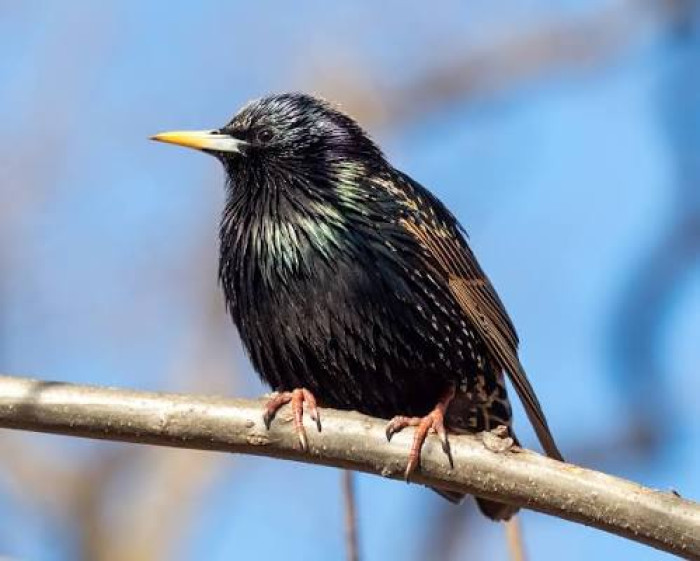
12. European starling
European Starlings can look black from a distance, but fresh winter plumage is speckled and breeding birds show strong green-purple iridescence. Their short tails, pointed bills, and fast direct flight give them a compact profile.
13. Lark bunting
Breeding male Lark Buntings are largely black with a bold white patch on each wing. Females and nonbreeding birds are brown and streaked. The thick seed-eating bill and open grassland habitat are useful field marks.

14. Phainopepla
Male Phainopeplas are silky black birds with pointed crests, long tails, and red eyes. Large white wing patches flash in flight but stay mostly hidden when perched. Their slim body and desert or scrub habitat are distinctive.

Then the group-feeding behavior showed up, and the birds that used to look identical suddenly acted like they belonged to different species.
If you want more practical field cues like bills, tails, and feeder habits, see how to identify common backyard birds in the United States.
When the bird perched with shaggy throat feathers and stayed mostly alone or in pairs, the “common raven” label finally stopped feeling like a guess.
Black birds with white or bright markings
List:
15. Black-and-white warbler
Black-and-white Warblers are covered in narrow black and white stripes and creep along trunks and branches in a nuthatch-like way. Their tiny size and bark-foraging behavior separate them from larger monochrome birds.

16. Black-necked stilt
Black-necked Stilts have dark upperparts, white underparts, extremely long pink legs, and a thin straight bill. The leg length and wetland habitat make them easy to identify even when the bird is only a distant black-and-white shape.

17. Willie wagtail
Willie Wagtails are small Australian birds with dark upperparts, a white belly and eyebrow, and a long tail that is frequently fanned. Their restless tail movements are often more useful than plumage at a distance.

18. White-rumped shama
Male White-rumped Shamas are glossy dark above with a chestnut belly, plus a bright white rump and long white-edged tail. The long tail is central to the identification. Pupperish has a full White-rumped Shama profile.

19. Black-throated bushtit
Black-throated Bushtits have a dark mask and throat against a much paler face and body, with additional gray and warm tones. The strong head pattern dominates a quick view. Pupperish has covered the Black-throated Bushtit in detail.

20. Dracula parrot
The Dracula Parrot, or Pesquet’s Parrot, is mostly black with vivid red panels on the belly and wings. Its bare dark face and heavy hooked bill create an unusually severe profile. Pupperish’s Dracula Parrot feature shows how strongly black dominates the overall impression.

The real twist came when wing-tip white patches appeared from below during a long soar, and it clicked that black vulture was in the mix too.
Why black birds can look blue, purple, or brown
Iridescence changes with angle.
Behavior can be just as useful. Pupperish has examples of crows repeatedly targeting a neighbor after a negative interaction, showing why corvid behavior can help distinguish them from more routine flocking birds.
If white is the main body color, move to white birds. Warm rusty plumage belongs in orange birds, while muted females and juveniles are often easier to compare under the brown-bird guide that solves the “little brown bird” ID confusion.
Share this article: