
20 Orange Birds: Orioles, Thrushes, Hummingbirds, and More

It started the same way it always does, with one bright orange flash in the yard and a brain that immediately went, “Okay, but which bird is that?” Orioles, thrushes, hummingbirds, and a bunch of other unrelated species all pull the same warm color trick, so one look is never enough.
Now picture a weekend bird-watcher standing under a canopy tree, squinting at a moving orange streak while the light changes every minute. The bird might be a male with crisp black-and-orange contrast, or it might be a duller female or nonbreeding bird, and suddenly the “easy” ID turns into a checklist. Head, throat, breast, belly, shoulders, tail, bill shape, wing bars, facial masks, eye lines, tail flashes, and then the big one, where you are and what season it is.
Once you learn where the orange sits, the whole mystery starts to click.
How to identify orange birds
Audubon’s guide to orange birds in the United States shows how many unrelated families use the same warm color. The Cornell Lab’s Baltimore Oriole identification guide is a good model for combining plumage with size, bill shape, behavior, and range.
- Check where the orange sits: head, throat, breast, belly, shoulders, or tail.
- Compare bill shape before comparing subtle shades of orange and red.
- Watch for wing bars, facial masks, eye lines, and tail flashes.
- Use location and season because females and nonbreeding birds may look much duller.
Orange orioles and similar canopy birds
List:
1. Baltimore oriole
Adult male Baltimore Orioles have brilliant orange shoulders and underparts, a black head and back, and pale wing bars. Females and young males are yellower and less sharply divided.
The pointed bill and canopy-feeding behavior help confirm the identification.

2. Bullock's oriole
Male Bullock’s Orioles show orange across the face, breast, and belly with a dark crown, eye line, throat, and wings. A large pale wing patch is prominent. Their western range is another useful clue when comparing them with Baltimore Orioles.

3. Hooded oriole
Male Hooded Orioles range from yellow-orange to deep orange on the head and body, with darker wings and facial markings. Their bills are long and slightly curved. In the southwestern United States they often nest in palms and other tall ornamental trees.

4. Altamira oriole
Altamira Orioles are large, long-tailed orioles with rich orange heads and bodies plus dark wings and upperparts. In the United States they are mainly associated with far southern Texas. Their size is immediately noticeable beside smaller orioles.

5. Spot-breasted oriole
Spot-breasted Orioles have bright orange underparts and faces, with a dark back, bib, wings, and spotting along the breast. They are native to Central America but established populations occur in parts of Florida, making location essential.

That’s when the “orange birds” label stops being helpful and you start sorting by where the orange lands, head versus shoulders versus tail.
Orange birds in North American woods and backyards
List:
6. Blackburnian warbler
Male Blackburnian Warblers have an intense orange throat and face set against a dark-and-white head pattern. The rest of the body is much paler. They often forage high in trees, so the fiery throat may be the first field mark visible from below.

7. Black-headed grosbeak
Adult males have warm orange-cinnamon underparts, a dark head, and patterned wings. Their large pale bill is the decisive clue. Females are browner and more streaked, which means the same species can look far less orange outside an adult male view.

8. Spotted towhee
Male Spotted Towhees have rusty-orange flanks beneath dark upperparts marked with white spots. They spend much of their time on or near the ground, scratching through leaf litter. The orange is confined to the sides rather than filling the whole breast.

9. Brambling
Breeding male Bramblings combine orange across the breast and shoulders with a darker head and patterned wings. Winter plumage is softer because pale feather edges cover much of the darker coloring. Flocking with other finches is common outside the breeding season.

10. Varied thrush
Varied Thrushes have a warm orange eyebrow, throat, breast, and wing markings against slate-gray upperparts. A dark band crosses the chest. The larger thrush body and upright forest posture separate them from orioles and small warblers.

11. Rufous hummingbird
Adult male Rufous Hummingbirds can look copper-orange across much of the body, with a glowing throat that changes with viewing angle. Their tiny size and direct hovering style remove most confusion. Pupperish explains why a hummingbird can fly backward while feeding and maneuvering around flowers.

12. Eastern bluebird
Male Eastern Bluebirds are blue above with a warm rusty-orange breast and white lower belly. The combination is distinctive in open country and around nest boxes. Females are duller, but they keep the same basic blue-and-rust arrangement.
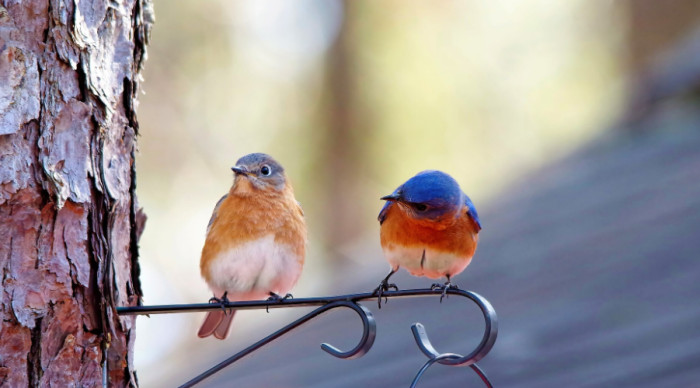
13. Western bluebird
Male Western Bluebirds have blue across the head, wings, and back with orange on the chest and flanks. Their throat is often blue rather than rusty, helping separate them from Eastern Bluebirds where ranges approach each other.

If the bird you saw had a black head and back with pale wing bars, you’re basically staring down a Baltimore oriole in real time.
Orange birds not your only tricky color, just like red birds with red heads and bright chests that cause ID mix-ups.
But if the orange was across the face and belly with a darker crown and a big pale wing patch, the Bullock’s oriole comparison becomes impossible to ignore.
Orange birds from other parts of the world
List:
14. Flame bowerbird
Adult male Flame Bowerbirds are saturated orange-red across the head and body with much darker wings and tail. Courtship brings the color into motion through rapid poses and displays. Pupperish shows the full effect in the Flame Bowerbird dance.

15. Venezuelan troupial
The Venezuelan Troupial has a bright orange body, dark head and upper chest, pale wing stripe, and blue bare skin around the eyes. Strong blocks of color make the adult easy to recognize once range is considered.

16. Orange-headed thrush
Orange-headed Thrushes have a rich orange head and underparts with darker or olive-toned wings depending on the population. Their shape is unmistakably thrush-like, with a rounded body, medium bill, and ground-feeding habits in wooded habitats.

17. Flame-colored tanager
Male Flame-colored Tanagers range from orange to red-orange across the head and underparts, with darker wings. Females are yellow-green. In the southern edge of their North American range, the combination of a heavy tanager bill and warm body color is useful.

18. Orange-bellied parrot
The Orange-bellied Parrot is mostly green, but adults carry a distinct orange patch low on the belly along with blue on the forehead and wings. The orange area is small, yet unusually precise, making it a strong field mark on this Australian parrot.

19. Orange-breasted sunbird
Male Orange-breasted Sunbirds combine bright orange-yellow underparts with iridescent green and blue around the head and upper breast. Their slender curved bills fit a nectar-feeding lifestyle. Females are much duller and more olive-toned.

20. Orange-breasted bushshrike
Orange-breasted Bushshrikes have rich orange across the breast and belly, with green upperparts and yellow on the face and throat. They often remain inside dense vegetation, where the bright underparts may be easier to notice than the whole body shape.

And if you’re in far southern Texas, or you spot a long-tailed, rich orange bird next to smaller orioles, your brain will start jumping straight to the Altamira oriole.
When orange starts looking red or yellow
Color names shift with light. The Indian Golden Oriole is genuinely yellow but can look warmer in photographs, while the Flame-throated Bulbul mixes warm red and yellow in ways that can push an observer toward an orange search. Even the Golden Pheasant can contribute to the confusion because several saturated colors sit next to one another.
For very small species, compare proportions with Pupperish’s Bee Hummingbird profile rather than relying on color alone. Birds where crimson dominates belong in red birds. Dark birds where black is the main impression now have their own black birds guide, while rose and salmon shades are covered under pink birds.
The next time that orange flash hits, you won’t just guess, you’ll know exactly where to look.
Still mixing up lookalikes, check the brown-bird guide that tackles backyard confusion.
Share this article:





