20 Common Backyard Birds in the United States and How to Identify Them

A 28-year-old woman thought her backyard bird problem was simple, just a few pretty visitors at the feeder. Then she noticed the same “mystery bird” showing up in different outfits, a red flash one day, a duller look the next, and suddenly she was guessing like it was a game show with no host.
Her yard is the kind where everything gets complicated fast, cardinals and blue jays hitting the same spots, finches bouncing in groups, and hummingbirds turning the birdbath into a tiny, chaotic stage. Add in the fact that some species are year-round only in certain places, and the usual “looks like this” comparison starts slipping the second you move a few miles.
By the time she compared size, color patterns, behavior, and habitat, she realized the backyard guide was basically a map to what she was actually seeing.
How to identify birds in your backyard
The American Bird Conservancy backyard bird guide separates nationwide species from eastern and western regulars. That regional split matters because a chickadee, hummingbird, or jay common in one area may be absent in another.
Cornell’s guide to an unfamiliar yard bird recommends four visual clues: size and shape, color pattern, behavior, and habitat. See its yard bird identification method. A photograph helps, but posture and movement often decide the match.
Pupperish has also collected close feeder views in a hidden-camera backyard bird gallery and a separate backyard bird photo booth.
Colorful backyard birds
List:
1. Northern cardinal
Males are red with a black mask, pointed crest, and thick orange-red bill. Females are tan with red accents. The bird stays in many regions throughout the year and belongs to a broader guide to types of cardinals.

2. Blue jay
A blue crest, black neck band, white face, and barred wings identify the Blue Jay. It moves boldly through yards and often announces itself with harsh calls. The large body and crest rule out bluebirds.

3. American goldfinch
Breeding males are bright yellow with a black forehead and black wings. Females and winter birds are duller olive-brown. The small conical bill and bouncing flight remain useful after the yellow fades.

4. House finch
Males usually have red on the face and chest over a brown streaked body. Females are entirely brown and streaky. Groups gather at seed feeders and around buildings. A similar small cage bird may be one of the types of canaries, but wild setting, streaking, and voice separate them.

5. Ruby-throated hummingbird
Males show a red throat above a pale belly and green back. Females lack the red. The tiny size, hovering flight, and needle-like bill are decisive. Dense groups can turn a birdbath into the kind of scene shown in Pupperish’s hummingbird pool party.

Her first clue came from the feeder, when the cardinals showed up with that black-masked face and she finally stopped calling everything “just a red bird.”
Small black, white, gray, and brown feeder birds
List:
6. Black-capped chickadee
A black cap and throat frame white cheeks. The body is gray with buff sides. These birds take one seed at a time and often carry it away to open elsewhere.

7. Carolina chickadee
The pattern closely resembles a Black-capped Chickadee, but the Carolina species is smaller, grayer, and centered farther south. Range and voice are more reliable than trying to judge tiny plumage differences.

8. Tufted titmouse
A gray crest, white face, black forehead patch, and peach-colored sides identify this eastern bird. It is larger and longer-bodied than a chickadee and often joins mixed flocks.

9. White-breasted nuthatch
This bird has a white face and underparts, dark crown, and blue-gray back. It commonly walks headfirst down tree trunks. That downward movement separates it from woodpeckers and creepers.

10. Song sparrow
Heavy brown streaks cover a pale chest and often converge into a central spot. Face stripes are strong. Regional variation is wide, so song and habitat support the visual match.

11. House sparrow
Males have a gray crown, chestnut nape, black bib, and pale cheeks. Females are sandy brown with a pale eyebrow. Both have thick bills and a compact body. The female belongs to the identification problem covered in Pupperish’s guide to brown birds.

12. Dark-eyed junco
Most juncos look dark above and pale below, with a small pink bill and white outer tail feathers. Plumage varies by region. Many appear in yards mainly during the colder months.

Then the blue jay barged in with its crest and harsh calls, and it was obvious why people mix it up with smaller look-alikes.
Want stranger color patterns than your yard jay or chickadee, check these tropical birds, from macaws to toucans.
After that, the goldfinch and house finch started confusing her back-to-back, bright yellow one day and brown streaks the next, right at the same seed pile.
Larger birds on lawns, fences, and rooftops
List:
13. American robin
A gray-brown back, orange breast, yellow bill, and white eye arcs identify the American Robin. It spends much of its time on lawns, pausing with a tilted head before pulling worms or insects from the ground.

14. Mourning dove
Soft gray-brown plumage, black wing spots, a small head, and long pointed tail create a delicate shape. The wings whistle during takeoff. Pairs and small groups feed on open ground.

15. Northern mockingbird
The body is pale gray with darker wings and tail. Large white wing patches flash in flight. The bird often perches on exposed rooftops and fences while repeating long sequences of borrowed sounds.

16. European starling
Adults are glossy dark birds with a short tail and pointed yellow bill in breeding condition. Pale spots cover the plumage in winter. Flocks move in tight groups and probe lawns with an upright stance.

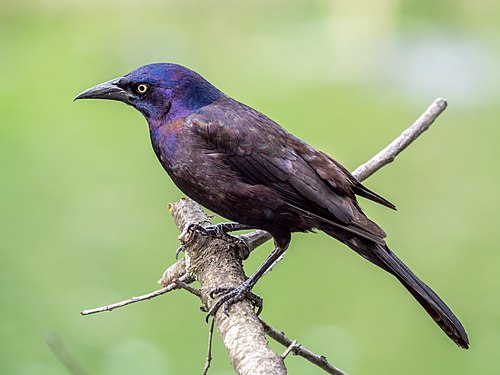
17. Common grackle
A long keel-shaped tail, pale eye, and iridescent blue-purple head identify adult males. They are larger and longer than starlings. Several may dominate a feeder simply through size and confidence.
And once the ruby-throated hummingbirds started hovering over the birdbath like they owned the place, she had to match posture and movement, not just color.
Woodpeckers and wrens near homes
List:
18. Downy woodpecker
Black wings with white spots, a white back stripe, and a short bill identify the smallest familiar North American woodpecker. Males have a small red patch behind the head. It clings vertically and braces with the tail.

19. Red-bellied woodpecker
Black-and-white bars cover the back, while males have red from the forehead to the nape. The pale belly carries only a faint reddish wash. The name is less helpful than the striped back and red head.

20. Carolina wren
Warm reddish-brown upperparts, a bold white eyebrow, curved bill, and raised tail identify this small bird. Its voice is far larger than its body. Dense shrubs, brush piles, and porch corners provide cover.

Birds that visit yards but do not fit the feeder list
Suburban ponds can attract egrets, geese, swans, and pelicans that belong in a guide to big white birds. Seasonal finches can also appear unexpectedly. Pupperish’s profile of the Purple Finch in backyard habitats shows why a regional or winter visitor should be checked against the resident House Finch rather than treated as the same bird.
- Record size against a familiar object before the bird flies.
- Note whether it feeds on the ground, trunk, flower, or hanging feeder.
- Listen for repeated calls and song patterns.
- Check season and region before accepting a photo match.
A yard list becomes useful when it records more than names. Date, weather, food source, flock size, and behavior reveal which birds are residents, migrants, occasional visitors, or one-time surprises.
She might have started with “pretty birds,” but she ended up with a backyard lineup she can actually name.
Still unsure which cardinal you spotted, compare bill shape, crest, and color placement in these 8 types of cardinals.
Share this article: