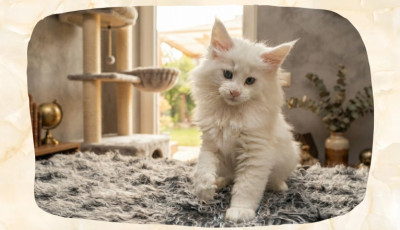
Maine Coon Size Comparison: Normal Cats, Dogs, and More

It all starts with a simple, harmless photo swap: someone posts a “normal cat” next to a Maine Coon, and suddenly everyone is arguing about what “big” even means. Not because the Maine Coon is just fluffy, but because the comparison changes depending on how the cat is posed, how long its body looks on camera, and whether you’re judging weight or length.
In this little drama, you’ve got the average mixed-breed house cat doing its best to stay anonymous, and then you’ve got a Maine Coon showing off that longer rectangular body, heavier bone, broader chest, and tail that looks like it has its own zip code. Add in the “tiny cats” crowd, where compact adults make the range inside domestic cats feel wild, and things get complicated fast.
By the time the gallery hits and the scale numbers get thrown around, the real question becomes: are you comparing cats, or comparing angles?
Maine Coon vs normal cat size
The average domestic cat is not one standardized size because mixed-breed house cats vary widely. Still, Maine Coons tend to stand out for three reasons:
longer rectangular bodies
heavier bone and broader chests
longer tails and fuller coats
The contrast is often most obvious when both cats are lying down. A stretched Maine Coon may occupy far more length even when the two cats do not look dramatically different while sitting upright.
Pupperish’s gallery of tiny cats shows the opposite end of the visual spectrum. Place one of those compact adults beside a mature Maine Coon and the range within domestic cats becomes obvious.
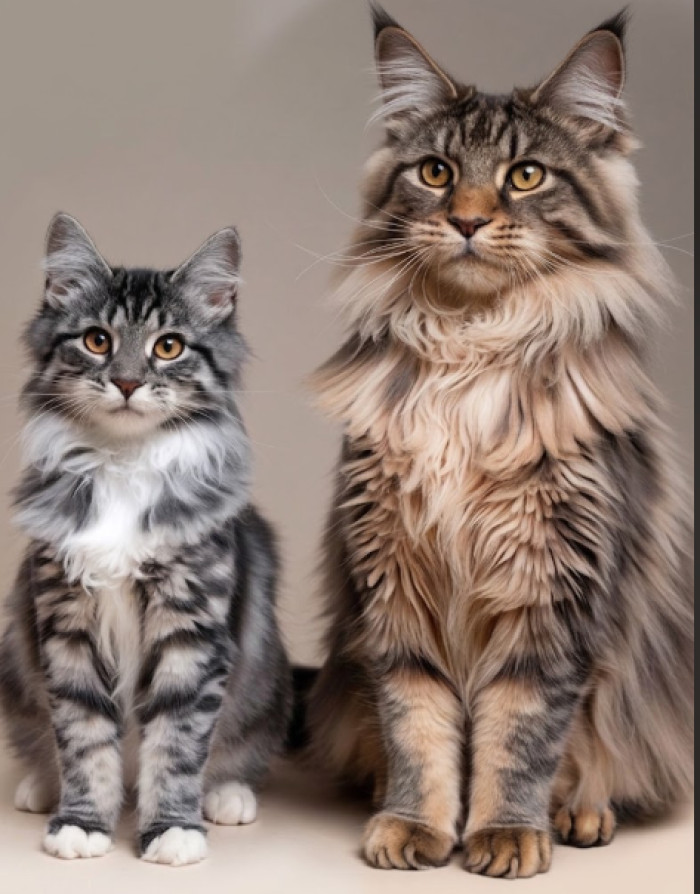
That’s when the “lying down” photos become the whole plot twist, because a stretched Maine Coon can look way longer even if the sitting versions seem close.
Maine Coon weight vs normal cat weight
TICA’s current adult male range of 18 to 22 pounds puts many males comfortably above the weight of a typical smaller house cat. Its 12-to-15-pound female range can overlap more with larger domestic cats.
But weight can mislead.
A compact overweight cat may weigh as much as a long, lean Maine Coon. The Maine Coon can still look much larger because the weight is distributed across a longer frame.
That is why a photo comparison should ideally show body length and height as well as the number on the scale.
Maine Coon vs dog size
This comparison depends almost entirely on the dog.
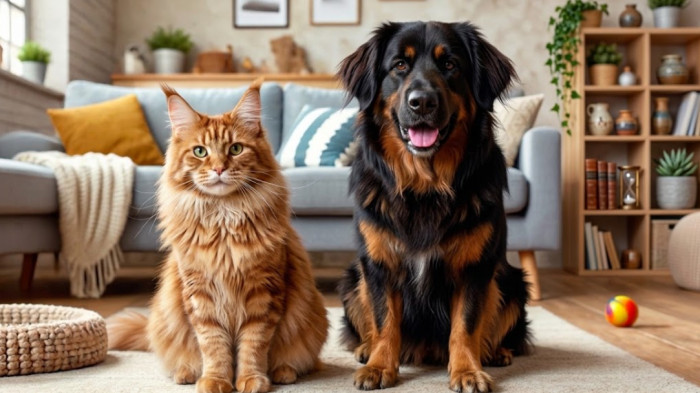
Maine Coons can overlap in weight with many toy and small dog breeds. A substantial male may outweigh some Chihuahuas, Yorkshire Terriers, Pomeranians, or small mixed-breed dogs. Beside a Labrador or German Shepherd, of course, the Maine Coon is still clearly the smaller animal.
The interesting part is shape.
For a breed-to-breed feline comparison, the Norwegian Forest Cat vs Maine Coon question is more useful than comparing a Maine Coon with an undefined “normal cat,” because both breeds are large, longhaired cats with very different proportions.
A long Maine Coon stretched from nose to tail tip can create a surprisingly dog-like amount of length. CFA even notes that Maine Coons are larger than many small dogs, while emphasizing that the breed’s coat and body structure contribute strongly to the effect.
Pupperish’s collection of giant dog breeds gives useful perspective. Maine Coons are large cats, not canine giants.
Maine Coon vs human size
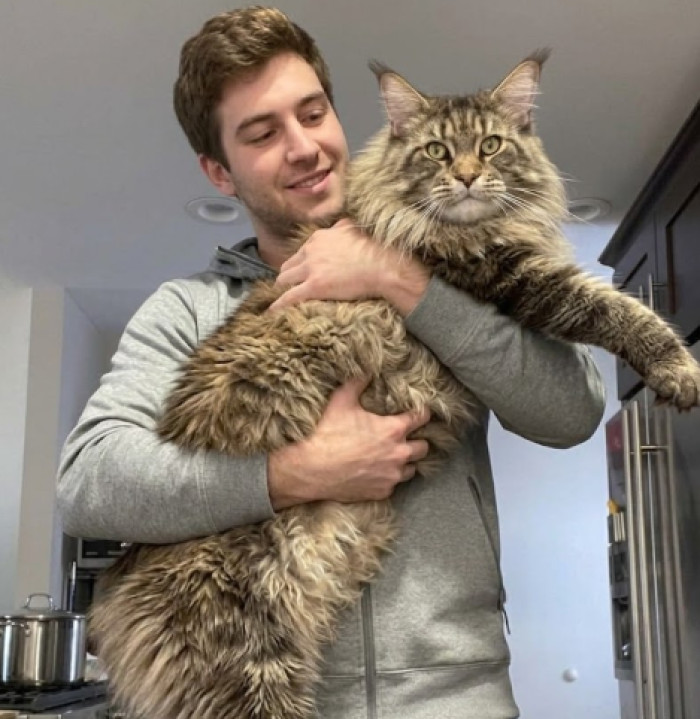
Photos of adults holding Maine Coons are popular because the human body provides an immediate scale reference.
A mature Maine Coon held under the front legs can stretch a long way down a person’s torso. The tail may extend even farther. Yet holding photos also exaggerate size if the cat is pushed toward the camera.
For a fairer comparison, look for images where the person and cat are on the same plane.
Pupperish’s existing Maine Coon photo collection is useful here because multiple images reveal more about real proportions than one carefully staged viral shot.
Then the argument shifts from length to weight, because a 12-to-15-pound female Maine Coon can overlap with some larger domestic cats while still looking bigger in frame.
And if you want the real numbers, Maine Coon weight by age and sex breaks down the healthy ranges.
Why Maine Coon length matters so much
The Governing Council of the Cat Fancy describes a long rectangular body and requires the tail to be at least the length of the back. That combination produces an animal whose nose-to-tail-tip measurement can feel much more dramatic than its standing height.
This is why “How long is a Maine Coon?” and “How heavy is a Maine Coon?” produce different impressions.
A 16-pound Maine Coon can be astonishingly long.
A 16-pound compact cat may simply look stocky.
Next comes the dog showdown, where a Maine Coon can overlap with toy and small breeds, but beside a Labrador or German Shepherd it’s the smaller animal every time.
Coat creates another layer of apparent size
Maine Coon fur is shorter over some parts of the back and shoulders and fuller around the ruff, belly, hindquarters, and tail. In a full winter coat, that extra volume can blur the body’s real outline.
The effect is similar to visual tricks in other animals. Pupperish’s playful feature on photoshopped giant cats takes the idea to an absurd extreme, but real Maine Coon photographs can also distort scale through fur and perspective.
Look at the legs and torso underneath the coat if you want a fair comparison.
Maine Coon vs large rabbit
This sounds like an odd comparison until you see some giant rabbit breeds.
A large rabbit can approach or exceed the weight of a smaller Maine Coon, though the body proportions are completely different. Pupperish once covered a rabbit large enough to work around a no-dogs housing rule, which is a useful example of why species labels do not always predict visual size well.
Again, context wins.
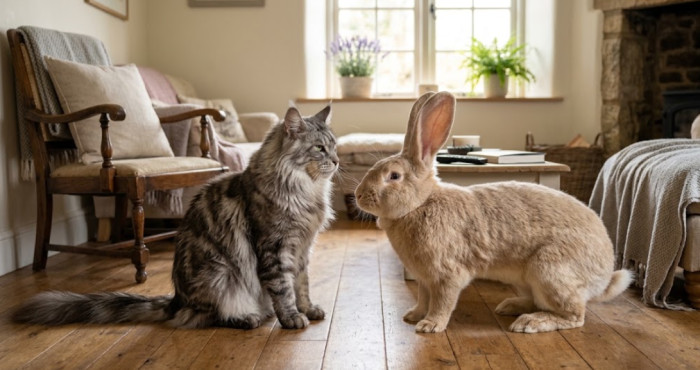
And right as everyone thinks they’ve got it figured out, the Norwegian Forest Cat comparison drags the whole thing into “breed-to-breed proportions” territory, not “normal cat” chaos.
What makes a good Maine Coon size comparison photo?
The most useful images have:
both subjects at the same distance from the camera
no wide-angle distortion
the full body visible
a familiar object or person for scale
similar posture between animals when possible
A Maine Coon sitting upright beside a curled-up house cat can make the difference look larger than it is. Two standing cats photographed from the side tell you much more.
The practical size comparison
Maine Coons are genuinely big domestic cats. Mature males often outweigh smaller house cats and can overlap with small dogs. Their long bodies, large feet, substantial bone, full coats, and enormous tails then magnify the effect.
They are not dog-sized in the sense of medium or large dogs. They are not all record breakers either.
They are simply built on a bigger feline frame.
That is enough to make an ordinary adult Maine Coon look extraordinary when a normal cat walks into the same photo.
The photo that started as a size check ends with everyone side-eyeing the pose, the scale, and the whole “normal” label.
Before you guess every Maine Coon is “giant,” read how big Maine Coons actually get.
Share this article: