White Maine Coon: Coat Color, Eye Colors, and What Makes Them Stand Out

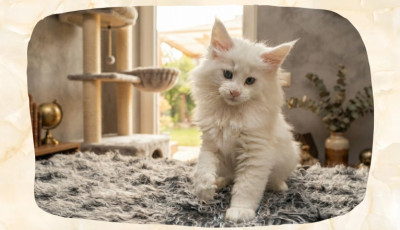
A white Maine Coon can look like it’s wearing moonlight, especially when the eyes are icy blue or mismatched. People don’t just notice them, they stare, because that coat color plus those eye shades turn a regular cat into a full-on spectacle.
The tricky part is that “white” is not one simple label. Registries break it down by eye color, so a blue-eyed white Maine Coon gets treated differently on paper than a gold-eyed, green-eyed, copper-eyed, or odd-eyed one, and that can change what people expect to see at home.
And then there’s the deafness rumor, which is real for some white cats but not a guarantee for every single one, making the whole thing feel weirdly personal the moment you bring one into the mix.
Are white Maine Coons recognized by cat registries?
Yes. The Cat Fanciers’ Association recognizes white as a solid Maine Coon color. Its color listings also distinguish white Maine Coons by eye color, including blue-eyed, gold-eyed, green-eyed, copper-eyed, and odd-eyed classifications.
That last detail matters because eye color is one of the first things people notice on a white cat.
A white Maine Coon with blue eyes can look almost unreal. An odd-eyed cat, with two different eye colors, gets even more attention.
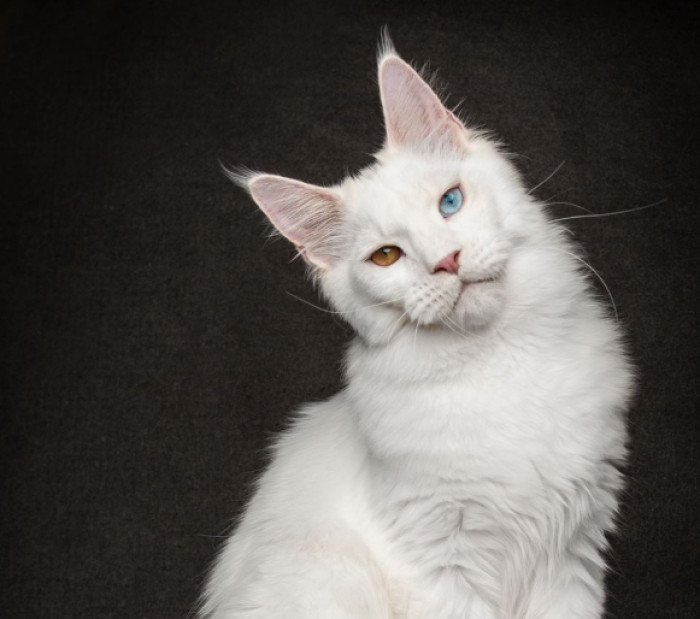
The moment someone spots a blue-eyed white Maine Coon, they usually assume the story ends there, but the registry details keep getting more specific.
What eye colors can white Maine Coons have?
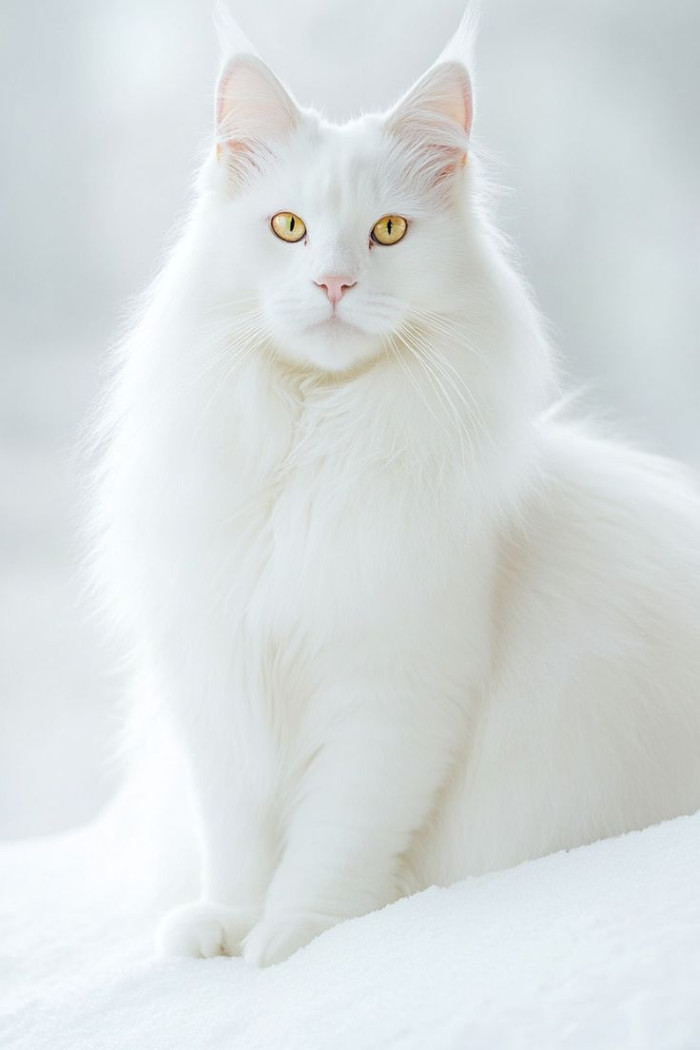
White Maine Coons can have several accepted eye colors. Blue is possible, but it is not the only option. Gold, green, copper-toned, and odd-eyed combinations also occur depending on the registry.
Do not confuse a white Maine Coon with a colorpoint cat. Maine Coon breed standards generally do not accept the pointed pattern associated with breeds such as Siamese or Ragdoll.
The CFA color prefix chart lists separate Maine Coon codes for blue-eyed white, gold-eyed white, odd-eyed white, green-eyed white, and other white-eye combinations.
That makes white one of the easiest colors to describe visually and one of the more detailed ones on paper.
Are white Maine Coons deaf?
Not automatically.
White cats, especially some blue-eyed white cats, have a known association with congenital deafness. That does not mean every white Maine Coon is deaf, or that every blue-eyed white Maine Coon will have hearing loss.
This is one place where a visual trait can have a real biological connection, but the connection is probabilistic rather than absolute.
If hearing is a concern, a veterinarian can assess it. Responsible breeders may also use hearing testing in white breeding cats and kittens.
Pupperish has covered cats with sensory differences before, including a hearing-impaired cat who became a cycling companion. A hearing difference does not prevent a cat from having a full, active life, but owners should know what they are dealing with.
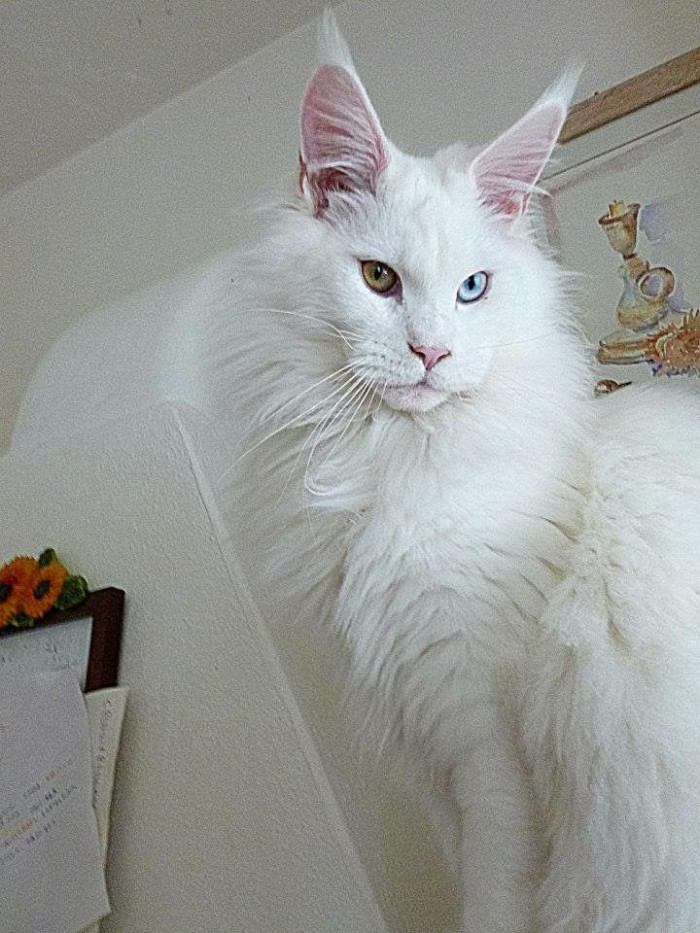
That’s where the odd-eyed white classification steals the spotlight, because two eye colors can make the cat feel unreal in a way “solid white” alone never could.
White Maine Coon vs albino Maine Coon
White and albino are not the same thing.
A dominant white gene can mask other coat colors. Albinism involves a different genetic pathway affecting pigment production.
Most white Maine Coons are not albino.
That distinction is important because online photo captions often use “albino” simply to mean “very white.” Biology is more specific.
And “gray” can be a misread, just like the way “blue” can show up as slate-gray across coat patterns in this breakdown of why “gray” can mean blue, silver, or smoke.
Do white Maine Coons get dirty easily?
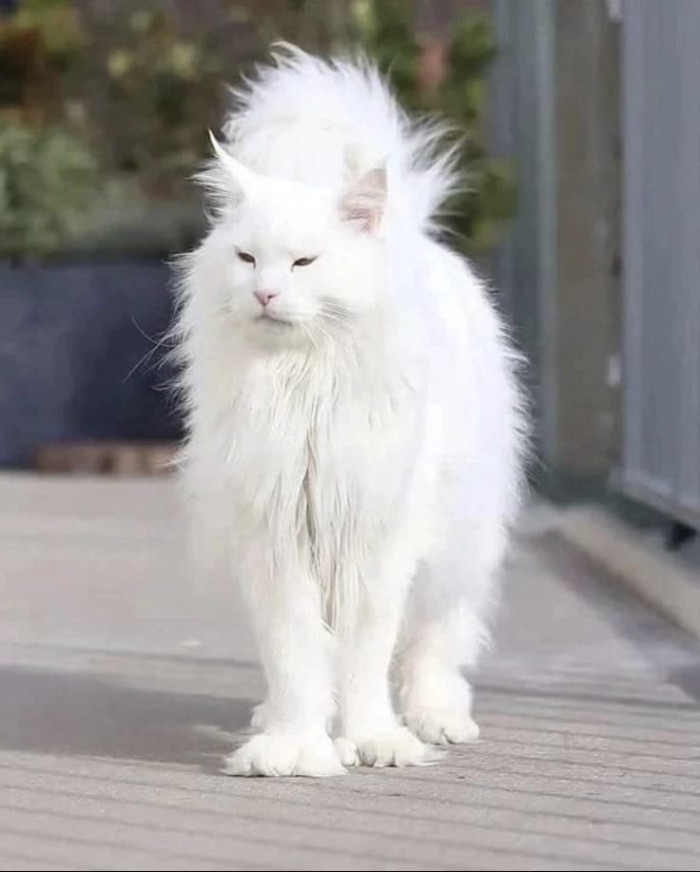
They can show dirt more clearly than dark-coated cats, particularly around the paws, chin, and tail. The solution is not constant bathing.
Regular brushing removes loose fur and debris. Spot-cleaning can handle small stains. Full baths should be occasional and based on actual need, not coat color alone.
The Maine Coon coat is designed to be functional as well as decorative. Over-bathing can strip natural oils and create more grooming problems than it solves.
A white cat does not need to be showroom-white every hour of the day.
Meanwhile, the white-versus-colorpoint confusion shows up fast, since people mix up Maine Coon standards with the pointed pattern seen in Siamese and Ragdoll types.
Does white fur make a Maine Coon look bigger?
Visually, often yes.
White reflects light and can blur the boundaries between the ruff, body coat, and tail. On a breed known for a broad chest and long frame, that makes the outline feel even more substantial.
A dark cat can look compact because shadows hide the edges of the coat. White does the opposite.
Pupperish’s story about a black-and-white cat finding a new home shows how sharply white areas can define a cat’s shape when contrasted with darker fur. On a fully white Maine Coon, the effect becomes much softer.
Are white Maine Coons rare?
White is an accepted color, but it is less common than several traditional Maine Coon looks such as brown tabby. Reliable breed-wide percentages are difficult to find, though, so claims that white Maine Coons make up an exact tiny fraction of the population should be treated carefully unless the source provides registry data.
Availability also depends on local breeding lines.
A color can be uncommon near you and not globally exceptional.
And when the deafness question pops up, the talk about blue-eyed white cats gets people nervous, even though not every white Maine Coon ends up with hearing loss.
Does a white Maine Coon have a different personality?
No evidence supports a special white-Maine-Coon personality.
The breed is generally described as friendly and social, but individuals differ. Eye color and coat color do not tell you whether a cat will be cuddly, independent, talkative, or obsessed with sitting beside the faucet.
Pupperish’s story about a white cat saying goodbye at a gravesite is moving because of the individual animal’s behavior, not because white cats share a predictable temperament.
A white Maine Coon is visually unusual enough without adding personality mythology.
The useful things to know are simpler: white is a recognized coat color, several eye colors are possible, hearing deserves attention in some white cats, and the long pale coat can make an already large breed look enormous.
That bright white coat and those eye codes are only half the story, the rest is what you notice once the cat is actually in your life.
Want to see how “blue” shifts from slate-gray into white, tabby, smoke, and silver? Read this guide to what “blue” really means in cat color terms.
Share this article: