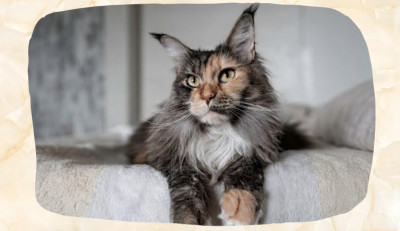
Maine Coon Paws: Why Are They So Big?

Some Maine Coon paws look like they belong to a tiny snowshoe athlete, all broad pads and fuzzy toe outlines that make the whole foot seem bigger than the cat itself. You notice it most when they’re lounging, stretching, or padding across the floor like they own the place.
It gets complicated fast because those “comically large” paws are a mix of real bone and breed structure, plus the coat doing extra work. In some winter coats, the long fur can blur the toe edges, and suddenly you’re staring at a paw that looks even wider than it actually is. Then there’s the extra tuft situation, where some cats have dramatic fur between the toes and others look almost tidy.
The next time you see those big, sturdy feet, you’ll be looking at more than cuteness, you’ll be seeing the whole Maine Coon build in miniature.
What do Maine Coon paws look like?
A typical Maine Coon paw looks broad and sturdy rather than delicate.
The toes may be partly hidden by long fur, especially in winter coat. Hair can grow between and around the pads, creating the impression of a larger foot even before the underlying bone is considered.
The Cat Fanciers’ Association places legs and feet directly in the breed standard and describes the cat as substantial and heavily built. That broader structure is why Maine Coon feet look proportionate on the adult even if they seem comically large on a kitten.
Pupperish has covered cats with genuinely unusual webbed-looking feet, which is a useful contrast. Maine Coon toe fur can blur the outline, but it does not turn the paw into a different anatomical structure.
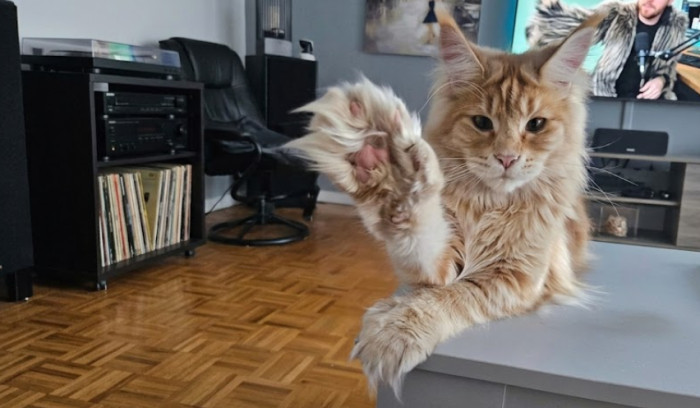
That’s why the “broad and sturdy” look shows up even more in winter, when the toes get partially hidden by fluffy fur.
Why are Maine Coon paws so large?
Partly because the whole cat is large, and a broad, heavily boned frame supported by sturdy legs naturally produces a larger foot than the neat compact paw seen on many shorthaired domestic cats, even before toe furnishings add extra visual width.
A heavily boned breed needs feet that support its frame. Large paws also fit the rugged look that breed standards preserve: broad chest, long body, substantial legs, and a thick weather-resistant coat.
There is also a popular historical explanation that wide, tufted paws helped ancestral Maine Coons move through snow. TICA mentions the idea in connection with polydactyl cats, describing the extra digits as something that may have functioned like natural snowshoes.
That is plausible as a functional story, but it should not be overstated as a precise evolutionary fact proven for every Maine Coon line.
Big feet. Lots of fur.
Do all Maine Coons have toe tufts?
Many do, and the feature is strongly associated with the breed’s semi-long coat.
The amount varies. Some cats have dramatic fur projecting between the toes, while others show a neater outline. Season, grooming, age, and individual coat texture all affect how noticeable the tufts look.
A kitten’s paw fur may also become more obvious as the adult coat develops.
That variability matters if you are trying to identify a cat. Toe tufts support a Maine Coon-like appearance, but they do not provide proof by themselves.
Pupperish’s article about why cats wrap their tails around their paws also shows how easily feet disappear under fur and posture in photographs. Seeing the full paw clearly can be harder than it sounds.
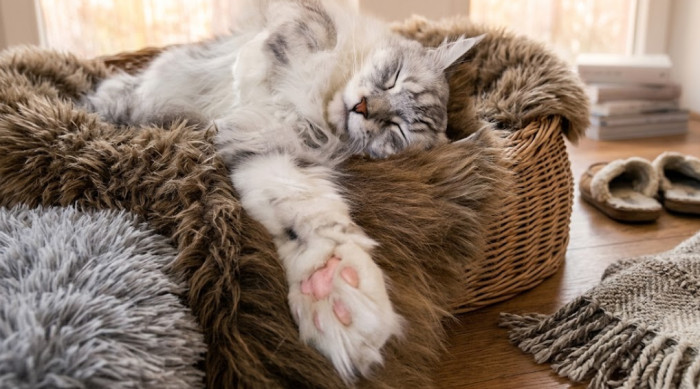
Then you remember the whole cat is built heavy and substantial, so the paws never look random, they look proportionate.
To really see why Maine Coon paws look massive, compare them to normal cats, small dogs, and a human in this Maine Coon size comparison.
What is a polydactyl Maine Coon?
A polydactyl cat is born with more toes than the usual number.
TICA recognizes Maine Coon Polydactyls and links the trait to the breed’s early history. The extra digits can make a paw look especially broad, almost mitten-like.
Polydactyly is genetic. It is not caused by a cat “growing extra toes” as it gets older, and it does not automatically mean the cat is a Maine Coon.
Many unrelated domestic cats are polydactyl too.
Pupperish has a gallery of cats with extra toes and prominent paw pads, which makes that point visually: the trait appears well beyond one breed.
Do big paws mean a Maine Coon kitten will be huge?
Not reliably.
Large paws can suggest a substantial frame, especially in a kitten from known Maine Coon parents, but there is no formula that converts paw width into adult weight.
Maine Coons also grow slowly. A kitten can look all feet and ears for months before its chest and body catch up. Another kitten may have less dramatic paws and still mature into a large adult.
Parental size, sex, pedigree, nutrition, and individual genetics are more useful together than one visual clue.
So yes, those giant kitten feet are suggestive.
No, they are not a prediction chart.
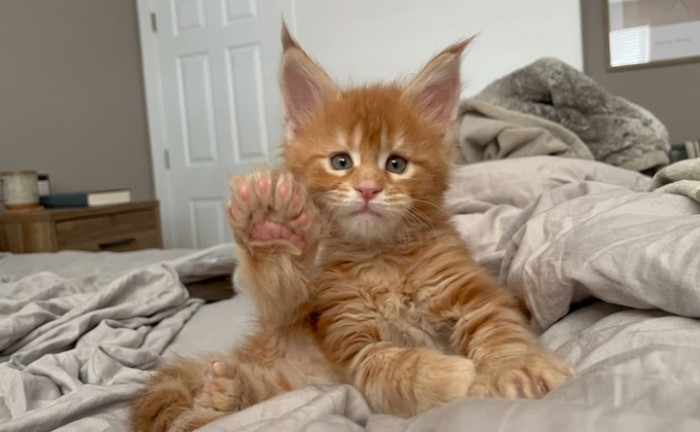
After that, the snowshoe story pops up in the background, especially with the idea of extra digits, but it’s not a guaranteed, universal Maine Coon origin.
Finally, the tuft level decides the visual effect, because season, grooming, age, and coat texture can make the toe fur go from subtle to dramatic.
Maine Coon paws vs normal cat paws
The main differences are usually scale and coat.
A shorthaired domestic cat often has a cleaner paw outline because there is less fur between the toes. A Maine Coon may have broader feet, heavier legs, and obvious tufts that make the paw appear even larger.
Size comparisons work best when the cats are standing on the same surface rather than being held at different distances from the camera.
Even then, variation is broad.
Can you identify a Maine Coon by its paws?
Not with confidence.
Paw size is one clue among many. A more convincing Maine Coon-like combination includes a long rectangular body, broad chest, square muzzle, large ears, shaggy coat, long tail, and substantial feet.
Documentation is stronger than appearance. A pedigree from a recognized registry establishes ancestry in a way that toe tufts never can.
That distinction matters because social media identification often turns one feature into a verdict. A fluffy shelter cat has large paws, therefore it must be a Maine Coon. That leap is too large.
Pupperish’s lighthearted cat paw-reading story is based on the same human impulse to read a lot into feet. For breed identification, use paws as evidence of type, not a DNA test in miniature.
Maine Coon paws deserve the attention anyway. They are broad, furry, sometimes extra-toed, and perfectly matched to a cat famous for taking up more space than expected.
Those giant Maine Coon paws are basically the cat’s whole “rugged build” showing off, one fuzzy step at a time.
Think “giant” means a separate breed? See how some Maine Coons top out as outliers, not rules, in this giant Maine Coon myth-buster.
Share this article: