
Maine Coon Weight: Average Weight by Age and Sex

Some Maine Coons look like they swallowed a small sofa, and then you check the numbers and they’re not even that heavy. That’s what makes this whole “Maine Coon weight” thing so messy, especially when you’re trying to compare your cat to some neat, internet-friendly range.
In this story, we’re bouncing between TICA’s adult averages for males and females, the Cat Fanciers’ Association idea that the breed is slow-maturing, and Pupperish’s archive of “wait, how is that cat so big?” moments. One dramatic frame can fool you, and two kittens from the same litter can grow at totally different speeds, so weight can feel like a moving target.
And if you’ve ever seen a tiny kitten go from 82 grams to a powerhouse cat, you already know the real answer is never one number.
Average Maine Coon weight for males and females
For a quick reference, TICA’s published adult averages are:
- Adult males: about 18 to 22 pounds
- Adult females: about 12 to 15 pounds
Some healthy individuals fall outside those ranges. A large-framed male may exceed 18 pounds while remaining lean, and a smaller female may be healthy below the average.
What matters is whether the weight fits the cat.
The Cat Fanciers’ Association describes the breed as slow-maturing and substantial rather than setting one ideal weight. That is sensible because muscle, bone, length, and fat distribution can produce very different-looking cats at the same number.
Pupperish’s story about an enormous-looking Maine Coon is a good example. A dramatic frame can make a cat look heavier than it actually is.
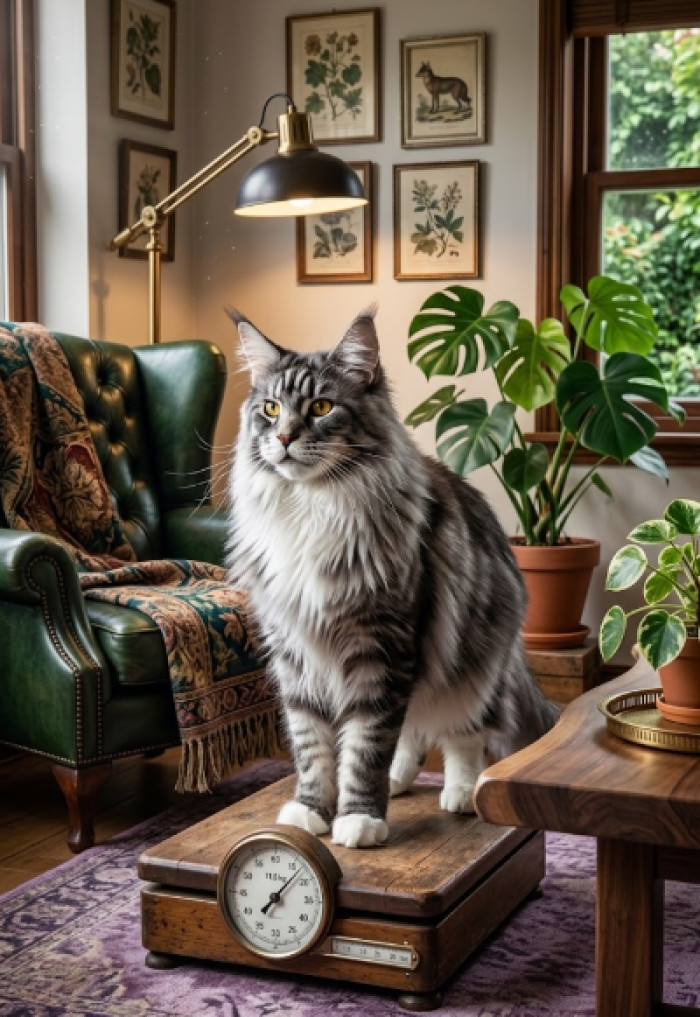
That whole “18 to 22 pounds for males, 12 to 15 for females” range starts looking less like a rule and more like a vibe once you remember Pupperish’s enormous-looking Maine Coon.</p>
Maine Coon weight by age is not a straight line
A growth chart can be useful, but it should not be treated like a deadline.
Maine Coons develop slowly. TICA says the breed may not reach full size until three to five years of age. Growth during that period is not perfectly linear. Kittens may shoot up in length, look lanky for a while, then fill out with more muscle and chest depth later.
Two kittens from the same litter can also grow at different rates.
That makes rigid month-by-month charts risky. If a chart says a six-month-old “should” weigh one exact number, it creates false precision. Sex, parental size, neuter status, diet, health, and individual genetics all matter.
A better use of a growth chart is to watch the cat’s own trend over time. Sudden loss, stalled growth, or rapid gain is more meaningful than missing an internet average by a pound.
The contrast can be dramatic in rescue stories. One tiny kitten in Pupperish’s archive was found weighing only 82 grams before growing into a much stronger cat. That is not a Maine Coon growth standard, but it shows why context matters whenever weight is discussed.
How much should a Maine Coon kitten weigh?
There is no reliable single answer without age, sex, and developmental context.
A breeder who knows the parents and litter history can often provide more useful expectations than a generic online table. Veterinarians can also plot weight against the kitten’s own previous measurements and assess body condition.
The trend matters most.
A kitten that is steadily gaining, active, eating normally, and developing proportionately may be doing well even if it sits outside a chart’s average. A kitten that suddenly stops gaining deserves attention regardless of whether today’s number still falls inside a broad published range.
Pupperish has documented very small kittens who later changed dramatically as they matured, another reason not to judge long-term adult size from one early weigh-in.
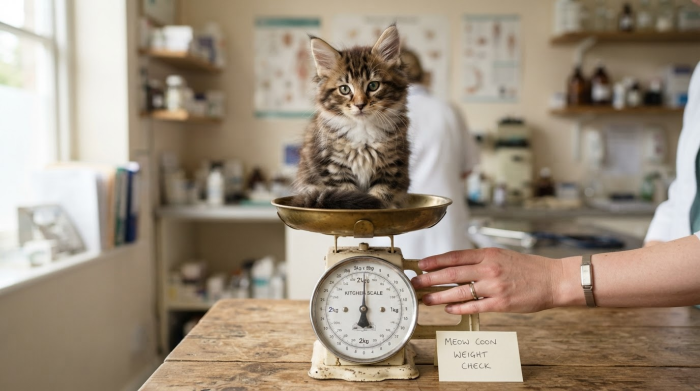
Then the story zooms in on how Maine Coons do not grow in a straight line, with lanky kitten phases that later fill out into muscle and chest depth.</p>
And if you’re thinking of a “bigger” look, remember calico Maine Coons are almost always female.
Why can two Maine Coons at the same weight look completely different?
Frame.
One 15-pound Maine Coon may be very long and lean. Another may be shorter, broader, and more heavily muscled. Coat fullness can then exaggerate the visual difference even further.
This is why comparing photographs is poor weight estimation. Fur hides the waist, changes the apparent width of the chest, and can make a slim cat look massive.
Even age changes the picture. A young adult may have reached much of its length while still lacking the heavier chest and mature coat that come later.
The same principle appears in Pupperish’s adult cats standing beside their miniature lookalikes: proportions can change how large an animal seems before the scale is ever involved.
Is a 20-pound Maine Coon overweight?
Not necessarily.
CFA specifically notes that mature males can reach or exceed 20 pounds. But that does not make 20 pounds an automatic healthy target either.
A veterinarian looks at body condition, not just breed and scale weight. A healthy large-framed cat should have appropriate muscle and a body shape that does not suggest excessive fat. A smaller-framed Maine Coon can be overweight at a number that would be perfectly reasonable for a larger male.
That is the key distinction.
“Large breed” should never become permission to ignore weight gain.
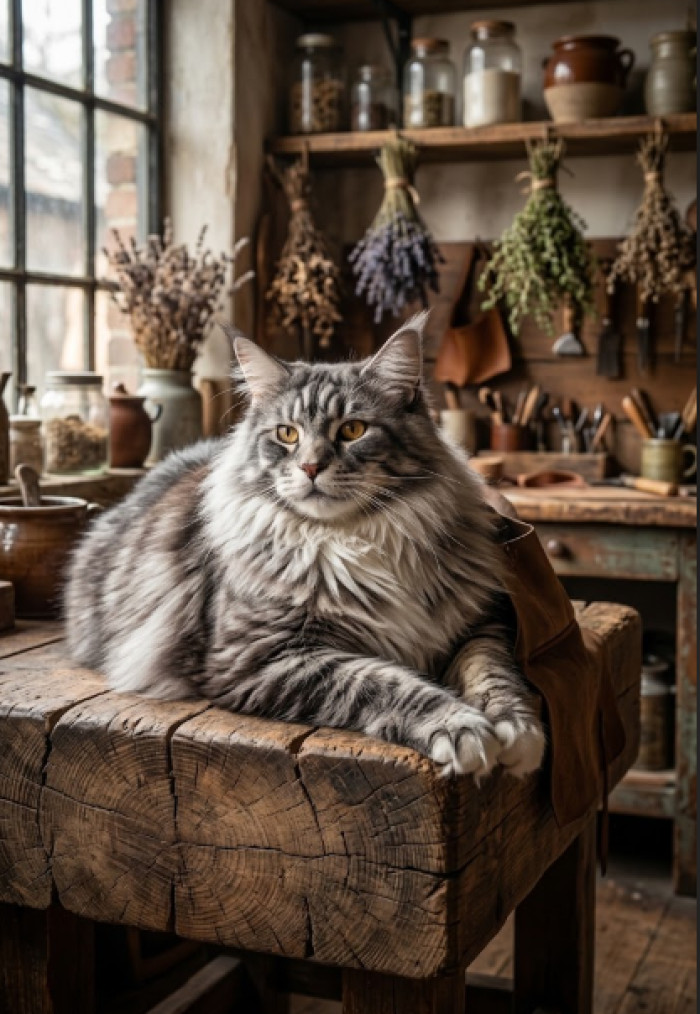
Before you get stuck on a month-by-month chart, the archive throws in the wild part, a kitten weighing only 82 grams that later became much stronger.</p>
So the real takeaway lands hard: without age, the “how much should a Maine Coon kitten weigh?” answer is basically impossible to pin down.</p>
Why forcing weight gain is a bad idea
There is no SEO-friendly shortcut around this one: deliberately overfeeding a Maine Coon to make it look bigger is a bad goal.
The breed already has substantial bone and muscle. Extra fat does not improve breed type, and it can make it harder to judge whether the cat’s real frame is developing normally.
A healthy Maine Coon should be allowed to mature at its own pace with balanced nutrition appropriate for its life stage. If growth or weight seems unusual, the right comparison is with the individual cat’s condition and veterinary history, not the heaviest Maine Coon on social media.
Some online photos make size look like a competition. It isn’t.
What should you track instead of one target number?
Track several things together:
- body weight over time
- body condition
- appetite and activity
- muscle development
- changes in length and chest depth
- any sudden gain or loss
That gives a much better picture than asking whether an adult “made it” to 18 or 20 pounds.
Pupperish’s archive includes another large Maine Coon whose size drew attention online, but individual outliers are best treated as interesting examples, not targets.
Average Maine Coon weight is useful for orientation. Healthy weight is personal. The best number is the one that fits the cat’s frame, age, sex, and body condition rather than the most impressive figure in a search result.
Your Maine Coon’s weight only makes sense when you zoom out to the cat, the timeline, and the weird little story that got them there.
Before you assume every Maine Coon is oversized, see how big Maine Coons really get.
Share this article:





