This Rare African Wild Cat Keeps Turning Up in Surprising Locations

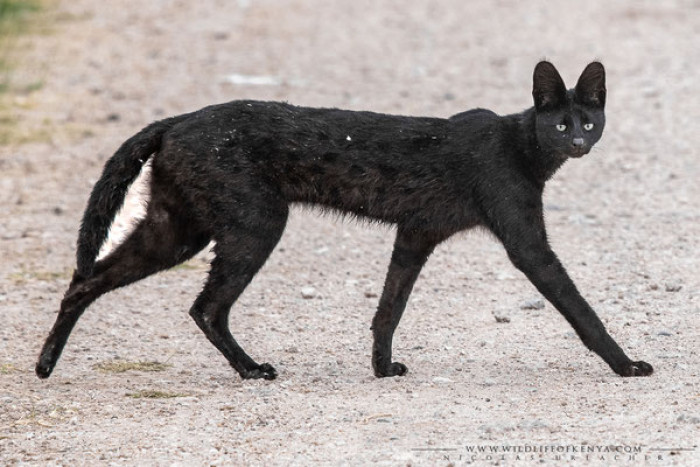
Black servals should be easy to spot, at least in theory. For years, these rare, jet-black cats were mostly linked to cool, high-altitude forests in places like Kenya’s mountain ranges and the Ethiopian Highlands, where their dark coats blend into shadowy woods.
Then the Tsavo Ecosystem surveys upended the whole story. Researchers kept recording black servals in Kenya’s open grasslands, a habitat that should not be ideal for a melanistic coat, and in some survey periods, nearly half of the servals spotted were black. That’s not just surprising, it’s the kind of pattern that makes you stare at the data and wonder what you missed.
Now the big question is whether these cats are truly adapting, or if the grasslands are just turning up more of them than anyone expected.
Black servals found thriving in Kenya’s open grasslands
For decades, black servals were mainly associated with cool, high-altitude forests in places such as Kenya's mountain ranges and the Ethiopian Highlands. Their dark coats seemed perfectly suited to shadowy woodland habitats, making the occasional sighting elsewhere all the more surprising.
Wildlife surveys in Kenya's Tsavo Ecosystem changed that picture. Researchers repeatedly recorded black servals living in open grasslands, a landscape where many expected the darker coat to be less effective. In some survey periods, nearly half of the servals observed carried the unusual black coloration, an unexpectedly high proportion that caught scientists' attention.

The whole thing starts looking less like a fluke the moment the Tsavo Ecosystem data keeps showing up, again and again, with black servals in the open where they supposedly should not fit.
No single explanation has solved the mystery. Some researchers believe black servals simply stand out more clearly in open landscapes, making them easier for observers to record than their spotted relatives. Others suggest it may be nothing more than a fortunate genetic coincidence concentrated within local populations.
And once the surveys reveal that nearly half the sightings in some periods are black, the “rare forest cat only” narrative starts to wobble.
Unexpected Locations Raise Questions
The black serval's surprising appearances challenge our understanding of habitat and adaptability. Researchers expected these rare cats, marked by their unique melanism, to stick to their known habitats, but their unexpected sightings are throwing a wrench in the established narrative of wildlife distribution.
This opens up a fascinating discussion about how changing environments, possibly due to human impact, could be influencing their behavior and survival. Are these cats venturing into new territories because they’re adapting to threats, or is it simply a matter of chance? The uncertainty makes this story all the more compelling, as it reflects broader themes of evolution and resilience in wildlife.
And if you’re curious about pattern power, these 12 spotted animals show how dots and rosettes help them survive.
Black servals may carry hidden survival advantages
Another possibility is that the dark coat offers hidden biological advantages beyond camouflage. Scientists have proposed that melanism could be linked to better temperature regulation, stronger resistance to certain diseases, or other traits that improve survival. If true, those advantages could help the genetic mutation spread naturally through future generations.
For now, the evidence remains incomplete. Black servals continue appearing in habitats that challenge long-standing assumptions, reminding researchers that even well-known animals can still produce unexpected discoveries. Every new sighting adds another piece to a puzzle that remains far from solved.
That’s when the mystery turns into a real head-scratcher, because the options range from black coats standing out in grasslands to a genetic quirk piling up locally.
The black serval proves that nature still holds plenty of unanswered questions. Its striking appearance is only the beginning of a much bigger scientific mystery involving genetics, evolution, and survival.
As researchers continue tracking these rare cats across different African landscapes, each encounter has the potential to reshape what is known about one of the continent's most successful predators.
Even the idea that melanism might offer an advantage hangs in the air, especially as human-caused change keeps reshaping where these cats can survive and roam.</p>
The Genetic Mystery Unfolds
The rise of black servals due to melanism adds a layer of intrigue to this story. While this genetic trait is rare, its sudden visibility raises questions about the role of genetics in survival and adaptation. Is this a sign of a shift in the serval population, or just a fascinating anomaly?
This situation also evokes mixed feelings within the conservation community. On one hand, these sightings could indicate a healthy genetic diversity, but on the other, they might point to environmental pressures that could undermine traditional serval populations. The tension between the celebration of this rare occurrence and the underlying implications for the species' future makes the story resonate deeply with readers.
What It Comes Down To
This story about the black serval serves as a reminder that nature is constantly evolving, and our understanding of it must adapt too. As we witness these rare cats in unexpected places, it raises essential questions about the impact of environmental change on wildlife. Are we prepared to embrace these shifts, or will they challenge our existing notions of conservation? What does this mean for the future of other species facing similar adaptations?
Somewhere in Tsavo’s grasslands, a black serval is quietly proving the rules might not be as fixed as we thought.
Those Tsavo sightings are wilder than the list of 12 black animals with the darkest coats.
Share this article: