12 Purple Animals That Prove Nature Uses the Rarest Colors

It starts with a color you almost never see in nature, and then it gets weird fast. Purple animals look like they’re cheating, like someone painted the ocean and forgot to tell the laws of light.
Why is purple so uncommon? Because it is not just a single “purple” dye sitting on a creature’s skin.
And once you notice that, the purple sea star on a rocky Pacific shore and the purple emperor butterfly in mid-flight stop being “pretty” and start being a whole story about how nature hides its rarest color in plain sight.
Why is purple so uncommon in animals?
Animal color comes from pigments, microscopic structures, or a combination of both. Purple is particularly difficult because few animals make a simple purple pigment. Instead, light may bounce off feathers, scales, or shells in a way that changes with angle.
That helps explain why some of the most convincing purple animals seem to shift toward blue or magenta as they move. The Natural History Museum’s guide to colorful creatures shows the same broader principle across many species: color is often doing a job, from courtship to warning and camouflage.
1. Purple sea star
Purple sea stars can range from deep violet to reddish purple, orange, or brown. On rocky Pacific shores, that color sits against kelp, stone, and dark water rather than a clean white background, so the animal can look far less conspicuous than it does in a close-up photo.
Seen in its normal habitat, the shade can read very differently from a close-up photo because background, distance, and light all change the contrast.

2. Purple emperor butterfly
The male purple emperor is famous for an iridescent sheen that appears only at certain angles. Move the butterfly or the light source, and the color can fade toward brown. That disappearing act is a classic sign of structural color rather than a flat purple pigment.
The useful detail is that the color is part of a whole body pattern, not an isolated patch of paint, so texture and neighboring markings change how we perceive it.

3. Violet-backed starling
Male violet-backed starlings carry a glossy violet back and head above a much paler underside. The contrast makes the purple feel even more saturated. The bird is another example of how dark feathers and reflected light can create a color that seems to glow.
Its appearance also shows why animal color is rarely a fixed visual value. The same body can look brighter, duller, or slightly different in tone as the light changes.

4. Purple grenadier
Purple grenadiers combine a violet-purple chest with warm brown wings and a bright red bill. They do not look monochrome, and that is part of the appeal. Purple becomes one piece of a much more complicated color palette.
That makes this species a strong example of how a familiar color can be produced in an unfamiliar biological way rather than by one universal pigment.

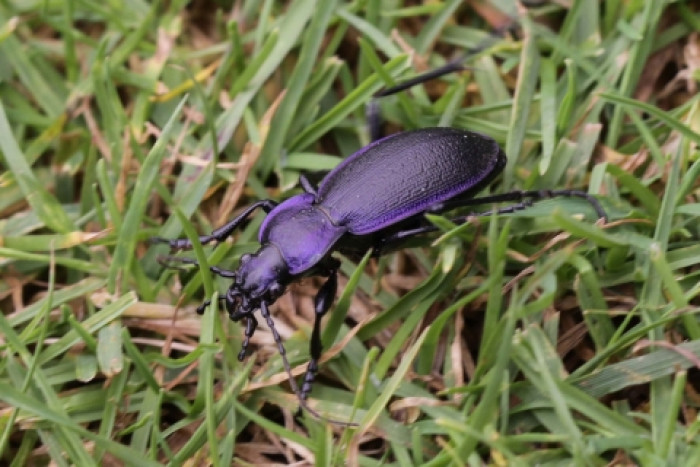
5. Violet ground beetle
Violet ground beetles are mostly dark, but the edges of the wing cases can catch the light in a metallic purple or blue-violet line. The color is subtle until the angle is right. Then it suddenly becomes obvious.
Up close the color may dominate the animal's appearance, but at a greater distance its outline, movement, and surroundings become just as important as the shade itself.
6. Purple-striped jellyfish
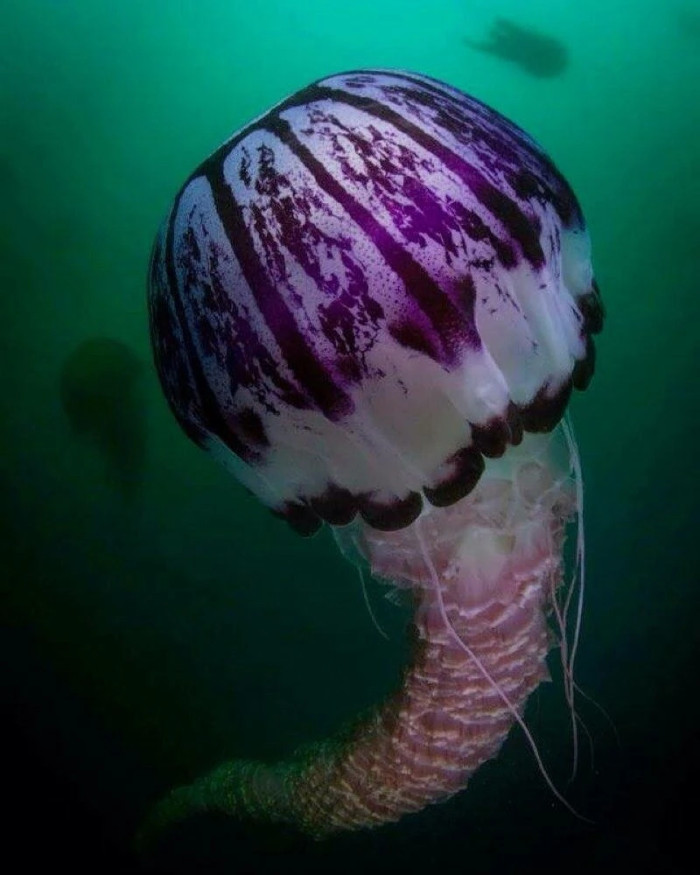
The purple-striped jellyfish has a translucent bell crossed by strong violet lines. Long tentacles trail beneath it, creating a dramatic shape even before the color is considered. In open water, the transparent body makes those purple markings appear suspended on their own.
It is a useful contrast with the other species here because the visible color does not necessarily have the same source or purpose even when the final result looks similar.
Purple’s hard to nail, but it’s not as tricky as the flamingos people always think are the only pink animals.
7. Purple frog
The purple frog of India looks almost unreal for reasons beyond color. It has a rounded body, small eyes, and a pointed snout, with skin that can appear dark purple-brown. It spends much of its life underground, which helps explain why most people never encounter anything that looks quite like it.
The category is therefore visual rather than biological: what links these animals is what we see, not a shared pigment system, habitat, or evolutionary history.

8. Purple honeycreeper
Male purple honeycreepers can appear violet-blue with dark wings and a bright yellow flash on the legs. Depending on lighting, the body may look more blue than purple. That ambiguity is exactly what structural color does best.
That distinction matters when comparing photographs, since camera exposure and direct sunlight can exaggerate a color that looks more muted in the wild.

9. Purple nudibranch
Several nudibranchs carry intense violet or purple tones, often edged with orange, white, or blue. These shell-less sea slugs can look almost painted because the color sits on exposed folds, gills, and sensory structures rather than hiding beneath a shell. The combination turns a very small animal into one of the loudest-looking creatures on a reef.
The effect works because color never appears alone. Shape, movement, surface texture, and the surrounding habitat all change how strongly the animal stands out.

10. Violet sabrewing
The violet sabrewing is a large hummingbird with saturated violet plumage across much of the body. In shadow, it can look almost black. In direct light, the purple appears abruptly, a useful demonstration of how much lighting changes our perception of animal color.
This is one reason the species remains memorable: the color is striking to human eyes, but it still fits into the animal's normal ecology rather than existing just for display.
Pupperish has covered similarly dramatic plumage in the varied bunting and the courtship colors of the splendid fairy-wren. Neither bird needs to be entirely purple for violet tones to dominate the photograph.

11. Malabar giant squirrel
The Malabar giant squirrel can carry deep maroon, brown, cream, and purple-looking tones across the same body. Pupperish has featured the animal’s multicolored coat, which is a good example of why some mammals look purple without producing a pure violet pigment.
Depending on angle and lighting, the same individual may fall near the edge of the color category, which is common with natural shades that blend into neighboring hues.

12. Purple queen anthias
Purple queen anthias are small reef fish that can glow in violet, magenta, and pink tones. In a school, the effect becomes much stronger because dozens of similarly colored bodies move together against blue water and coral.
Taken with the rest of the list, it shows how many unrelated routes can lead to roughly the same visual result in nature.
Birds often push purple toward neighboring colors. One Pupperish profile of a vivid bird called Carbonito de Sophie shows how quickly blue, violet, and dark plumage can blend in a single animal.
That same overlap appears in green animals, where reflected blue light and yellow pigment can combine to create green, and in black animals, where a dark surface may reveal hidden color only under strong light.

The purple sea star looks almost invisible on the rocks, then suddenly pops in a close-up because the kelp and dark water change the whole color story.
The purple emperor butterfly plays the same game, its iridescent sheen fading toward brown the second you move the light or the butterfly itself.
Even the violet-backed starling feels like it’s glowing, because that glossy violet back hits differently than the pale underside under shifting light.
And by the time you get to the purple grenadier, you realize this is not a “paint job” problem, it’s a “how the animal’s surface interacts with light” problem.
Purple is often a lighting problem as much as a pigment problem
Feathers and scales can change dramatically with angle, while underwater light can shift hues even further.
That is why purple wildlife can be so hard to photograph accurately. The animal may look violet to the eye, blue to the camera, and almost black a moment later. Nature gets away with a lot more color ambiguity than a paint chart would allow.
Nature is basically trolling us with purple, and the moment you stop looking at it like a flat color, the mystery finally makes sense.
Want more color shock, check out 12 Blue Animals That Look Almost Unreal in Nature.
Share this article: