
Redditor Stoops Down To Dog Level Against Neighbor's Passive-Aggressive Dog, Steals Its Territory By "Marking" It

A tenant in a basement apartment thought he was just going to live his quiet life, until the neighbor’s “passive-aggressive” dog turned the yard into a petty battlefield. And when your cat has a favorite outside spot, you learn real fast that some dogs do not share, they negotiate with poop.
The OP is renting from a couple who definitely spoil their dog, which means the dog has developed a talent for showing up right where it shouldn’t. Every time the OP brings his cat outside to read, the spoiled dog swoops in and poops on the cat’s go-to spot, like it’s making a point in slow motion.
So the OP stooped down to dog level, and somehow the territory war got even more ridiculous.
The OP explains his current situation: He is renting a basement apartment from a couple with a spoiled dog.

He has a cat that he brings along outside while he's reading a book.

The second the OP steps outside with his cat to read, the neighbor’s dog starts treating that exact spot like its personal throne.
The act of marking territory, a behavior common to both dogs and humans, often reveals deeper dynamics of dominance and social hierarchy. In the case of the Redditor confronting a neighbor's passive-aggressive dog, their decision to assert control over the disputed space highlights a complex emotional response rooted in frustration. This incident not only underscores the competition for territory but also reflects the human desire to reclaim agency in the face of perceived challenges. The Redditor's actions can be interpreted as a response to feelings of inadequacy, showcasing how territorial behaviors can serve as a mechanism for coping with insecurity in social interactions.
The spoiled dog would poop on the OP's cat's favorite spot.

So he thought of a way to retaliate.
When the dog was about to take a dump, it realized that someone had invaded its territory.

Studies in social psychology have shown that aggressive behaviors can escalate quickly in competitive situations. A report in the Journal of Social Psychology highlights how perceived threats to one’s territory can lead to heightened aggression, often resulting in confrontations.
The actions taken in this situation may reflect a moment of impulsivity driven by emotional distress rather than a well-thought-out decision.
The OP perfectly sent the message in dog language.
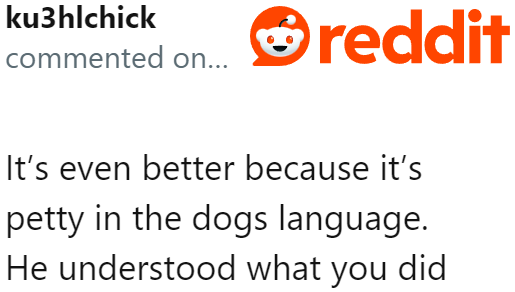
In case the OP wants to be pettier, a Redditor suggests a better alternative:
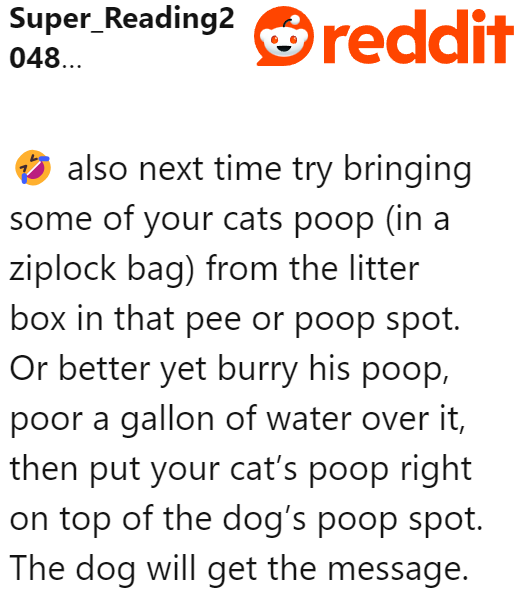
That’s when the OP realizes the spoiled dog isn’t just being gross, it’s actively “claiming” the area by targeting the cat’s favorite place.
This also echoes the landlord-versus-tenant grudge, where a cunning tenant retaliated over a security deposit tied to a dying tree.
The recent incident on Reddit highlights the complexities of managing aggression, especially in social interactions between neighbors and their pets. As one user took matters into their own hands by marking territory to counter a passive-aggressive dog, it serves as a reminder of how unchecked emotional responses can lead to unusual behaviors. The situation showcases a dog's natural instinct to mark territory but also reflects human tendencies to react emotionally when faced with perceived threats to personal space. This anecdote underscores the importance of understanding triggers and finding healthier outlets for frustration, rather than resorting to actions that could escalate tensions further. By employing coping strategies like mindfulness, individuals might navigate such conflicts more thoughtfully, promoting better neighborly relations.
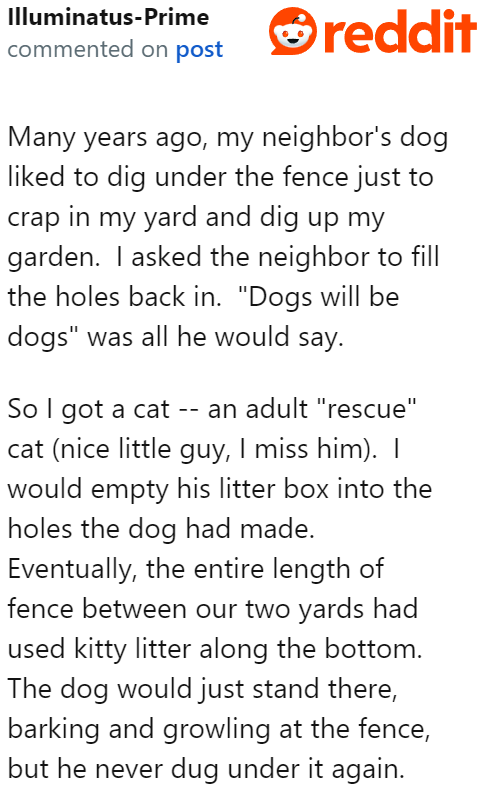
Believe it or not, people have done something similar to what the OP did.
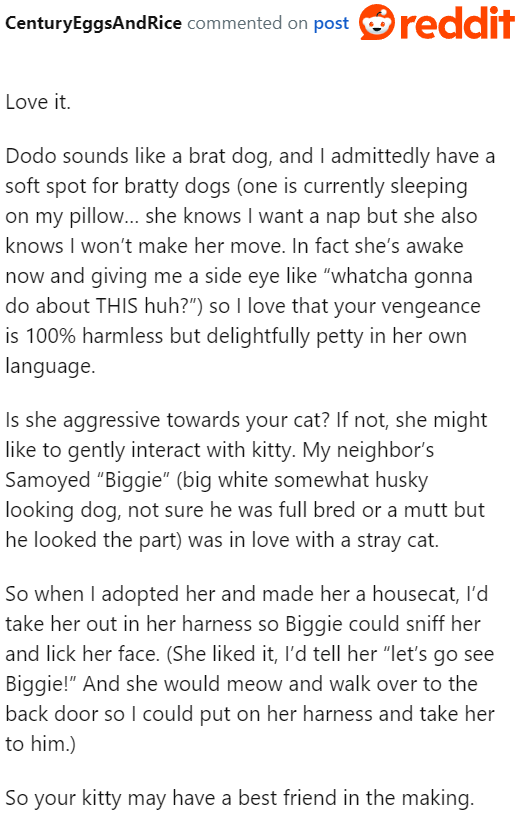
A user suggests another alternative. If the dog isn't aggressive with the cat, maybe they can hang out and be friends.
The moment the dog was about to drop a load, the OP invaded the dog’s territory right when it mattered most.
When a spoiled dog’s territorial antics pushed the limits, the clever OP took matters into his own hands—literally.
The sight of the dog retreating with its tail between its legs was a victory not just for our Redditor but for anyone who’s ever wanted to outwit a pesky pet. It’s a hilarious reminder that, sometimes, a little bit of cleverness and a lot of patience can turn a frustrating situation into a satisfying, if unconventional, triumph.
And it turns out, other people have done the same thing too! At least now, we have an idea of how to handle this kind of passive-aggressiveness.
Do you love animal stories like this? Go ahead and share it with your friends and family!
This kind of deed is common, apparently.
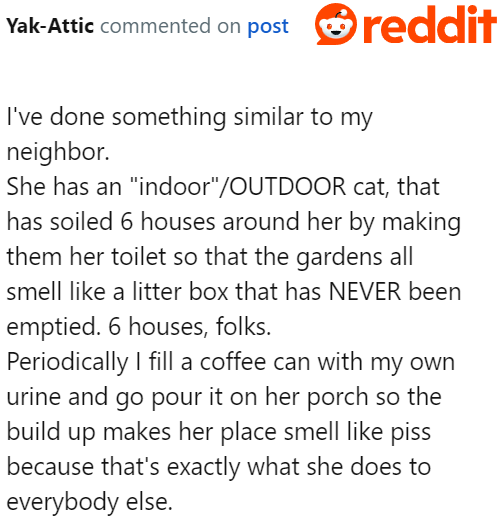
No one could've said it better.
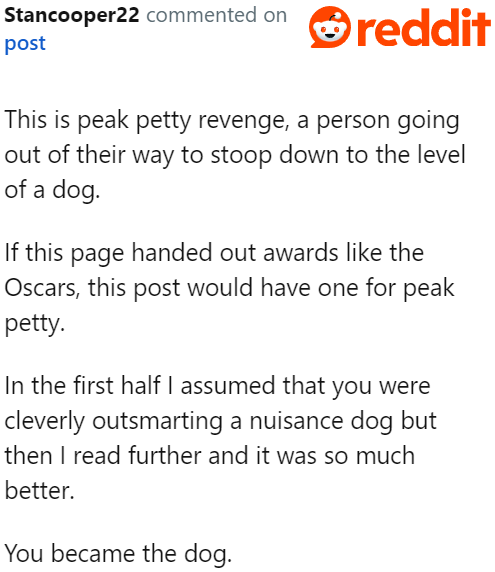
Now the neighbor’s passive-aggressive dog and the OP are locked in a weird dominance contest, one “marking” move at a time.
To promote healthier interactions in similar situations, it is beneficial to practice techniques for calming down before reacting. By learning to pause and reflect before acting, individuals can make more considerate decisions that foster positive outcomes.
In this peculiar encounter between neighbors, we see how the age-old conflict over territory can escalate into a battle of wills. The Redditor's decision to "mark" the dog’s territory is not merely an act of defiance but a reflection of the broader psychological dynamics at play. This situation serves as a reminder of how important emotional responses are in managing interpersonal conflicts. Rather than allowing frustration to dictate actions, the Redditor's playful retaliation suggests a calculated effort to reclaim their space. Such behavior highlights the necessity of understanding one's feelings and making conscious choices in response, especially when navigating competitive or passive-aggressive interactions. This incident is a microcosm of larger social dynamics, where territory and emotional regulation intersect in unexpected ways.
He might be happier in a different apartment, because that cat spot is never getting peace again.
Next up, see how a tenant went viral after spraying neighbor’s dog escalated the yard war.
Share this article:





