
16 Types of Sharks With Pictures and Identification Tips

A 28-year-old woman went to the aquarium gift shop for one quick souvenir, then ended up stuck in the shark exhibit for hours, arguing with her friend over a single fin.
They kept pointing at silhouettes through the glass, trying to match the dorsal fin and tail, but the tank lighting made every shark look like it belonged to a different species. Then the staff turned off a few lights for a feeding demo, and suddenly whale shark spots looked like smudges, thresher tails looked shorter, and even the blacktip reef shark tips barely showed up.
By the time they finally left, they weren’t just guessing anymore, they were hunting for the exact clues.
How to Identify Different Types of Sharks
- Look at the head first. Hammerheads, goblin sharks, nurse sharks, and whale sharks have especially recognizable profiles.
- Compare the dorsal fin and tail. Thresher sharks have a remarkably long upper tail lobe, while oceanic whitetips show broad fins with pale tips.
- Check the markings. Tiger sharks have dark bars when young, whale sharks carry pale spots, and blacktip reef sharks show dark fin tips.
- Consider the habitat. Bull sharks enter rivers, Greenland sharks favor cold northern water, and reef sharks stay around tropical reefs.
- Use size carefully. Young sharks can resemble smaller adult species, so proportions and markings are often more reliable.
16 Types of Sharks and What Makes Each One Different
List:
1. Whale Shark
The whale shark is immediately recognizable by its broad, flat head and pale checkerboard of spots and stripes. It is a filter feeder, using its enormous mouth to collect plankton and small fish rather than hunting large prey. Despite its size, its outline looks softer and more rounded than that of fast predatory sharks.

2. Basking Shark
Basking sharks are another giant filter-feeding species. Their open mouth, long gill slits, pointed snout, and dark gray body make them look dramatic from the front. A massive basking shark sighting can easily be mistaken for a more aggressive species until the feeding posture becomes clear.

3. Great White Shark
Great whites have a heavy, torpedo-shaped body, conical snout, and sharp boundary between the gray back and pale underside. Their triangular teeth and powerful tail fit sudden acceleration.
A great white approaching a fishing boat also shows how clearly the tall dorsal fin stands above the water.

4. Tiger Shark
Young tiger sharks show dark vertical bars that fade as they age. Adults keep a broad head, thick body, and powerful jaws capable of handling a wide diet.
The pattern is the easiest clue, although older animals may require a closer look at their blunt snout and body proportions.

5. Bull Shark
Bull sharks are stocky, broad-snouted sharks with small eyes. They tolerate fresh water and may travel into rivers. Their compact build appears heavier than the sleek shape of a great white or blue shark.

6. Great Hammerhead Shark
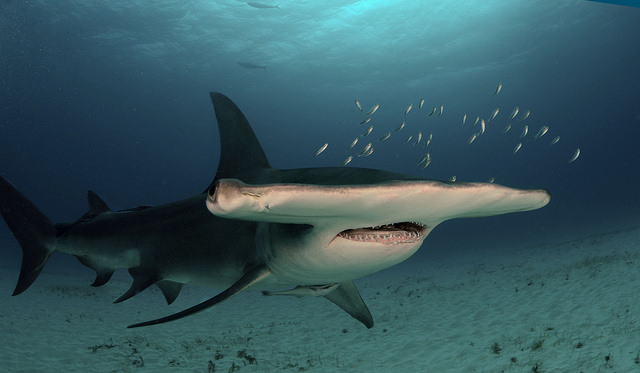
The great hammerhead has a wide, nearly straight head and a tall curved first dorsal fin. The head spreads sensory organs across a larger area and helps detect prey hidden in sand.
7. Shortfin Mako Shark
Shortfin makos have a narrow, pointed snout, large dark eyes, and a streamlined body. Their teeth may remain visible even when the mouth is closed.
The shape is built for speed, with a strong crescent tail and a noticeably slim connection between body and tail.

8. Blue Shark
Blue sharks are slim, elegant ocean travelers with long pectoral fins and a deep blue upper body. Their snout is long and pointed, while the body narrows gradually toward the tail.
They look delicate beside bulkier sharks, although adults are capable open-ocean predators.

This list of rare sightings, from glass-headed fish to living ribbons of light, is a great follow-up to your shark ID hunt in the ocean.
9. Oceanic Whitetip Shark
Broad, rounded fins with white markings give the oceanic whitetip its name. It usually moves through warm offshore water rather than hugging the coast.
The rounded fin shape separates it from reef sharks with sharper black-tipped fins.

10. Nurse Shark
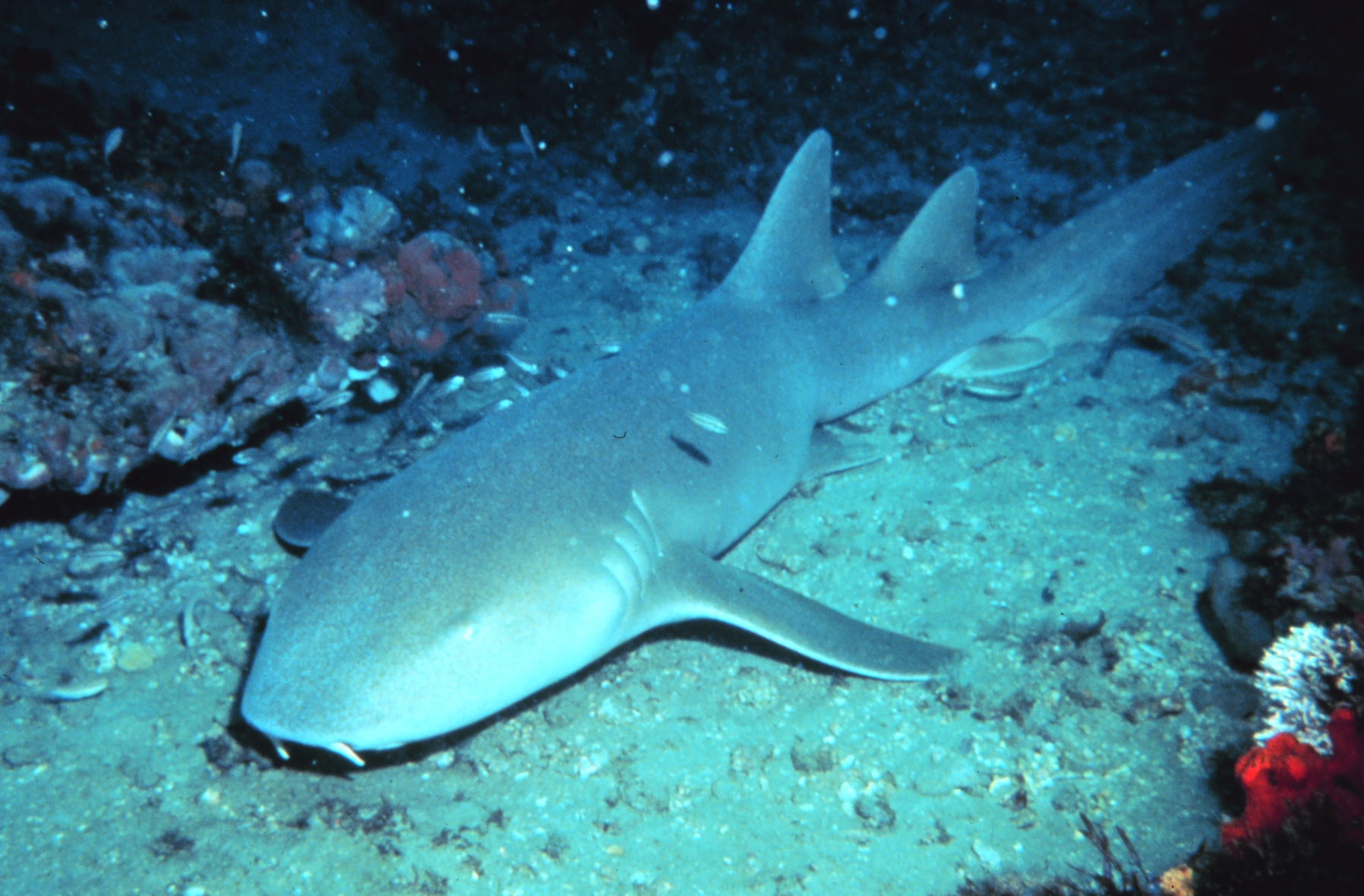
Nurse sharks often rest on the bottom during the day. They have a broad head, small eyes, and two short barbels near the mouth that help them locate prey.
Their dorsal fins sit far back on the body, giving them a different silhouette from many active open-water sharks.
11. Lemon Shark
The lemon shark’s yellow-brown coloring blends with sandy coastal shallows. Its two dorsal fins are similar in size, which is a stronger identification clue than color alone. Juveniles often use mangrove and lagoon habitats as sheltered nursery areas.
Cold-water range is another useful clue. The same southern seas support several types of penguins, while Greenland sharks remain in northern waters.

12. Blacktip Reef Shark
Blacktip reef sharks are slim tropical sharks with clear black tips on the first dorsal fin and lower tail lobe. They are commonly seen in shallow lagoons and reef edges. Their smaller size and quick turns contrast with the slower, heavier nurse shark that may share the same habitat.
Coastal identification often involves more than sharks. Several types of turtles use the same reefs, seagrass beds, and shallow feeding grounds.

13. Thresher Shark
Nothing identifies a thresher faster than its tail. The long upper lobe is used to stun schooling fish. Its small mouth looks almost out of proportion beside that whip-like tail.

14. Goblin Shark
Goblin sharks live in deep water and have a long, blade-like snout above protrusible jaws. Their soft body often looks pink because blood vessels show through the skin.
They appear in collections of rare deep-sea discoveries for good reason. Few living sharks look as unusual.

15. Greenland Shark
Greenland sharks are heavy-bodied animals of cold northern seas. Their blunt snout, small fins, and slow movement suit a life in deep, cold water.
They are also known for extraordinary longevity, although aging such animals requires specialized scientific methods.

16. Dwarf Lantern Shark
The dwarf lantern shark is among the smallest sharks. It has light-producing organs on its underside, an adaptation common among several deep-sea lantern sharks.
Small size does not make identification easy, since these animals are rarely observed alive at the surface.

That’s when things got complicated, because the whale shark’s checkerboard pattern looked totally different under the exhibit lights.
Her friend swore the long tail meant a thresher shark, but the lighting made the upper lobe look way less dramatic.
Then the tiger shark debate flared up, since the “easy clue” bars were fading like they were already aging out.
When they finally compared habitat to what they were seeing, the bull shark rumor about rivers and the Greenland shark vibe made the whole list click.
Shark Groups That Are Often Confused
Sharks and rays are close relatives with cartilage skeletons, but rays usually have flattened bodies and pectoral fins joined broadly to the head. Sawsharks have gill slits on the sides, while sawfishes are rays with gill slits underneath.
Regional guides are also important. The sharks seen beside a tropical reef differ from species recorded in cold northern water, and fossil discoveries can add extinct forms to the picture. Researchers have even named ancient shark species from cave fossils, showing how incomplete the family history remains.
Context helps. Orcas may hunt large predatory sharks, as documented in killer whale and great white interactions, while tiny lantern sharks occupy a different food web.
Why Shark Identification Matters
Correct identification supports research, fisheries management, and conservation. NOAA Fisheries notes that Atlantic, Gulf, and Caribbean waters hold sharks ranging from small dogfish to white sharks, with identification rules tied to management and reporting.
That is the useful part. Once the head, fins, tail, markings, and habitat are checked in order, the silhouette stops being “a shark” and starts becoming a species with its own place in the ocean.
Some are unmistakable. Others demand patience.
She walked out with no souvenir, just a brain full of shark IDs and one stubborn “I’m right” left to prove.
Wait until you see the 20-foot shark that showed up in a Rhode Island pond. Massive 20-Foot Shark Seen In Rhode Island Pond.
Share this article:





