Arctic Birds: 15 Species Built for Life at the Top of the World

Arctic birds don’t just survive up top, they look like they were designed by someone who really hates convenience. One minute you’re staring at a Snowy Owl that melts into the snow, the next you’re clocking an Arctic Tern that treats migration like a daily commute.
The tricky part is they all play different games in the same frozen landscape. Atlantic Puffins cruise the North Atlantic, Dovekies dive like they’re late for something, and Northern Fulmars float over rough seas with the kind of defense that turns a “nice walk” into a very memorable shower. And if you’re trying to spot them, the names you recognize are only the start, because their look changes with the season, the light, and where they’re nesting.
By the time you get to the Rock Ptarmigan’s seasonal disguise, you’ll realize the top of the world is basically one long, feathered prank.
Arctic birds names you are most likely to recognize
List:
1. Snowy Owl.
Few Arctic birds look more at home on tundra than the Snowy Owl. Its pale plumage blends into snow, while a thick layer of feathers extends over the legs and feet. Pupperish has previously covered a Snowy Owl caught in flight, and the species remains one of the easiest Arctic birds to identify from a distance.

2. Arctic Tern.
This slim gray-and-white tern breeds across northern regions and then migrates toward Antarctic waters. The result is one of the longest regular migrations in the animal world. Its pointed wings, forked tail, and black cap make it look delicate. Its travel schedule says otherwise.

3. Atlantic Puffin.
Atlantic Puffins spend much of the year at sea and return to islands and coastal cliffs to breed. Their colorful bills are brightest during the breeding season, then become duller afterward. BirdLife tracks the species across the North Atlantic, including Greenland, Iceland, and northeastern North America.

4. Dovekie.
Also called the Little Auk, the Dovekie is a compact black-and-white seabird that nests in rocky northern colonies. It looks almost toy-sized beside larger auks. In the water, though, it is a capable diver that pursues small marine prey beneath the surface.

5. Northern Fulmar.
Fulmars glide over rough northern seas with stiff-winged flight that can resemble a small albatross. They also have a memorable defense: oily stomach fluid can be projected at a threat. That behavior has surprised more than one person, including in Pupperish's story about an unpleasant fulmar encounter.

6. Gyrfalcon.
The Gyrfalcon is the largest falcon and a specialist of northern open country. Plumage ranges from dark gray to nearly white. It hunts birds over tundra and rocky coasts, where speed matters more than cover.

7. Rock Ptarmigan.
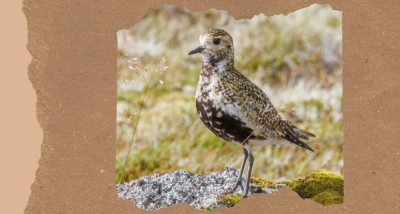
Rock Ptarmigan change with the seasons. Winter plumage is largely white, helping them disappear against snow. In warmer months, mottled brown and gray feathers match exposed rock and tundra vegetation. Even the feet are feathered, adding insulation and helping the bird move across snow.

That Snowy Owl on the tundra is the perfect warm-up, because once you’ve seen how it blends in, everything else feels like a magic trick waiting to happen.
Then the Arctic Tern shows up with that forked tail and black cap, and suddenly “long regular migration” feels less like a fact and more like a plot twist.
As with birds migrating for food, seasons, and survival odds, these Arctic species move to beat harsh winters.
An Arctic birds list is really a list of survival strategies
The species differ, but the same pressures keep showing up: heat loss, short breeding seasons, unpredictable food, exposed nesting sites, and predators. Arctic birds solve those problems in very different ways.
8. King Eider.
Male King Eiders are unmistakable in breeding plumage, with a bright bill shield and a mix of black, white, and soft blue-gray. Females are mottled brown. Both are strong sea ducks, and dense feathering helps them cope with cold northern waters.

9. Ivory Gull.
The adult Ivory Gull is almost entirely white, which makes it look like a piece of moving ice. It is closely associated with high-Arctic marine environments and often follows sea-ice edges where food becomes available.

10. Snow Bunting.
Snow Buntings breed in rocky Arctic landscapes and often use crevices for nests. In winter they move farther south, where flocks can appear over fields and shorelines. Their white wing patches flash strongly in flight.

11. Red-throated Loon.
This small loon breeds on northern lakes and pools but feeds heavily at sea in many areas. Its breeding plumage includes a rust-red throat patch. Like other loons, its body is designed for diving, not graceful walking on land.

12. Long-tailed Jaeger.
Long-tailed Jaegers are agile hunters over tundra and ocean. They eat insects and small animals on breeding grounds, then spend much of the nonbreeding season at sea. The long central tail feathers of adults make them especially striking in summer.

13. Black-legged Kittiwake.
Kittiwakes build crowded nesting colonies on cliffs. Their name comes from the repeated call that sounds roughly like “kitt-i-wake.” Dense colonies are visually impressive, but they also concentrate noise, waste, and competition in a very small area.

14. Whimbrel.
This large curlew relative uses a long downcurved bill to probe for invertebrates. Shorebird identification can be hard when several similar species appear together, something Pupperish touched on in a story about an endangered curlew caught in a confusing photo.

15. Blackpoll Warbler.
The Blackpoll Warbler breeds in northern boreal and sub-Arctic regions, then makes a remarkable southbound migration. Pupperish has covered its multi-day nonstop flight over the Atlantic, a journey that turns a tiny songbird into one of the strongest travelers on this list.

After that, Atlantic Puffins and Dovekies steal the spotlight at sea, while Northern Fulmars remind everyone that getting too close can end with oily stomach fluid in your day.
And just when you think you’ve got it figured out, Rock Ptarmigan flip the whole script with winter white that makes them disappear against snow.
Where do Arctic birds live?
“Arctic” does not mean one uniform habitat. Birds use sea cliffs, tundra, wetlands, open ocean, pack-ice edges, rocky islands, and low shrubs. The birds of Iceland overlap with many northern seabirds, even though much of Iceland sits just south of the Arctic Circle. Farther west, Greenland and the Canadian Arctic support huge breeding colonies and wide tundra systems.
The same open landscapes also support mammals such as Arctic foxes. Photos of foxes in the Arctic Circle show how little cover these environments can provide once snow and rock dominate the view.
Why do so many Arctic birds migrate?
Arctic summers offer a short burst of food and daylight. Birds can feed chicks for long hours, and insects may become abundant on tundra and wetlands. Staying through winter is another matter. Many species leave for temperate coasts, the tropics, or the Southern Hemisphere.
That creates surprising links between distant bird communities. Some northern migrants eventually share wintering regions with South American birds, while others move through European migration corridors that also shape the seasonal mix of birds in Spain.
Compared with rainforest birds, Arctic species face lower plant diversity and much stronger seasonality. Yet the breeding spectacle can be enormous. Fewer types of birds do not mean fewer birds in the sky.
Sources: AECO: Birds in the Arctic | BirdLife: Atlantic Puffin factsheet
Once you notice how these birds switch tactics, “recognizable species” stops feeling simple and starts feeling suspicious.
Want more snowy lookalikes? See 22 white birds, from small songbirds to snowy owls and swans.
Share this article: