Birds of Iceland: 14 Species From Puffins to Gyrfalcons

There are birds in Iceland that basically act like living scenery. One minute you’re staring at black volcanic rock, the next you’re watching a puffin pop out of a burrow like it’s clocking in for the day.
This is the part of Iceland where the landscape is the plot twist. Puffins vanish back into burrows, Arctic terns patrol nesting areas like tiny airborne bodyguards, and eiders tuck their down into nests along the coast. Meanwhile, the open-country drama belongs to gyrfalcons, who hunt with zero interest in your camera angle.
And once you notice how each species shows up with its own timetable and attitude, the whole island starts telling a story you cannot unsee.
14 birds in Iceland that define the landscape
List:
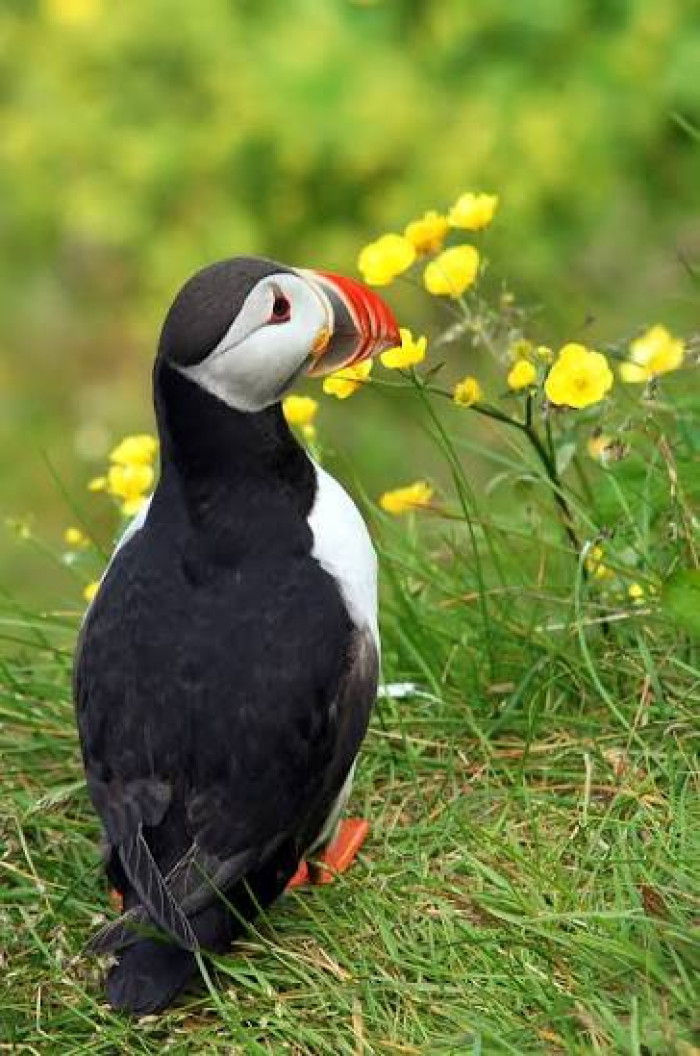
1. Atlantic Puffin.
Puffins return to Icelandic coasts and islands to breed in burrows or rocky cavities. Their colorful summer bills and upright stance make them instantly recognizable, but most of the year is spent at sea rather than posing on cliffs.
2. Arctic Tern.
Arctic Terns arrive for the breeding season and defend nesting areas aggressively. They may look light and elegant in flight, but walking too close to a colony can produce repeated dives at your head.

3. Common Eider.
Eiders are heavy sea ducks found around Icelandic coasts. Females line nests with soft down, and eiderdown has a long cultural and economic history in Iceland.

4. Gyrfalcon.
The Gyrfalcon is a powerful falcon of Iceland's open country. It hunts birds such as ptarmigan and waterfowl. Plumage varies, with pale individuals looking especially dramatic against dark volcanic ground.

5. Red-necked Phalarope.
Red-necked Phalaropes are small shorebirds that breed around northern wetlands before spending much of the nonbreeding season at sea. Females are more brightly colored than males, and the usual parental pattern is partly reversed because males take the larger role in incubation and chick care.

6. European Golden Plover.
The arrival of the Golden Plover is traditionally associated with spring in Iceland. In breeding plumage, adults show a dark belly and face bordered by a strong white stripe.

7. Whooper Swan.
Large, white, and loud, Whooper Swans breed on lakes and wetlands. Their yellow-and-black bills separate them from Mute Swans, which have orange bills.

And if you’re sorting lookalikes, this matches the challenge of identifying white birds, from cranes to seabirds.
8. Black-tailed Godwit.
Iceland supports an important breeding population of Black-tailed Godwits. The long bill and legs suit shallow wetlands, where the birds probe mud and water for food.

9. Common Raven.
Ravens are resident year-round and fit Iceland's dark cliffs and open landscapes almost too well. They are large, intelligent, and capable of using many food sources, which helps in a place where winter can be unforgiving.

10. Harlequin Duck.
Harlequin Ducks favor fast rivers during the breeding season and rough coastal water at other times. Adult males have an unusually graphic pattern of slate blue, chestnut, and white, while females are much plainer and easier to overlook.

11. Razorbill.
Razorbills are chunky black-and-white auks with deep, blunt bills. They breed on cliffs and rocky islands, often in the same larger seabird areas as guillemots and puffins.

12. Black Guillemot.
Black Guillemots are mostly dark in breeding plumage, with bold white wing patches and red feet. Unlike many cliff-nesting auks, they often use low rocky cavities near shore.

13. Great Skua.
Large, aggressive, and built like a heavy gull, Great Skuas patrol coastal areas and seabird colonies. They will chase other birds to steal food and defend nesting territories forcefully.

14. Great Auk.
The Great Auk is the bird you cannot see. The last confirmed pair was killed on Eldey in 1844. Pupperish has covered the Great Auk's extinction, which gives Iceland bird history a darker chapter among all the modern colony spectacles.

The puffins might be the first “wow” you spot, but the Arctic terns will remind you fast that spring comes with rules near their colonies.
After the terns start dive-bombing your personal space, the heavy Common Eider feels almost peaceful, until you realize it’s building a nest with down like it’s got a job to finish.
Then the scene shifts from coast to open country, because the Gyrfalcon doesn’t care about your itinerary, it cares about ptarmigan and waterfowl.
By the time you reach the wetlands for the Red-necked Phalarope and Black-tailed Godwit, even the walking pace feels different, like the birds are running the schedule.
Why seabirds dominate lists of birds in Iceland
Iceland sits in the North Atlantic where productive ocean waters support fish and other marine prey. Cliffs and offshore islands provide nesting sites with some protection from land predators. That combination favors puffins, guillemots, razorbills, kittiwakes, fulmars, gannets, and other seabirds.
These birds are built for saltwater. Some seabirds have specialized glands that remove excess salt, a feature explained in Pupperish's article about how pelagic birds handle seawater. Dense colonies also come with practical hazards, including exposure to dried droppings, which is why bird-dropping dust is treated seriously around captive and concentrated bird environments.
Iceland birds in summer and winter
Summer is the obvious season for variety because migrants return to breed. Winter strips the list back toward residents, sea ducks, gulls, and birds adapted to harsh conditions. That seasonal swing connects Iceland closely with broader Arctic birds, even though Iceland itself is not entirely inside the Arctic Circle.
Migration also links Iceland with Europe. Some species continue through or winter in areas where the mix of birds in Spain is far more Mediterranean. The contrast is sharp: Icelandic cliffs and tundra on one end, Iberian wetlands and dry plains on the other.
Birdwatching around colonies needs distance
Seabirds look abundant when thousands are packed together, but a colony is still a breeding site. Staying back reduces disturbance and keeps birds from wasting energy on repeated alarm flights. It also avoids the chaos that can happen when people crowd wildlife for a photo.
Social seabirds are especially sensitive to colony dynamics. Pupperish has covered both birds responding to apparent flock size and a famous story about Nigel the gannet, whose attachment to a concrete decoy became a sad example of how strongly colony cues can matter.
A giant-looking gull can also be nothing more than camera perspective, as one seagull photo proved. Iceland gives photographers plenty of chances to make that mistake.
For another island contrast, common birds in Japan are shaped by a much warmer and more forested archipelago. Islands do not produce one type of bird community. Latitude changes everything.
Sources: BirdLife: Iceland factsheet | Iceland Natural History: Birds of Iceland
Iceland’s birds do not just live here, they stage the whole island like a nonstop show.
Want more cold-weather champs like snowy owls and dovekies, see these Arctic birds built for life at the top of the world.
Share this article: