24 Brown Birds: From Little Brown Birds to Thrushes and Waterbirds

Brown birds may not have the instant recognition of a bright cardinal or blue jay, but identifying them can be surprisingly challenging. Similar shades appear across a huge range of birds, from sparrows and wrens to thrushes, doves, finches, flycatchers, and even seabirds.
Females and young birds can make the puzzle even harder, since their coloring is often more subdued than that of adult males. Size helps narrow the possibilities, but color alone rarely settles the question.
A bird that initially looks uniformly brown can reveal several useful clues once you look more closely. Fine streaks across the chest, a pale eyebrow, a ring around the eye, spots, rusty coloring on the tail, or the shape of the bill can separate one species from another.
Behavior and location add another layer of useful information. Some brown birds spend much of their time close to the ground, while others prefer trees, open fields, wetlands, or coastal habitats. Even the way a bird moves or searches for food can help point toward its identity.
How to identify brown birds
Common brown birds
List:
1. California towhee
California Towhees are among the plainest brown birds in western neighborhoods. They are large sparrows with thick bills, long tails, and matte gray-brown plumage, plus a warmer rusty patch under the tail.
Their habit of feeding on the ground near shrubs and fences also helps narrow the identification.

2. Canyon towhee
Canyon Towhees are chunky, long-tailed sparrows that look plain brown at first glance. A warmer crown, pale eye ring, rusty undertail, and occasional dark breast spot provide the details.
They are especially useful to compare with California Towhees because both can look almost uniformly brown from a distance.

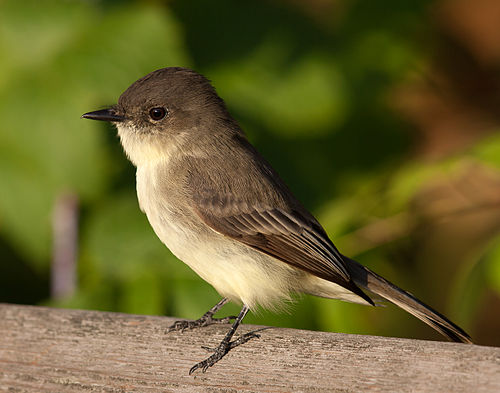
3. Eastern phoebe
Eastern Phoebes are gray-brown above with pale underparts and a darker head, creating a subdued overall look rather than strong streaking.
Their thin flycatcher bill and repeated tail-dipping motion are better clues than color. They often perch openly near buildings, bridges, and woodland edges.
4. Carolina wren
Warm reddish-brown upperparts, a bold white eyebrow, and a slightly curved bill identify the Carolina Wren. It often holds the tail upright and delivers an unexpectedly loud song for such a small bird.

5. Female brown-headed cowbird
Female Brown-headed Cowbirds are plain warm brown from head to tail, without the male's black body and darker brown head. They have thick, conical bills and a heavier shape than most sparrows.
In mixed feeding flocks, size and bill structure keep them from disappearing into the general category of brown birds.

6. Mourning dove
This larger backyard bird is soft gray-brown with black wing spots, a small head, and a long pointed tail. It walks on the ground and launches with a sharp whistle from the wings. Size alone removes it from the sparrow group.

7. Brown thrasher
A long tail, bright rufous back, yellow eyes, and heavy dark streaks on the chest make the Brown Thrasher distinctive. It often stays low, sweeping leaf litter with its bill. The elongated shape differs from a thrush.

8. Hermit thrush
The Hermit Thrush has a brown back, spotted pale breast, and a tail that is noticeably more reddish than the wings. It frequently lifts the tail and slowly lowers it. That tail contrast separates it from several similar thrushes.

9. Wood thrush
Warm cinnamon-brown covers the head and back, while bold round spots mark a white breast. The spots are larger and cleaner than the smudged streaks of many sparrows. Wood Thrushes usually stay on shaded forest floors.

10. Cedar waxwing
Smooth tan-brown plumage, a pointed crest, black mask, and yellow tail tip make the Cedar Waxwing unusually sleek. Pupperish's feature on the masked Cedar Waxwing shows why texture and silhouette matter as much as color.

11. Chestnut-breasted mannikin
This small finch has a rich chestnut chest, brown back, gray head, and a pale heavy bill. It often gathers in social flocks. Pupperish's Chestnut-breasted Mannikin profile covers the compact bird in detail.

12. Brown booby
Adults have a dark chocolate head and upper body with a sharply white belly. The long pointed wings and ocean habitat identify a seabird. Juveniles are browner below and show less contrast.

Right when she thought “plain gray-brown” meant California towhee, the rusty undertail patch kept throwing her off.
And if your “brown bird” turns out to have a red head or chest, check this red-bird guide with bright plumage.
Then the bird that perched near the bridge started tail-dipping like an Eastern phoebe, while her brain tried to force it into the towhee box.
Little brown birds
List:
13. Song sparrow
Strong brown streaks cover a pale chest and often converge into a central spot. The face has a busy mix of brown and gray stripes.
Song Sparrows vary across their range, but the combination of heavy streaking and a rounded tail is dependable.

14. Chipping sparrow
Breeding adults have a rusty cap, black eye line, pale eyebrow, and clean gray underparts. Winter birds are browner and less distinct. The unstreaked chest separates them from Song and Savannah Sparrows.

15. Field sparrow
A pink bill, pale face, rusty crown, and complete pale eye ring create a gentle expression. The breast is plain. Field Sparrows favor brushy open habitats rather than crowded urban settings.

16. Savannah sparrow
This short-tailed sparrow is streaked brown and usually shows a small yellow patch near the eyebrow. It favors grasslands and marsh edges. The yellow can be difficult to see, so habitat and compact proportions matter.

17. Lincoln's sparrow
Fine streaks cross a buff-colored upper chest beneath a gray eyebrow. The pattern is delicate compared with a Song Sparrow's heavy lines. Lincoln's Sparrows often stay low in dense wet vegetation.

18. Female house sparrow
Sandy brown upperparts, a broad pale eyebrow, plain gray-buff underparts, and a thick bill identify the female House Sparrow. Its preference for buildings, parking lots, and outdoor dining areas provides strong context.

19. Bewick's wren
Bewick's Wrens are medium-small brown wrens with a bold white eyebrow, long slightly curved bill, and a long tail that is often held up. Fine dark barring crosses the tail.
The strong eyebrow makes this bird easier to separate from the plainer House Wren once a clear view is available.

20. Brown-headed nuthatch
Brown-headed Nuthatches are tiny, compact birds with a brown cap, blue-gray back, whitish underparts, and a short chisel-like bill. They move up, down, and around trunks and branches rather than staying on the ground.
The brown head can dominate a quick view even though the body is mostly gray and white.

21. Pine siskin
Pine Siskins are small, sharply streaked, and equipped with narrow pointed bills. Yellow flashes may appear in the wings and tail. Their buzzy calls and flocking behavior help when the yellow is hidden.

22. Vampire finch
The Vampire Finch is a brown-gray Galapagos finch whose behavior attracts more attention than its plumage. Pupperish's Vampire Finch profile shows the heavy bill and subdued coloring behind the dramatic name.

23. House wren
A small warm-brown body, fine barring on the wings and tail, and a slim curved bill identify the House Wren. It moves quickly through cavities and tangled vegetation. The tail is often raised, though not constantly.

24. Blackpoll warbler in fall
The striking black-and-white breeding male molts into a much quieter olive-brown and yellowish fall bird. Pupperish's article on the Blackpoll Warbler migration helps explain why season can completely change a familiar species.

Next came the moment a Carolina wren popped up with that bold white eyebrow and an unexpectedly loud song, making her question every “brown bird” label she’d used so far.
Finally, in the mixed feeding flock, the female brown-headed cowbird’s thick conical bill and heavier shape made her realize why these birds don’t blend in the way you’d expect.
Why brown birds are easy to misidentify
Females, juveniles, and nonbreeding males often lose the bright marks shown in field-guide photographs. Close images can help, as Pupperish's backyard bird photo booth demonstrates, but behavior and habitat still matter.pupperish.com/rifleman-bird" rel="noopener noreferrer" target="_blank">Rifleman bird show how quickly subdued plumage disappears against bark and foliage. If the bird is much paler, compare white birds; if warm red becomes the dominant feature, move to red birds.
Now she’s realizing the “little brown bird” she photographed was never one bird at all.
Want more backyard ID clues, like bills and feeder behavior, see these 20 common backyard birds.
Share this article: