30 Fun Facts About Dogs That Explain Their Remarkable Abilities

It starts with a simple wag, a quick nose boop, and one confused human trying to decode what their dog is actually saying. Because in dog language, the same behavior can mean five different things, and the difference is usually in the details humans never notice.
Picture the scene: someone sees a tail swishing and assumes happiness, then the dog turns stiff, pauses, or changes direction like it is sending a whole paragraph instead of a single word. Meanwhile, that patterned nose is doing real science, the whiskers are reading the air, and the “just a wet nose” moment is really about scent particles and context, not a quick health check.
Here’s the part that makes it messy: once you learn what their bodies and senses are doing, you start seeing the “mystery” in every wag, yawning fit, and face-licking moment.
Dog Facts About Bodies and Senses
- A dog may have up to hundreds of millions of scent receptors, depending on breed. Humans have only a small fraction of that equipment.
- Every dog has a patterned nose surface. Like a human fingerprint, the combination of ridges and creases is individual.
- Dogs do not see only in black and white. Their color vision is strongest in shades of blue and yellow, while reds and greens are harder to separate.
- Low-light vision is one reason dogs can move confidently at dawn and dusk. Their wild ancestors were especially active during those hours.
- Whiskers are sensory tools, not decorative hairs. They help dogs notice air movement and nearby objects, especially around the face.
- Dogs cool themselves mainly by panting. They also have sweat glands in their paw pads, but sweating plays a much smaller role than it does in humans.
- Stretched back legs can produce the pose owners call a sploot. It looks comic, although many flexible dogs simply find it comfortable.
- A wet nose can help trap scent particles, but a dry nose does not automatically mean a dog is ill. Context matters more than one quick touch.
That’s when the tail-wag myth starts falling apart, because direction, speed, and stiffness matter as much as the movement itself.
How Dogs Think and Communicate
- A wagging tail does not always mean happiness. Height, speed, stiffness, and direction can signal excitement, uncertainty, tension, or friendliness.
- The play bow, front legs down and rear end raised, is a widely understood invitation. It tells another dog that the movements that follow are meant as play.
- Dogs dream. Puppies and older dogs may move, twitch, or vocalize more often during sleep than healthy middle-aged adults.
- Many dogs can learn the names of toys, people, places, and routines. Exceptional individuals have demonstrated vocabularies of hundreds of object names.
- Dogs read human pointing unusually well. Even young puppies can use a gesture to locate food or follow attention.
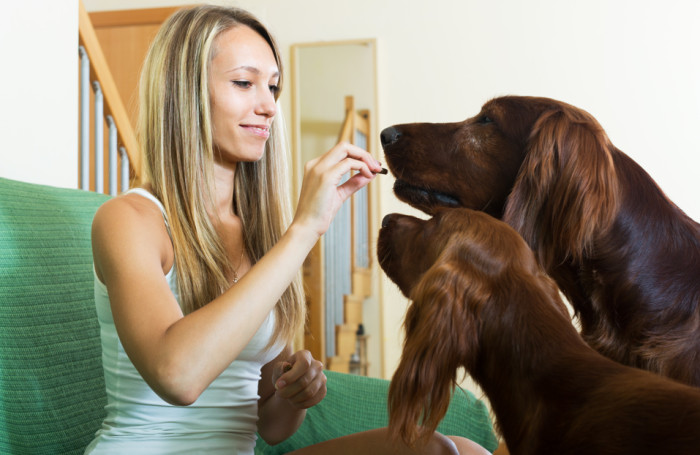
- Face licking can be affection, information gathering, appeasement, or a request. The reasons behind dog licking depend on the moment.
- Yawning may spread between people and dogs, although studies do not all agree on whether empathy, attention, or simple arousal explains it.
- Head tilting has no single confirmed explanation. A dog may be locating a sound, concentrating, or trying to see around its muzzle.
Facts About Dog Breeds and Daily Life
- Domestic dogs show more variation in size and body shape than any other mammal species. A Miniature Schnauzer and a Great Dane still belong to the same species.
- Greyhounds can reach roughly 45 miles per hour in short bursts. Their flexible spines and double-suspension gallop help lengthen each stride.
- Basenjis are often called barkless dogs, but they are not silent. They produce yodel-like sounds, whines, and other vocalizations.
- Dalmatian puppies are born with plain white coats. Their spots develop after birth and become clearer during the first weeks.
- Newfoundlands have broad, webbed paws and water-resistant coats that support their history as working water dogs.
- Dogs commonly eat grass. Occasional grazing can be normal, although repeated vomiting or sudden changes deserve veterinary attention.
- Digging may come from prey drive, denning instincts, temperature control, boredom, or the simple discovery that loose soil is entertaining.
Then the play bow shows up, and suddenly you realize your dog is basically holding up a sign that says, “This is friendly, not a fight.”
And if you’re still wondering about dog quirks, these 51 pets in weird positions will crack you up, especially the ones owners can’t explain.
Next comes the sleep stuff, where puppies and older dogs twitch and vocalize more, and the “why is he doing that” moment gets a lot less spooky.
The strongest dog abilities are not isolated party tricks. Smell, movement, social attention, memory, and learning work together, which is why a dog can read a routine before a person says a word.
The same system explains useful work such as tracking and assistance, along with ordinary habits such as waiting near the door at the usual walk time. Human interpretation still needs restraint. A tail wag, lick, yawn, or head tilt has meaning only when posture and context are considered together. That combination shaped the partnership.
Dogs, People, and Their Long History
Dogs, People, and Their Long History
Dogs were probably the first animals domesticated by humans. That happened long before people domesticated horses for transport and work.
Dogs share the family Canidae with wolves, jackals, and foxes. Domestic dogs remain much closer genetically to wolves than to foxes.
Compared with cats domestication, the dog-human relationship appears to have begun earlier and involved stronger selection for cooperation.
Wild canids do not all organize themselves like domestic dogs or gray wolves. Research on dogs in the wild shows that social structure depends heavily on species and food supply.
Human gaze matters to dogs. Mutual looking can increase oxytocin in both species, reinforcing the bond during calm, friendly interaction.
That bond has emotional weight. Research into the experience of losing a dog suggests that grief can resemble the loss of a close human relationship.
Working dogs can detect explosives, missing people, wildlife, agricultural pests, and changes associated with some diseases. The nose does most of the heavy lifting.
After that, the face licking and yawning fit right in, because they can be affection, information gathering, appeasement, or a full-on request, depending on what’s happening right then.
Common Questions About Dogs
Can dogs see colors?
Yes. Dogs mainly distinguish blues and yellows. Their vision does not process the full red-green range available to most humans.
Why are dog noses wet?
Moisture can capture odor particles and support scent analysis. A healthy dog can still have a temporarily dry nose after sleeping or spending time in warm air.
How many dog breeds exist?
The number depends on the registry. Major kennel organizations recognize different totals, while many regional breeds remain outside the largest registries.
Nobody gets the “dog translation” right the first time, but every clue is already there.
Want more “good people” signals? See how dogs react when they detect kindness, per this article.
Share this article: