
24 Red Birds: Species With Red Heads, Chests, and Bright Plumage

It started with a red bird that looked like it had jumped straight out of a cardinal poster. One minute it was “definitely a cardinal,” the next minute the light hit wrong, the feathers looked softer, and suddenly the whole thing felt way too complicated for a simple color check.
In this guide, the confusion is built in. You’re trying to sort out red heads, red chests, and bright plumage across species that can look similar, like tanagers that go nearly uniform red, cardinals with their black mask and heavy bill, and scarlet tanagers that can molt into a totally different look. Add in the seasonal changes, the black wings and pale bellies, and the way location and habitat narrow the options, and it becomes a real bird-spotting mystery.
Here’s how to crack it without getting tricked by red alone.
How to identify red birds
Color alone is unreliable because light, age, sex, and molt can change how red feathers look. The Cornell Lab recommends combining color with size, shape, behavior, and habitat in its four keys to bird identification. The American Bird Conservancy also shows how unrelated groups can share similar red plumage in its overview of red birds in North America.
- Check whether the red covers most of the bird or only one body part.
- Use the bill to separate finches and cardinals from woodpeckers, flycatchers, and hummingbirds.
- Watch for black wings, pale bellies, crests, eye lines, and other marks around the red.
- Confirm the bird with location and season before relying on color.
Mostly red birds
List:
1. Northern cardinal
Adult males are bright red with a black mask, pointed crest, and thick orange-red bill. Females are tan with warm red accents.
Cardinals stay in many areas throughout the year, so the combination of color, crest, and heavy bill is one of the easiest red-bird identifications. Pupperish has also documented a masked cardinal whose unusual head pattern changes that familiar look.

2. Summer tanager
Male Summer Tanagers are red almost from bill to tail, with no black wings. Their pale, substantial bill separates them from cardinals. Females are mustard yellow.
They often remain high in trees, where their slow movements are easier to notice than fine feather details. Pupperish's profile of this strawberry-red summer songbird shows the nearly uniform male plumage clearly.

3. Scarlet tanager
Breeding males are scarlet with black wings and tail. The contrast is stronger than the plain red appearance of a Summer Tanager.
After breeding, males molt into yellow-green plumage, while retaining darker wings, so the same species can seem to vanish from a color-based list.

4. Vermilion flycatcher
This compact flycatcher combines glowing red underparts and crown with a dark mask and back. It usually hunts from an exposed perch, darting out for insects before returning.
Females show peach or salmon tones rather than the male's full vermilion.

5. Pyrrhuloxia
This desert relative of the Northern Cardinal is mostly gray, but males carry red on the face, crest, chest, belly, wings, and tail.
The thick yellow bill has a curved upper edge. From a distance, it can resemble a faded cardinal until the gray body becomes clear.

6. Northern red bishop
Breeding males develop red-orange on the crown, chest, back, and rump, divided by a black face and belly. Outside the breeding season they become streaky brown.
Pupperish shows the full seasonal change in its profile of the Northern Red Bishop.

7. Red avadavat
Also known as the Strawberry Finch, the breeding male is red with small white spots and dark wings. Females are brown-gray.
The dramatic molt is why the bird can appear ordinary for part of the year and almost unreal during breeding season. See the strawberry-colored finch for a closer view.

8. Crimson-backed tanager
A vivid crimson back and underparts meet black wings and a black face. The thick, pale bill adds another strong field mark. The color contrast is visible in Pupperish's feature on the Crimson-backed Tanager.

That cardinal-like “red mask” moment is exactly where this article warns you not to trust color by itself, especially when light and molt can shift the shade.
When you compare Summer tanager’s nearly bill-to-tail red to the cardinal’s pointed crest and thick orange-red bill, the details start doing the heavy lifting.
Birds with red heads, crowns, and crests
List:
To nail the red-headed look at your feeder, use 20 Common Backyard Birds in the United States and How to Identify Them for bills, tails, face patterns, and songs.
9. Red-headed woodpecker
Few names are as exact as this one. Adults have an entirely crimson head, a white belly, and large white wing patches set against a black back.
The bold blocks of color make the bird look almost geometric in flight. Pupperish has a closer look at the red-headed woodpecker and its unmistakable tricolored plumage.

10. Ruby-crowned kinglet
Most of the time, a male Ruby-crowned Kinglet hides the feature that gives it its name. When excited, it can raise a brilliant red crown patch above an otherwise olive-gray face with a strong white eye ring.
The tiny bill, wing bars, and nervous movement help separate it from finches with more permanent red coloring.

11. Red-naped sapsucker
Red-naped Sapsuckers combine a red crown with red on the throat and nape, broken up by black-and-white facial stripes. Females usually keep the red crown but have a white throat.
The vertical white wing patch and upright trunk-clinging posture are as useful as the head color, especially during a quick woodpecker encounter.

12. Pileated woodpecker
A flaming crest sits on top of an otherwise black head. Pileated Woodpeckers are crow-sized, with white stripes along the face and neck and broad white flashes in flight.
Their size alone rules out most other red-crested birds in North American woods.

13. Acorn woodpecker
The crown is red, but the rest of the face mixes black, white, and sometimes a small yellow patch. These social woodpeckers often gather around oak woodland and store acorns in drilled holes.
The clown-like face is much more complex than the plain red hood of a Red-headed Woodpecker.

14. Red-capped manakin
A male Red-capped Manakin looks dressed for a stage performance: red head, black body, and yellow thighs. It is also known for rapid courtship steps along a branch.
Shape and behavior make it difficult to mistake for a red-headed finch, even before location is considered.

15. Red-headed finch
This southern African finch has a red head and throat, gray-brown body, and stout seed-cracking bill. Females lack the male's red hood. In dry grassland and open country, the compact shape and flocking behavior are useful clues.

16. Red-crested cardinal
This South American songbird has a bright red crest and throat above a white chest and gray back. Despite its common name, it is a tanager rather than a close relative of the Northern Cardinal.
Introduced populations also occur on several islands.

Then scarlet tanager throws the curveball, because after breeding it can molt into yellow-green plumage while keeping darker wings, so it may look like it “vanished” from your list.
Birds with red chests, breasts, and bellies
List:
17. American robin
The American Robin has warm orange-red underparts, a gray-brown back, and a dark head. The color is often called red in casual identification.
Its large thrush shape, yellow bill, and habit of running across lawns make it easy to separate from smaller finches.

18. Purple finch
A male Purple Finch has raspberry color across the head, chest, and back, with a cleaner belly than a House Finch. The richer wash is visible in Pupperish's profile of the Purple Finch.

19. Rose-breasted grosbeak
The male is black and white with a triangular rose-red patch on the upper chest. Its pale heavy bill is built for seeds and insects. Females are brown and streaked, with none of the male's dramatic chest patch.

20. Red-breasted sapsucker
Red covers the head, throat, and upper breast, blending into a pale belly. The back is dark with lighter markings. As a woodpecker, it clings to trunks and drills rows of sap wells rather than perching like a finch.

21. Painted bunting
The adult male's red chest and belly sit below a blue head and green back. Few birds combine all three primary colors so cleanly. Pupperish covered a rare local appearance in its report on bird watchers gathering for a Painted Bunting.

22. Scarlet robin
Male Scarlet Robins have a scarlet chest, black head and back, and a white forehead patch. The strong color blocks resemble a simplified flag. Females replace the black and red with gray-brown and dull orange.

23. Flame robin
The male's orange-red chest extends from the throat down the belly, beneath a dark gray head and back. Females are brown-gray. Flame Robins favor more open habitats than several other Australian robins.

24. Allen's hummingbird
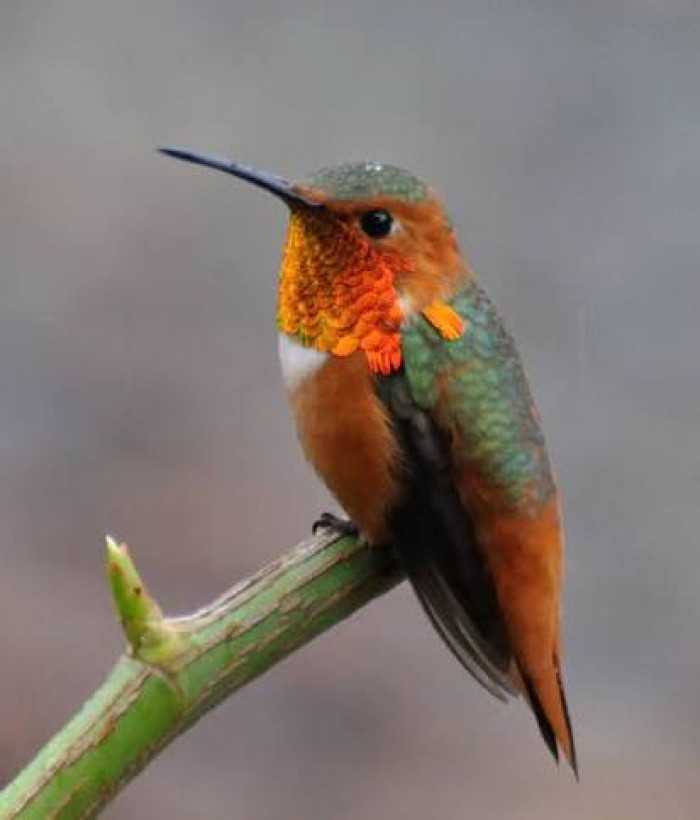
Adult males have an iridescent orange-red throat, green back, and rusty flanks and tail. The glowing throat can read as red, orange, or copper as the bird moves. Pupperish's Allen's Hummingbird feature captures that shift.
By the time you’re watching a vermilion flycatcher hunt from an exposed perch and checking for that dark mask and glowing red underparts, you stop guessing and start confirming.
When red starts to look pink or orange
Bird color names overlap. A raspberry finch may look pink, while warm sunlight can push scarlet plumage toward orange. For those edge cases, compare the bird with pink birds and orange birds rather than creating another red subcategory.pupperish.
The next time a red bird shows up, you’ll know whether it’s a cardinal at first glance or a red herring.
Still mixing up red birds? Compare bill shape, crest, and color placement in 8 Types of Cardinals and the Features That Separate Them.
Share this article:





