Facts About Alligators - From Powerful Jaws to Gator Holes

A 28-year-old woman refused to believe the warning signs and waded closer than she should have when an alligator wandered into a familiar backyard scene. The goal was simple, save a puppy that had slipped too near the edge of danger.
But alligators do not fight like movie villains, they defend like animals that have been underestimated. With eyes and nostrils sitting high on their heads, they can watch and breathe while staying mostly submerged, then shut down their breathing rhythm when they dive. And once that powerful jaw clamps down, the opening muscles are weaker, which is exactly why “close contact” turns into a survival problem fast.
Here’s what makes an alligator’s body such a nightmare when you think it’s just a “quick rescue.”
Alligator Facts About Their Bodies
- Two living alligator species exist: the American alligator and the much smaller Chinese alligator.
- The American species occurs naturally in the southeastern United States, from Texas and Oklahoma east to the Carolinas and Florida.
- A broad, rounded snout gives the head a U-shaped outline. Crocodiles usually have a narrower or more V-shaped snout, although species vary.
- When an alligator closes its mouth, the large fourth tooth in the lower jaw fits into a socket and usually disappears from view.
- Eyes and nostrils sit high on the head, allowing the animal to watch and breathe while remaining mostly submerged.
- A transparent third eyelid protects the eye underwater. Valves also close the ears and nostrils during a dive.
- Alligators cannot breathe underwater. They conserve oxygen by slowing activity and reducing the heart rate, sometimes to only a few beats per minute.
- The jaw closes with tremendous force, but the muscles that open it are weaker. Stories about a person who fought an alligator to save a puppy show why close contact remains extremely dangerous.
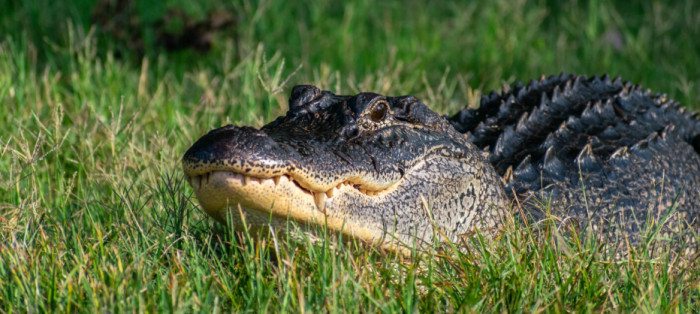
The puppy rescue plan went sideways the second the alligator’s eyes stayed locked on the commotion from just under the surface.
How Alligators Feed and Survive
- Juveniles eat insects, amphibians, crustaceans, and small fish. Larger animals take turtles, snakes, birds, mammals, and carrion.
- Alligators are opportunistic rather than constant hunters. They conserve energy and strike when prey enters a useful position.
- Conical teeth grip and puncture instead of chewing. Food is swallowed in chunks or whole.
- Lost teeth are replaced repeatedly. A large alligator may cycle through thousands of teeth during its lifetime.
- The muscular tail provides most swimming power. The legs steer, walk, climb over obstacles, and support short bursts on land.
- As ectotherms, alligators warm themselves by basking and cool down by entering water, seeking shade, or opening the mouth.
- During cold periods, an alligator may remain in a den or submerged refuge with only the snout exposed through ice or surface water.
- Floods can move alligators into buildings and neighborhoods. After Hurricane Milton, residents found a large alligator inside a kitchen.
Alligator Courtship and Parenting
- Males bellow during courtship and territorial displays. The low-frequency sound can make water vibrate around the body.
- A female builds a mound nest from vegetation, mud, and debris. Decomposing plant material helps warm the eggs.
- Incubation temperature influences the sex of hatchlings. Different temperature ranges produce more males or more females.
- The mother guards the nest and may help uncover it when the eggs begin to hatch.
- Hatchlings call from inside the egg and after emergence. Their chirps help coordinate the mother’s response.
- Young alligators stay in pods near the mother for protection. Cannibalism and predation still make early life dangerous.
- Juvenile alligators sometimes cross roads with birds and other wildlife nearby. One family of cranes guided a baby alligator across traffic.
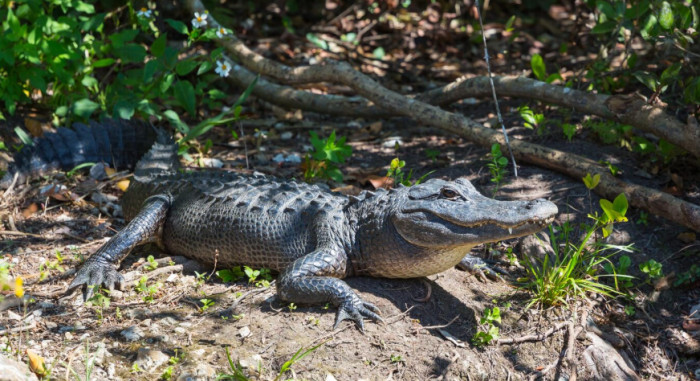
Even the jaw setup matters, that big fourth tooth drops into a socket when the mouth closes, so the bite is built to stay in place.
This is similar to spiders using silk to fly, see ultraviolet light, and recycle their webs.
While everyone is focused on the teeth, the real complication is that alligators cannot breathe underwater, so they manage oxygen by slowing their whole system.
Alligators in Wetlands and Around People
- Alligators excavate depressions called gator holes. During dry weather, those pools can hold water used by fish, turtles, birds, and other animals.
- Alligators and crocodiles both live in Florida, one of the few places where the two occur naturally together.
- Alligators sometimes eat snakes and are also preyed upon when young by larger reptiles, mammals, and birds.
- Large spiders occupy the same wetlands, but they belong to a completely different branch of animal life.
- The American alligator became a major conservation success after legal protection and regulated management allowed populations to recover.
- An alligator can become accustomed to people, especially when fed. The public attention around Wally the emotional support alligator does not make wild handling safe.
- A second appearance by Wally in Philadelphia also raised the distinction between an individual accustomed to people and normal alligator behavior.
What These Facts Reveal
The American alligator recovery shows that a feared predator can rebound under protection and controlled management. It also shows why recovery does not remove the need for boundaries.
A healthy population places more alligators near people living around lakes, canals, ponds, and wetlands. Most risk comes from reducing natural caution.
Feeding teaches alligators to associate people with food, while pets at the water edge resemble normal prey. Watching from a distance preserves the behavior that keeps routine encounters uneventful.
Conservation and public safety depend on the same rule. Wild should remain wild.
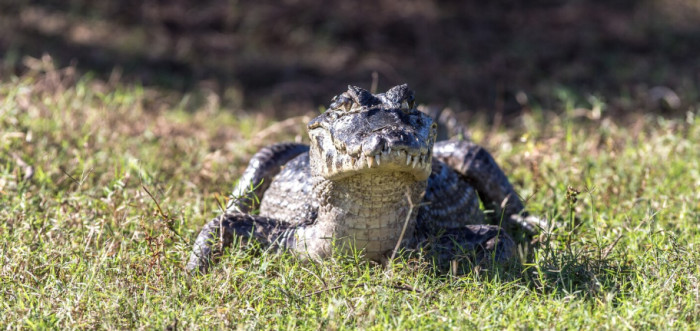
After that, the “it just stood there” moment turns into a sprint, because the tail provides most of the swimming power and the legs only handle quick bursts on land.
Common Questions About Alligators
What is the difference between an alligator and a crocodile?
Alligators usually have broader snouts, with the lower fourth tooth fitting into a socket. Crocodiles often have narrower snouts and visible upper and lower teeth.
How long can alligators stay underwater?
Time varies with temperature, activity, age, and stress. They can remain submerged much longer while resting than during a struggle.
Can alligators climb?
Yes. Young and medium-sized alligators can climb fences, banks, logs, and low obstacles more effectively than many people expect.
The puppy got saved, but the family never forgot how fast “close contact” becomes a full-body problem with a gator.
Want more jaw-dropping survival tricks, like snakes hearing without ears, check out fun facts about snakes that may change how you see them.
Share this article: