
Fun Facts About Snakes That May Change How You See Them

A 28-year-old woman once swore she “heard” a snake before she ever saw it, and the weirdest part is, she might not have been totally wrong. Snakes can’t blink, they don’t have external ear openings, and they’re built to read the world in ways that feel totally alien to us.
Picture the moment she tried to get a better look, only to realize the snake wasn’t reacting like a normal animal would. Its forked tongue was sampling the air from two directions, its spectacle-covered eyes stayed locked, and its jaw could open wide without any dislocation drama. Then, if it was a python, boa, or pit viper, those heat-sensitive pits could make a warm meal pop out in the dark.
Now she’s wondering how many of her “snake facts” were actually just assumptions.
Snake Facts About Senses and Anatomy
- Snakes have no external ear openings. They detect ground vibrations and can also perceive some low-frequency sound moving through the air.
- A forked tongue gathers chemical particles from two directions. The Jacobson’s organ in the roof of the mouth compares the samples.
- Snakes do not blink. A clear scale called a spectacle covers each eye and is shed with the rest of the skin.
- A snake jaw does not dislocate during feeding. Flexible joints, ligaments, and independently moving lower-jaw sections allow the mouth to spread.
- The backbone contains many vertebrae, each connected to ribs and muscles. That repeated structure gives the body both support and flexibility.
- Some pythons, boas, and pit vipers detect infrared radiation through heat-sensitive pits. Warm prey can stand out even in darkness.
- Snake skin is dry. The smooth or keeled scales reduce friction, protect the body, and help grip different surfaces.
- Iridescent scales can bend light into rainbow colors. A rare rainbow snake sighting shows why a dark snake may flash blue, green, and purple.
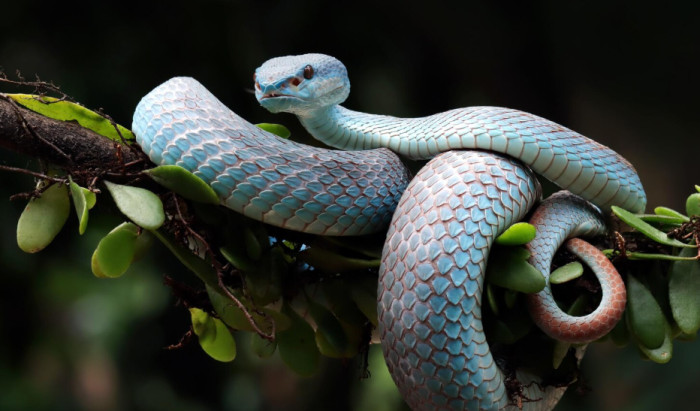
She first noticed the “sound” thing, but snakes actually detect ground vibrations and some low-frequency air movement, so her instincts were basically running on a different sensor system.
How Snakes Move, Hunt, and Eat
- Snakes use several movement styles, including lateral undulation, concertina movement, rectilinear crawling, and sidewinding.
- Not every snake hunts with venom or constriction. Many simply seize small prey and swallow it quickly.
- Constrictors generally kill by interrupting circulation rather than crushing every bone. Pressure stops blood from reaching vital organs.
- Venom and poison are different. Venom is delivered through a bite or sting, while poison causes harm when touched or eaten.
- Only a minority of snake species pose a serious venom risk to humans. Even venomous snakes usually bite defensively rather than hunt people.
- Snakes swallow prey whole, but the prey does not need to be wider than every part of the body. The ribs and skin expand after the head passes.
- Large meals can support a snake for weeks or months because metabolism slows between feeding events.
- Reticulated pythons are among the longest living snakes. A 10-foot python in a tree is large, but far below the species maximum.
Unusual Snake Adaptations
- Rattlesnake rattles gain a segment during shedding, not once per year. Segments also break, so they cannot reliably reveal age.
- Spitting cobras direct venom toward the eyes of a threat. The behavior is defensive and can cause severe injury without treatment.
- King cobras build leaf nests for their eggs, an unusual level of nest construction among snakes.
- Some tree snakes flatten the body and glide between branches. They steer through the air with wave-like movements.
- Sea snakes are powerful swimmers with paddle-shaped tails. Several species can absorb part of their oxygen through the skin.
- The eastern indigo is the longest snake native to the United States and is nonvenomous. Its return to Alabama inspired coverage of a rare indigo snake discovery.
- Corn snakes are among the most commonly bred pet snakes, but any reptile still requires secure housing. Disputes over a secret ball python show why disclosure matters.
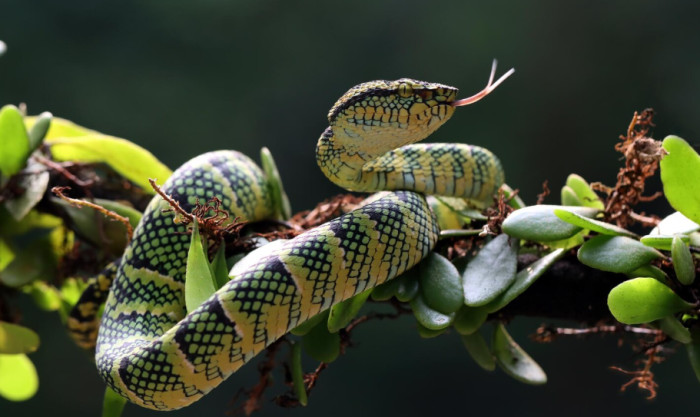
Then the forked tongue came into view, and suddenly her whole “it was just staring” theory fell apart because the Jacobson’s organ is literally comparing chemical samples.
And if you think snakes are weird about senses, these dog facts on scent-reading, tone, and human routine “hacks” will blow your mind.
After that, she watched the way it moved, lateral undulation to concertina to sidewinding, and realized not every snake is built to hunt with venom or constriction.
Snakes in Ecosystems and Human Life
- Snakes reduce populations of rodents and other fast-breeding prey. That role can benefit farms, forests, wetlands, and cities.
- Snake venom compounds have contributed to medicines used for blood pressure, clotting, and other medical problems. Research continues across many species.
- Dogs sometimes confront venomous snakes with serious consequences. A rattlesnake bite during pregnancy shows the risk to pets.
- Snakes share reptile ancestry with alligators and crocodiles but belong to a very different branch of the reptile family tree.
- Some spiders also use venom, yet spider and snake venoms evolved in separate animal groups.
- Milk snakes received their name from an old myth that they stole milk from cows. They were probably entering barns to hunt rodents.
- The safest response to a wild snake is usually distance. Leave it room to escape, keep pets back, and avoid handling an animal you cannot identify.
What These Facts Reveal
Snake diversity is the main fact that fear tends to erase. A burrowing threadsnake, a gliding tree snake, a sea snake, a rattlesnake, and a giant constrictor share a body plan, but they use it in very different habitats and ecological roles.
Most encounters do not require intervention. Distance protects both the person and the animal, while correct identification prevents harmless species from being killed.
Snakes control prey populations, feed larger predators, and contribute compounds used in medicine. Their value does not depend on being comfortable to look at. Respect is more useful than panic.
Common Questions About Snakes
Do snakes have ears?
They lack external ear openings and eardrums, but their inner ears detect vibrations and some low-frequency airborne sound.
Are all snakes venomous?
No. Most species are not dangerously venomous to humans, and many rely on speed, constriction, or simple capture.
Why do snakes shed their skin?
The outer layer does not grow with the animal. Shedding replaces worn skin and allows continued growth.
She thought she was watching a creature with one trick, but the snake was running a whole playbook.
Keep the animal drama going, read these cat facts about headbutts and catnip-fueled chaos.
Share this article:





