
Jaguar vs Leopard: How to Tell Them Apart

A 28-year-old woman snapped a blurry photo on vacation, then posted it like a mic drop. One commenter swore it was a leopard, another insisted it was a jaguar, and suddenly the whole thread turned into a jungle courtroom.
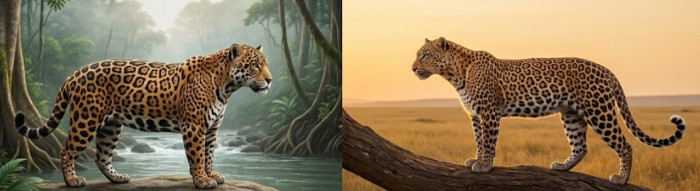
Here’s the mess: the two cats look close enough to fool even sharp eyes, and the usual “just look at the spots” rule falls apart the second the image is at an angle or the animal is half-hidden. Add in the fact that leopards often drag prey into trees, while jaguars hang around rivers, wetlands, and dense forest floor cover, and you get a lot of clues that are easy to mix up.
By the time the debate hits rosettes, tail length, and build, everyone is basically trying to identify a cat from a single frame.
Quick comparison
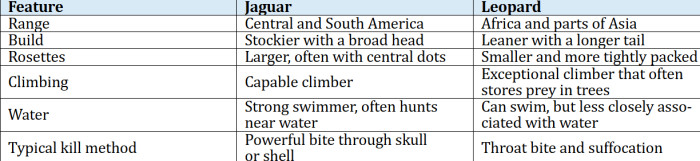
What is the main difference between a jaguar and a leopard?
The main difference is that they are separate species living on opposite sides of the world. The jaguar is Panthera onca. The leopard is Panthera pardus.
Panthera describes jaguars as heavier and more blocky through the head and body, while leopards have a leaner frame and longer tail. Those proportions reflect how each cat uses its habitat.
A leopard often carries prey into a tree, where its long tail helps with balance. A jaguar spends more time around rivers, wetlands, and dense forest floor cover. The elusive puma in Patagonia is another American cat, but it lacks the rosette pattern that causes most jaguar confusion.
Seven ways to tell a jaguar from a leopard
1. Check the rosettes
A rosette is a rose-shaped cluster of dark markings. Jaguar rosettes are generally larger and more widely spaced, and many contain one or more small black spots in the middle.
Leopard rosettes are usually smaller, simpler, and packed closer together. The central dot is the classic jaguar clue.
Not every mark follows the rule. Check several.
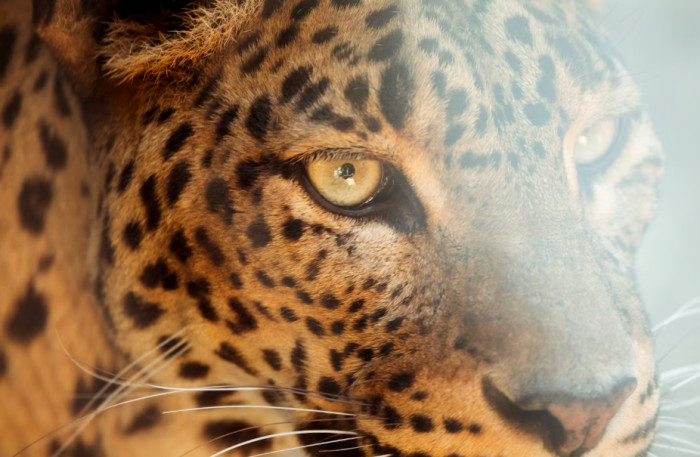
That’s when the rosettes become the first battleground, because jaguar markings and leopard markings can look almost identical until you zoom in on the spacing and the center dots.
2. Jaguars have a heavier build
A jaguar looks compact and muscular, with a deep chest, thick limbs, and a broad skull. A leopard tends to look longer and lighter, although a large male leopard is still a formidable animal.
The difference can be obvious when the cats stand side by side. In isolated photographs, camera angle can distort size, so head shape and tail length are safer clues. Eagle vs hawk identification poses the same scale problem when a distant bird has no reliable reference point.
A retired jaguar living at a sanctuary shows the square head and dense build particularly well.
3. Leopards have longer tails
Leopards spend a great deal of time in trees. Their long tails act as counterbalances while they climb, rest on branches, and move with heavy prey above the ground.
Jaguars can climb too. They are simply less specialized for a strongly arboreal lifestyle and usually have shorter tails relative to body length.

Then the conversation shifts to body shape, since a jaguar’s compact, blocky look can get lost in a distant photo, just like that “is it really bigger?” moment when the camera angle lies.
Speaking of tricky lookalikes, these 19 types of monkeys help you spot clear differences fast.
4. They live on different continents
Wild jaguars are native to the Americas, from parts of Mexico through Central America and into South America. Their strongest populations are associated with large, connected habitats such as the Amazon and Pantanal. The WWF jaguar profile provides additional range and conservation context.
Leopards occur across parts of sub-Saharan Africa, North Africa, the Middle East, Central Asia, India, China, and the Russian Far East. Their range is broader, although many populations are fragmented or declining.
A spotted cat in Brazil is not a wild leopard. One in Kenya is not a wild jaguar.
5. Jaguars are closely associated with water
Jaguars are confident swimmers and regularly hunt around rivers, flooded grasslands, and wetlands. Fish, turtles, caimans, and capybaras can all appear in their diet depending on habitat.
Leopards can swim, but they are more commonly associated with stalking on land and climbing. Their flexibility is one reason they survive in habitats ranging from rainforest to dry mountains.

After that, people start arguing about tails, because a leopard’s long tail is basically built for tree balance, while a jaguar can climb but does not rely on that same routine.
6. Their killing methods often differ
Both animals rely on stealth and a sudden rush. Leopards commonly use a throat bite that suffocates prey.
Jaguars are known for an exceptionally powerful bite relative to body size. They may bite through the skull of prey or pierce hard shells. That ability fits a diet that can include armored reptiles.
Power is not the same as a guaranteed win in an imaginary fight. Age, sex, size, condition, and circumstance matter. The animals do not naturally meet in the wild, and a jaguar that scratched a selfie seeker is a better warning than any staged fight scenario: distance from wild cats matters.
7. Both can be black panthers
Black panther is not a separate species. It is a general term used for melanistic jaguars and leopards whose coats contain unusually high levels of dark pigment.
Their rosettes are often still visible in strong light. The photograph of a leopard beside a black panther makes that hidden pattern easier to notice.

Which is bigger, a jaguar or a leopard?
Jaguars are generally heavier and more robust. Body size varies across each species' range, and males are larger than females, so there is overlap.
The useful field difference is shape rather than a single weight figure. Jaguars look thick through the neck and shoulders. Leopards look more stretched, with a slimmer waist and longer tail. Moose vs elk identification also becomes easier when proportions replace rough size guesses.
Built like a wrestler versus a climber.
Apparent size is one clue, not a verdict. Location, rosette pattern, head shape, and tail length should all point in the same direction.
What do jaguars and leopards eat?
Both are opportunistic carnivores. Leopards hunt animals ranging from rodents and birds to antelope and young livestock. They may drag a carcass into a tree to keep it away from lions, hyenas, and other scavengers.
Jaguars take deer, peccaries, capybaras, reptiles, fish, and other available prey. Their willingness to enter water expands the menu.
Neither species survives on one signature food. Habitat decides much of the diet.
The wider big-cat family contains many body plans and hunting strategies. A gallery of playful jaguars, pumas, tigers, and lions shows how similar behavior can sit on top of very different anatomy.

By the end of the thread, the whole argument circles back to habitat, since jaguar river vibes and leopard tree habits can confirm the guess even when the markings are muddy.
Jaguar vs leopard FAQs
Is a jaguar a type of leopard?
No. They are separate species in the genus Panthera. They share an evolutionary family and a similar coat pattern, but they are not the same cat.
Which cat climbs better?
Leopards are the more specialized climbers. Jaguars climb when needed, but leopards spend more time in trees and regularly haul prey upward.
Which cat has the stronger bite?
The jaguar is famous for a very powerful bite relative to its size. Its broad skull and jaw muscles support a killing method that can pierce skulls and shells.
Can a jaguar and a leopard have black fur?
Yes. Melanism occurs in both species. Under good light, the rosette pattern can still be visible beneath the dark coat.
The quickest identification rule
Start with location. Americas means jaguar; Africa or Asia means leopard. Then inspect the spots. Large rosettes with central dots point to a jaguar, while small, close rosettes point to a leopard.
Finally, compare the build. Broad head, thick chest, and shorter tail suggest jaguar. Lean body and a long balancing tail suggest leopard. A snow leopard hidden against rock may carry a similar common name, but it belongs to another species with a completely different mountain adaptation.
That blurry screenshot might not settle the debate, but it will absolutely make you look twice at every spotted cat you see.
Want more animal ID drama, check out the differences between seals and sea lions, from ears to sounds.
Share this article:





