Moose vs Elk: Size, Antlers, Habitat, and Behavior

It started with a “simple” wildlife ID problem, the kind that turns a calm walk into a full-on argument. One person swore the big, dark animal at the edge of the marsh was an elk, while someone else insisted it was a moose, because the silhouettes looked close enough at first glance.
Then the details piled up fast. They were trying to compare size, antlers, and even habitat from memory, but moose and elk both belong to the deer family, so the confusion is built in. Add in the naming chaos, where “elk” in British English can mean what North America calls a moose, and suddenly everyone is using different labels for the same animal.
Quick comparison
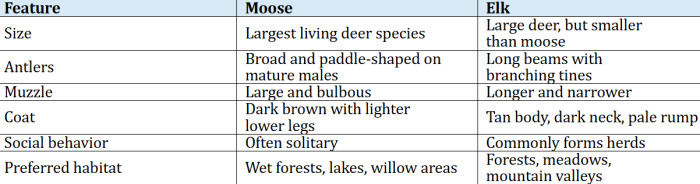
Are moose and elk the same animal?
No. Moose are Alces alces. North American elk are Cervus canadensis. Both belong to the deer family, Cervidae, but they are separate species with different body shapes, behavior, and habitat preferences.
The naming can become confusing outside North America. In British English, the word elk may refer to the animal North Americans call a moose. The North American elk is also called wapiti.
The National Wildlife Federation separates moose, elk, and caribou by size, antlers, body color, and habitat. A rare white reindeer calf belongs to the same wider deer family but has another distinct antler and body pattern.
Seven differences between moose and elk
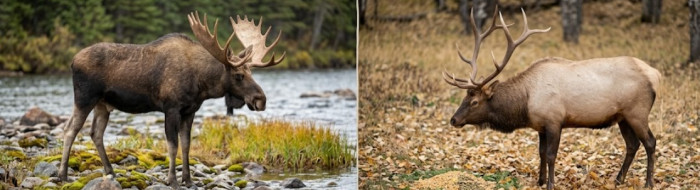
That’s when they noticed the moose’s towering build, the deep body and long legs that make it look taller than it is, while the bull elk looked more balanced and horse-like.
1. Moose are much larger
An adult bull moose can stand well over six feet at the shoulder and weigh more than 1,000 pounds. Bull elk are large, but usually stand lower and weigh considerably less.
A moose also appears taller because of its long legs and deep body. Elk look more balanced and horse-like in proportion.
Size is obvious when the animals share a landscape. Less so in isolated photos. Yak vs bison identification has the same problem, so body proportions are safer than apparent scale.
2. Their antlers have different shapes
Mature bull moose grow broad antlers with flattened, paddle-like sections. Bull elk grow long main beams that sweep backward and carry pointed tines.
Young males may have simpler antlers, and antlers are shed annually. Females generally lack antlers in both species, so use the muzzle, coat, and body shape when antlers are absent. Eagle vs hawk identification follows the same rule: combine several field marks when the most obvious clue is missing.
The Colorado Hunter Education comparison emphasizes the outward-growing moose antlers and backward-sweeping elk antlers as a practical field difference.

Next came the antlers, because one set looked broad and paddle-like, and the other swept backward with long main beams and pointed tines.
3. Moose have a bulbous muzzle
A moose's nose is broad, long, and rounded. A flap of skin called a bell or dewlap hangs beneath the throat, especially in males.
Elk have a narrower, more deer-like face. Their necks often appear dark and shaggy, particularly on mature bulls.
The huge muzzle is hard to miss.
Moose versus elk is another “looks similar, not the same” showdown, like cow vs buffalo confusion over appearance and behavior.
4. Their coats and rump markings differ
Moose usually have a dark brown body, sometimes appearing almost black, with lower legs that may look much lighter.
Elk commonly show a tan or light brown body, a darker neck, and a conspicuous pale rump patch. The pale patch can remain visible when the animal is moving away through trees.
A moose trapped in a swimming pool shows the dark body and long-legged silhouette clearly, even in a setting where no one expects to identify wildlife.

After that, the bulbous muzzle and the hanging flap of skin under the throat, the bell or dewlap, made it harder for anyone to keep calling the animal the wrong name.
5. Elk form larger groups
Moose are often solitary, apart from mothers with calves and temporary breeding interactions. Elk are much more social and can gather in large herds.
Season changes group size. During the rut, bull elk compete for groups of females and produce loud bugling calls. Bull moose also compete during breeding season, but their social pattern is less herd-based.
6. Moose prefer wetter habitat
Moose are strongly associated with northern forests, wetlands, lakes, and areas rich in willow and aquatic plants. Their long legs help them move through deep snow, marshes, and water.
Elk use forests, grasslands, mountain valleys, and open meadows. They may travel long distances between seasonal ranges.
A moose cow and calves entering a backyard is unusual only in location. Another moose family that ignored sprinklers shows how persistent these animals can be around residential food and cover.
7. Their calls sound different
Bull elk produce the famous bugle, a rising, high-pitched call that carries across open country during the rut.
Moose use grunts, low calls, and other vocalizations. A cow moose can produce drawn-out calls during breeding season, but the sound does not resemble an elk bugle.

Which is more dangerous, a moose or an elk?
Both can injure people. Moose are especially dangerous because of their size, speed, and willingness to defend space, calves, or access routes. A moose that lowers its ears, raises neck hair, licks its lips, or walks directly toward someone may be warning of a charge.
Elk can also attack, particularly during calving season and the autumn rut. A bull with antlers needs considerable distance.
Do not approach either animal for a photograph.
The mother moose that confronted a grizzly reacted to a direct threat to her calf. The same protective behavior can be turned toward a person or dog that gets too close.
Moose vs elk in a fight
A healthy adult bull moose usually has the size advantage over a bull elk. That does not make staged fight predictions useful. These species do not typically seek each other out for combat, and outcomes would depend on age, health, antlers, terrain, and motivation.
Bigger is not invincible.
The more useful question is how to avoid conflict. Keep distance, control dogs, follow park rules, and retreat if the animal changes behavior because of your presence.
Fight questions flatten animal behavior into a size contest. Identification, warning signals, and safe distance provide far more useful information.

And once they compared where each animal tends to hang out and how they behave, the “same animal” claim finally collapsed under the weight of real differences.
Moose vs elk FAQs
Do female moose and elk have antlers?
Females generally do not. Rare exceptions can occur because of hormonal or developmental conditions.
Which animal runs faster?
Both can run quickly enough to outrun a person over short distances. Exact speed estimates vary, and neither animal should be tested or provoked.
Are elk and caribou the same?
No. Caribou are Rangifer tarandus and are called reindeer when domesticated or in Eurasian usage. Both male and female caribou can grow antlers, which is unusual in the deer family.
What do moose and elk eat?
Both are herbivores. Moose browse woody plants and aquatic vegetation. Elk eat grasses, forbs, leaves, bark, and shrubs depending on season.
The quickest identification rule
Look at the head and antlers. Broad muzzle plus paddle antlers means moose. Narrower face plus long branching antlers means elk.
When antlers are absent, use coat and social setting. A dark, long-legged animal alone near water points to moose. A tan animal with a pale rump moving in a herd points to elk. A moose diving from a Newfoundland cliff shows how comfortably the species can enter water, reinforcing habitat as a useful supporting clue.
The moose and elk debate didn’t just end, it got corrected, right there at the marsh edge.
Want more head-to-head ID tricks, see 15 deer types, sorted by antlers, rump patches, and ears.
Share this article: