
Python vs Boa: 7 Differences Between These Constrictors

It started as a casual “python vs boa” argument, the kind that usually ends in a quick shrug and a change of topic. But this time, it got personal fast, because a photo of a big, patterned snake showed up in a group chat and nobody could agree what it was.
One person insisted it was “probably a python,” another swore it was “definitely a boa,” and a third person kept waving around size claims like that settles everything. The complication is that size overlaps, and colors, patterns, and body shapes can look painfully similar, especially when the snake is out of context.
So the real tell is stranger than you’d expect, and it has nothing to do with how impressive the coils look.
Quick comparison
What is the main difference between a python and a boa?
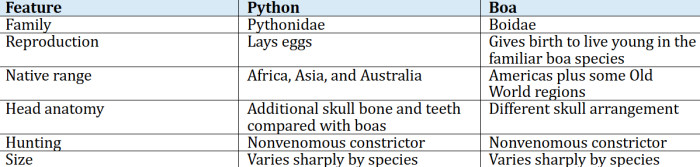
The most practical difference is reproduction. San Diego Zoo Wildlife Alliance notes that pythons lay eggs while boas give birth to live young. The same source also separates their usual ranges, with pythons native to Africa, Asia, and Australia and boas occurring in both the Old and New Worlds.
That makes reproduction much more useful than a rule such as “boas are smaller.” Size overlaps. So do colors, patterns, and body shapes.
Seven ways pythons and boas differ
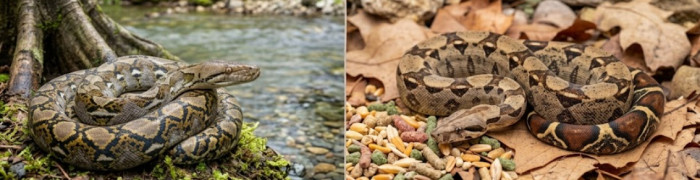
That’s when the group chat pivoted from “who’s right” to “what detail actually matters,” and the egg versus live-birth difference jumped to the top of the list.
1. Pythons lay eggs
Female pythons produce eggs. In several species, the mother coils around the clutch during incubation, and some can generate small amounts of heat through muscular activity.
Boas take another route.
Smithsonian’s boa constrictor profile describes females giving birth to live, independent young after internal development. That single difference answers many python vs boa questions faster than body size ever will.
2. They belong to different snake families
Pythons are members of Pythonidae. Boas are members of Boidae. They are related within the broader constrictor branch of snakes, but one is not a type of the other.
That family-level distinction is similar to salamander vs newt only in one respect: taxonomy settles the question. The relationship itself is different because newts sit inside the salamander group, while pythons and boas are separate snake families.

Then someone pointed out the location problem, because a “python emerging from a car” would make even good geography guesses fall apart.
This is like the way snakes “hear” without external ears, and these fun facts show how you’re wired to misunderstand them.
3. Their native ranges overlap less than their appearance suggests
Wild pythons are native to Africa, Asia, and Australia. Boas are especially associated with the Americas, although the boa family also includes species elsewhere.
Geography is therefore useful when the snake is wild and the location is known. It is useless for an escaped or captive animal, where species identification has to come from anatomy, pattern, and reliable ownership records.
A python emerging from a car is exactly the kind of encounter where location alone can mislead. Captive snakes travel far beyond their natural range.
4. Head structure is not identical
The two groups have subtle skull differences. San Diego Zoo notes that pythons have an additional head bone and extra teeth compared with boas. Those are real anatomical distinctions, but they are not useful field marks for someone looking at a snake from several feet away.
Pattern, head proportions, range, and a confirmed species name are safer for ordinary identification.
Small structures beat rough impressions.

After that, the debate shifted again, from wild ranges to family names, since Pythonidae and Boidae are separate buckets, not interchangeable labels.
5. “Boa” includes anacondas
Anacondas belong to the boa family. That surprises people because the common names sound like three equal categories: python, boa, and anaconda. Biologically, the last two are not equivalent levels.
A huge snake at a building site identified as an anaconda may look python-like at first glance, while a diver beside an anaconda shows the heavy aquatic build associated with that boa relative.
6. Both constrict prey, so hunting style does not separate them
Neither group should be defined as a venomous snake. Pythons and boas subdue prey by wrapping the body around it and tightening. Constriction interferes with circulation and quickly incapacitates prey.
The prey can be substantial. A python swallowing a deer shows why flexible jaws and expandable soft tissues matter, but an extreme meal does not identify the snake family by itself.
Snakes can also swallow objects they should not. A python that ate a shoe is a better lesson in enclosure management than in family identification.
7. Species matters more than the label for pet care
“Python” and “boa” each cover multiple species with different adult sizes, humidity needs, climbing habits, feeding schedules, and enclosure requirements. A ball python and a reticulated python are not interchangeable. Neither are a rosy boa and a boa constrictor.
Anyone considering a captive snake should identify the exact species first, then plan for its adult size, secure housing, veterinary access, and local rules. Buying a snake because the juvenile looks manageable is a poor care strategy.
Unexpected encounters make the same point. A snake that shocked drivers needs identification before anyone can make a sensible claim about risk.
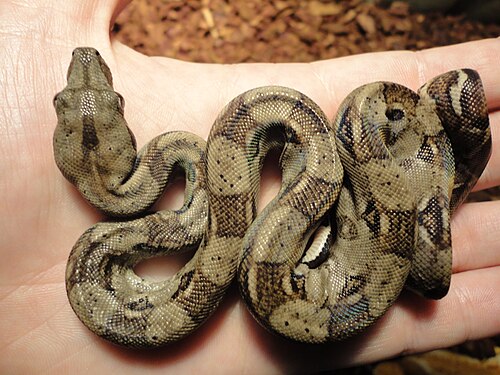
Finally, the room went quiet when the reproduction point made every other claim feel like background noise, because it answers the question faster than size ever could.
Which is bigger, a python or a boa?
There is no useful group-wide answer. Both families contain small and large species. Some pythons reach greater lengths than most boas, while very heavy boa relatives such as anacondas can outweigh many pythons.
Compare named species, not family labels.
That is the same reason jaguar vs leopard identification works better with proportions, markings, and geography than with a vague “which one is bigger?” rule.
Python vs boa FAQs
Is a boa a python?
No. Boas and pythons are related constrictors, but they belong to different families.
Do boas lay eggs?
The familiar boas in this comparison give birth to live young. That contrasts with pythons, which lay eggs.
Is an anaconda a boa?
Yes. Anacondas belong to the boa family, Boidae.
Are pythons and boas venomous?
No. They are constrictors rather than venomous snakes. A bite can still cause serious injury, especially from a large animal.
The quickest identification rule
Start with a confirmed species name and geographic origin. If reproduction is known, eggs point strongly toward python and live birth toward boa. Then use head shape, body pattern, and species-specific field marks.
Do not use size alone. A small python remains a python, and a large boa remains a boa.
The next time that group chat posts a mystery constrictor, nobody should trust the pattern first, they should trust how it reproduces.
Want more than pythons and boas, check out these 18 snake types with ID tips here.
Share this article:





