
Salamander vs Newt: What Is the Difference?

A 28-year-old woman refused to call it “a newt” at the park, even though the animal was sitting on a damp rock like it owned the place. Her friend kept saying “salamander,” and the whole group turned into a tiny taxonomy courtroom, arguing skin texture, habitat, and whether the name even mattered.
Then the confusion got worse, because salamander is the broad umbrella and newt is a narrower subset inside it. Add in the common look-alike problem, some newts often have rougher, drier-looking skin, while many other salamanders look smoother, and suddenly everyone is staring at the same creature with totally different conclusions.
By the time they finally stopped arguing and actually looked closely, the difference was right there in the details.
Quick comparison
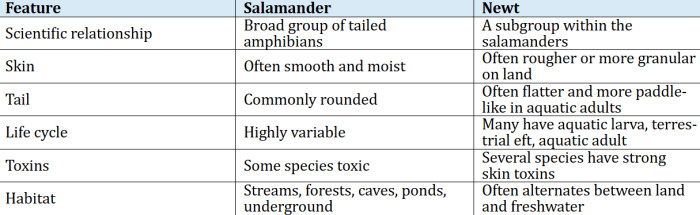
What is the main difference between a salamander and a newt?
Salamander is the broader term. Newt refers to a subgroup of salamanders, commonly placed within the subfamily Pleurodelinae in the family Salamandridae.
The San Diego Zoo explains the relationship simply: a newt is a salamander, but a salamander is not necessarily a newt. It also notes the common, but imperfect, difference between rougher newt skin and smoother salamander skin. Unlike seal vs sea lion, where two separate families share a broader group, newts sit inside the salamander group.
The rule resembles categories such as dog and terrier. Every terrier is a dog. Not every dog is a terrier.
A camouflaged frog hidden among rocks belongs to another amphibian order, but its moist skin and dependence on environmental water can make it look ecologically similar.
Six differences between newts and other salamanders

That’s when they realized “newt” is basically a salamander, but the reverse is not always true, like their argument was missing one key category.</p>
1. Newts form a smaller subgroup
Salamanders include hundreds of species spread across several families. The group contains newts, mole salamanders, lungless salamanders, giant salamanders, sirens, mudpuppies, and others.
Newt is a narrower common name. Taxonomy matters because no single body feature separates every newt from every other salamander.
Category first. Appearance second.
2. Newt skin is often rougher
Many terrestrial newts have dry-looking, granular, or warty skin. Other salamanders often look slick and smooth.
Both still need moisture. Amphibian skin is involved in water balance and, in many species, gas exchange. A newt with rough skin should never be treated like a dry-skinned lizard.
The leaf-tailed gecko that looks like a leaf is a reptile with scales and claws. A similarly shaped salamander has glandular skin and no scales.

Next came the skin debate, with the woman insisting the granular, warty look meant “newt,” while her friend pointed out both still need moisture.</p>
3. Many newts have a three-stage life cycle
A common newt pattern begins with an aquatic larva. The animal then becomes a terrestrial juvenile called an eft before returning to water as an adult.
The eastern newt is the familiar North American example, with a bright orange-red eft stage that may spend years on land.
Other salamanders often follow a two-stage pattern, moving from aquatic larva to land-dwelling adult. Yet salamander life cycles are exceptionally varied. Some remain aquatic, some develop directly inside the egg, and axolotls retain larval traits as adults.
Also, if you like ID guides, check 18 types of turtles, from sea turtles to box turtles, with pictures and tips.
4. Adult newts are often more aquatic
Many newts return to ponds, lakes, or slow water to breed and may spend long periods swimming as adults. Their tails can become flattened to provide better propulsion.
Other salamanders may live beside streams, beneath logs, underground, in caves, or even high in vegetation. Lungless salamanders can remain entirely terrestrial and exchange gases through the skin and mouth lining.
The diversity is the point.
AmphibiaWeb catalogues amphibian species and shows how much variation exists beyond the few newts and salamanders commonly seen in pet shops or backyard ponds. Python vs boa is another comparison where close outward resemblance hides a meaningful taxonomic split, although those snakes belong to separate families rather than one group sitting inside the other.

5. Newts are often more toxic
Many salamanders produce unpleasant or toxic skin secretions. Several newts take chemical defense much further.
Rough-skinned newts in western North America can carry tetrodotoxin, a potent neurotoxin. Bright orange or red coloration may warn predators not to bite.
Do not handle wild amphibians unless necessary. Oils, lotions, sunscreen, and dry hands can harm their skin, while secretions can irritate human eyes or mouths.
A mushroom discovered growing from a living frog drew scientific attention because amphibian skin is a sensitive biological surface where moisture, microbes, and disease can interact in unexpected ways.
6. Tail shape can provide a clue
Aquatic adult newts often have laterally flattened, paddle-like tails. Many terrestrial salamanders have rounder tails.
Species and season complicate the rule. Some male newts develop taller tail fins during breeding season, while aquatic salamanders outside the newt group can also have flattened tails.
Use tail shape with skin texture and habitat, not alone.

Then they remembered the life cycle twist, newts often do the whole aquatic larva, land eft, back to water adult routine.</p>
Is an axolotl a newt?
No. An axolotl is a salamander in the mole salamander family, Ambystomatidae. It is famous for neoteny, meaning it usually keeps larval features such as external gills while becoming sexually mature.
An axolotl is therefore a salamander but not a newt.
Beetle vs cockroach illustrates a separate-order comparison: the animals may look similar, but neither group sits inside the other. Newt and salamander are different because the narrower name belongs within the broader one.
Is a newt a baby salamander?
No. Newt does not mean juvenile salamander.
Some newts have a terrestrial juvenile stage called an eft, but adult newts remain newts. Other salamanders have larvae and juveniles that are never called newts.
This misconception probably comes from seeing a small newt and assuming it is an early stage of a larger salamander.
Can you touch a salamander or newt?
Observation is better than handling. Amphibians absorb water and chemicals through sensitive skin, and many species are stressed by capture.
When an animal must be moved out of immediate danger, use clean, wet hands or powder-free gloves, keep handling brief, and place it in nearby suitable cover in the direction it was traveling. Local rules may prohibit handling protected species.
Never put a wild salamander or newt into a home aquarium. Removing animals can damage local populations and spread disease.
A long-term photographic project on reptiles and amphibians is a better model: document the animal without turning the encounter into a capture.

Finally, the rocks-and-water setting clicked, because that frog-like camo problem was exactly the kind of mix-up that makes “salamander vs newt” arguments explode.</p>
Salamander vs newt FAQs
Do salamanders turn into newts?
No. A salamander species does not switch taxonomic identity. A newt is born as a newt species and remains one through its life stages.
Are salamanders reptiles?
No. Salamanders are amphibians. They lack scales, have permeable skin, and follow reproductive and developmental patterns that differ from reptiles.
Can newts regrow limbs?
Many newts and other salamanders have remarkable regenerative abilities, including regrowth of limbs and some tissues. Capacity varies by species and life stage.
Where do newts spend winter?
Depending on species and climate, they may shelter under logs, in soil, beneath leaf litter, or in protected aquatic sites. They reduce activity during cold conditions.
The quickest identification rule
First remember the category: every newt is a salamander. Then look for rougher skin, an aquatic adult lifestyle, and a flattened swimming tail. Those clues suggest newt, but exceptions exist.
A smooth, moist, long-tailed amphibian under a log may be another kind of salamander. A scaly animal with claws is a reptile, such as the armadillo lizard that resembles a small dragon. Taxonomy first prevents most identification mistakes.
By the time the group stopped naming the creature and started describing what it was doing, nobody felt right calling it the wrong word anymore.
Want another close look at lookalikes, read shrimp vs prawn, where gills, claws, and classification don’t match.
Share this article:





