Beetle vs Cockroach: How to Tell Which Insect You Found

It started the way a lot of bad backyard myths start, with a roommate screaming at something small and fast on the floor. The “giant water bug” panic was real, and the only thing more real was how quickly everyone decided it was a cockroach, no questions asked.
But in this house, fear moved faster than facts. One person swore it had the classic roach look, another insisted it was a beetle, and suddenly the whole apartment was playing insect detective with limited angles, bad lighting, and zero patience for “maybe it’s the wings.”
Here’s how to tell beetles and cockroaches apart without letting the panic pick the winner.
Quick comparison
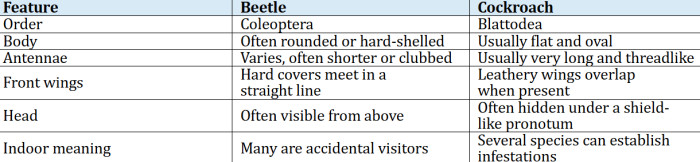
What is the main difference between a beetle and a cockroach?
They belong to different insect orders. Beetles are Coleoptera. Cockroaches are Blattodea, the same order that includes termites.
A beetle's defining feature is the hardened pair of front wings called elytra. These form protective covers over the flight wings and abdomen. Cockroaches may have wings, but the front pair is leathery rather than a hard shell, and the wings usually overlap.
The University of Minnesota Extension cockroach guide warns that ground beetles, crickets, and other insects are often mistaken for cockroaches. A roommate frightened by a giant water bug faced the same basic problem: fast identification based on fear is frequently wrong.
Seven ways to tell a cockroach from a beetle
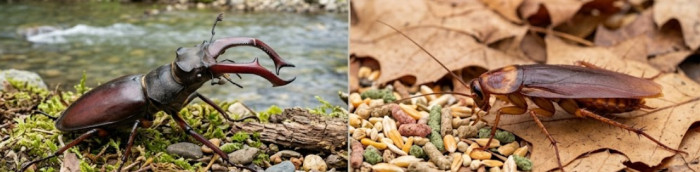
That same roommate who thought the “giant water bug” was definitely a roach is exactly why you should start with the body shape instead of vibes.
1. Check the body shape
Cockroaches are usually flattened from top to bottom and shaped like elongated ovals. This body lets them squeeze into narrow cracks.
Beetles vary enormously. Some are rounded, long, domed, narrow, or almost square. Ground beetles can look roach-like, but their bodies are often more rigid and less flat.
2. Look at the line down the back
A beetle's hardened wing covers usually meet along a clean, straight seam running from the upper back toward the abdomen tip.
Cockroach wings, when present, overlap rather than forming two symmetrical shell halves. Wingless cockroach nymphs lack the clear beetle seam.
One line can settle it.

While everyone was arguing in the kitchen, the flattened, crack-squeezing look of a cockroach would’ve been the first clue.
3. Compare the antennae
Cockroach antennae are typically longer than the body and extremely thin. They sweep constantly as the insect moves.
Beetle antennae vary by family. They may be short, clubbed, elbowed, feathery, or moderately long. Some longhorn beetles do have very long antennae, so combine this clue with the wing covers.
A gallery of macro insect photography makes those antenna shapes much easier to compare than a brief sighting on a kitchen floor. A rare metallic beetle also shows how far beetle shapes and surface textures can vary.
If you like clear ID rules, this is like spotting hawks versus eagles by wing shape and flight style.
4. Check whether the head is visible
From above, a cockroach's head is often largely covered by a plate called the pronotum. The body can appear to begin with a broad shield.
Many beetles show a clearer head, although the exact shape differs. Ground beetles often have visible jaws and a narrower connection between the head and thorax.

5. Watch how it moves
Cockroaches are fast runners and often dart toward cracks, appliances, or cabinets when lights turn on.
Ground beetles can also run quickly, but many wander in from outdoors and may appear less tied to food areas. Some beetles fly toward lights, while common household cockroaches are more likely to remain hidden in warm, moist, protected spaces.
Behavior supports identification. It does not replace anatomy.
6. Look for cerci
Cockroaches have a pair of small appendages called cerci at the rear of the abdomen. They may look like short tails or points.
Beetles do not have the same visible rear cerci. This feature can be difficult to see without a close photograph.

Then the back-wing seam comes into play, because a beetle’s clean, straight line is hard to fake when you finally get a clear view.
7. Consider where and how many you found
One ground beetle near a door or basement window may be an accidental visitor. It probably entered while hunting smaller insects or seeking shelter.
Repeated cockroach sightings, droppings, egg cases, shed skins, or activity in kitchens and bathrooms suggest an established problem. One sighting does not always reveal the scale, but multiple life stages are a serious clue.
The University of Minnesota ground beetle guide describes these beetles as mainly outdoor predators that occasionally enter buildings without reproducing indoors. Small structural details matter here, just as they do in shrimp vs prawn identification.
Are beetles as bad as cockroaches?
Most beetles found indoors are not equivalent to pest cockroaches. Ground beetles do not infest food storage or multiply in kitchen cracks. They are generally beneficial predators outdoors.
Some beetles are household pests, including carpet beetles, pantry beetles, and wood-boring species. Correct identification still matters because the source and treatment are different.
Cockroaches can contaminate surfaces and food, and their shed material and droppings may worsen allergies or asthma. An established infestation deserves prompt action.
No universal bug treatment.
The cockroach naming fundraiser at a zoo treats Madagascar hissing cockroaches as animals worth observing, while indoor pest species create a very different human conflict. The word cockroach covers thousands of species, and only a small portion commonly infest homes.

And once you compare antennae, those long, constantly sweeping cockroach feelers tend to give up the truth fast, even when the wings are confusing.
What should you do after finding one?
Photograph the top and underside, include an object for scale, and note the room, time, and behavior.
Then clean strategically rather than spraying at random. Seal food, repair leaks, vacuum crumbs, reduce cardboard clutter, and close gaps around pipes and doors. Sticky monitoring traps can show where insects are moving.
Broad pesticide use without identification can expose people and pets while missing the actual source. A pest professional or local extension office can identify uncertain specimens.
Taxonomy prevents bad assumptions. Salamander vs newt is a different relationship because one name sits inside the broader group, while beetles and cockroaches belong to separate insect orders.
Beetle vs cockroach FAQs
Can a beetle be mistaken for a cockroach?
Yes. Dark ground beetles are frequent lookalikes, especially in poor light. The hard wing covers, central seam, and visible head help separate them.
Do beetles eat cockroaches?
Some predatory beetles may eat cockroach eggs or small individuals, but finding a beetle does not provide useful cockroach control.
Can cockroaches fly?
Some species and sexes can fly or glide, while others rarely do so. Wings do not automatically mean beetle.
Why do beetles come inside?
Many enter accidentally through doors, windows, foundations, or gaps. Outdoor lighting can attract flying species. Moisture and seasonal temperature changes also drive movement.
The quickest identification rule
Look for a hard shell with a straight center seam. That points to beetle. A flat oval body, very long threadlike antennae, hidden head, and overlapping wings point to cockroach.
Then consider the pattern of sightings. One insect beside a door may be a visitor. Several sizes in a warm kitchen suggest breeding.
A bug-catching car device used to measure insect decline shows that insect identification can support research, while the strange Darth Vader sea bug proves that common names alone often tell us very little about biological relationships.
Next time someone panics in your apartment, you can stop the argument before the insect even gets a second name.
Want more insect-to-wing drama? Read how butterflies taste with their feet.
Share this article: