
Hawk vs Eagle: How to Identify These Birds of Prey

A 28-year-old woman stood on her porch with a coffee that had gone cold, watching a dark raptor wheel against the sky like it owned the place. It looked big, then it didn’t, then it somehow looked like two different birds depending on the angle. She kept telling herself it was “probably a hawk,” but the shape kept nagging at her, especially the wings.
The messy part is that field ID is rarely a nice close-up. Sometimes you get a silhouette, sometimes you get a quick pass over crows or gulls, and sometimes the raptor is far enough away that size lies to your face. Even the wing and head clues can blur because eagles and hawks overlap in look, and the same broad-winged “finger” vibe shows up in more than one group.
So when she saw the bird’s wingbeat and tail for just a second, she finally had to pick a side.
Quick comparison
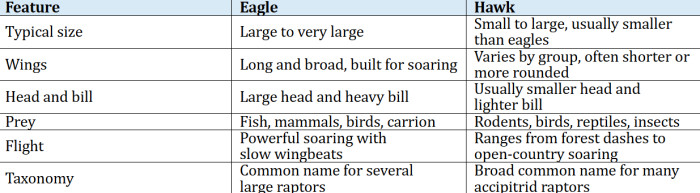
What is the main difference between an eagle and a hawk?
Eagles are usually larger and more heavily built. Their heads, bills, legs, and talons look substantial in relation to the body. Hawks are more varied because the name includes compact woodland hunters, broad-winged soaring birds, and several regional naming traditions.
The Audubon raptor identification guide recommends focusing on size, shape, overall tone, and wingbeat pattern rather than trying to read fine plumage details from a distant silhouette.
That method works. A harpy eagle's massive proportions are obvious at close range, but field identification often happens when the bird is only a dark shape against the sky.
Six ways to tell an eagle from a hawk
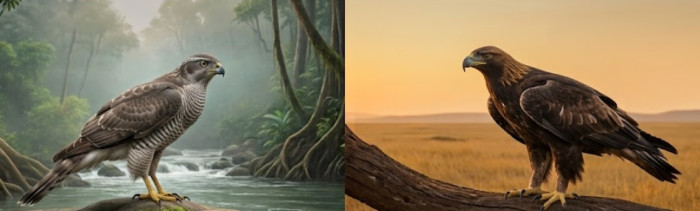
That porch-view moment is why “quick comparison” starts to feel like a real test, not a trivia question.
1. Compare overall size
Eagles are usually larger than hawks found in the same region. Bald and golden eagles have long wingspans, thick bodies, and large heads that project strongly in flight.
Size can deceive at a distance. A small bird nearby can look larger than an eagle far away, so compare the raptor with trees, utility poles, crows, gulls, or other birds at the same distance. The same scale problem appears in moose vs elk photographs, where camera distance can distort an animal's apparent size.
No reference point, no reliable scale.
2. Look at the wings
Eagle wings are broad and long, with separated primary feathers at the tips that resemble fingers. They are built for efficient soaring.
Many buteo hawks, including red-tailed hawks, also have broad wings and fingered tips. Accipiter hawks have shorter, rounder wings designed for rapid acceleration and turning among trees.
This is why wing shape alone is not enough. Combine it with tail length and head size.
A hawk attacking a plastic duck shows the compact shape and quick strike people often associate with hawks, although species vary widely.

When she tried to use size, the raptor kept changing scale against trees and utility poles like the camera was messing with her.
3. Check the head and bill
Eagles tend to have a larger, more projecting head and a deeper hooked bill. Hawks generally look smaller-headed and lighter-billed.
In a soaring bald eagle, the head and tail may project by roughly similar amounts on opposite ends of the body. A turkey vulture, which is often mistaken for an eagle, has a much smaller head and holds its wings in a shallow V.
For a different “spot the lookalike” showdown, see Jaguar vs Leopard, where rosette patterns and climbing habits decide the winner.
4. Watch the wingbeats
A large eagle often uses slow, powerful wingbeats followed by long periods of soaring or gliding. Smaller hawks may flap more frequently.
Forest hawks can alternate several quick beats with a glide. Open-country buteos soar extensively, sometimes barely flapping while riding rising warm air.
Flight rhythm narrows the options. It rarely names the species by itself.

5. Notice the habitat and prey
Bald eagles are strongly associated with rivers, lakes, reservoirs, and coasts because fish form a major part of their diet. The Cornell Lab Bald Eagle guide points birders toward water, especially during winter.
Golden eagles favor open country and hunt mammals. Many hawks hunt rodents, birds, reptiles, or insects in forests, fields, suburbs, and deserts.
A bald eagle carrying unexpected prey is a useful warning against rigid food rules. Raptors take opportunities.
6. Check leg feathering carefully
Golden eagles have feathers extending down the legs to the feet. Bald eagles have bare lower legs. Hawks vary, and the rough-legged hawk is named for feathered legs that can create confusion.
This clue is usually useful only in a clear photograph or through binoculars.

Then the wings showed up, and suddenly the fingered tips and the tail length mattered more than whatever fine plumage she couldn’t see anyway.
Are eagles a type of hawk?
In a broad family sense, yes. Eagles and many birds called hawks belong to Accipitridae, along with kites, harriers, and Old World vultures. The common names reflect size, tradition, and appearance more than a single scientific boundary.
That is why the phrase hawk vs eagle can oversimplify the family tree. A booted eagle may be smaller than a large hawk. Some languages and regional traditions apply the labels differently.
Common names are practical. Taxonomy is precise.
Common names can hide different kinds of relationships. Jaguar vs leopard compares two species, while eagle and hawk are broader labels spread across several raptor groups.
Which is stronger, an eagle or a hawk?
A large eagle has more body mass, heavier feet, and greater gripping power than most hawks. That does not mean every eagle dominates every hawk in every interaction.
Smaller raptors can mob larger birds, especially near nests. Crows, kingbirds, and hawks may repeatedly dive at an eagle until it leaves the area.
Strength is only one part of survival. Speed, maneuverability, numbers, and motivation count too.
A mother eagle remaining on snow-covered eggs demonstrates endurance and parental behavior rather than combat strength, but those traits matter just as much in the wild.

By the time she tracked the head and bill shape, the whole “hawk vs eagle” debate stopped being theoretical and started feeling personal.
Can a hawk carry off a dog?
Claims about hawks carrying medium or large dogs are usually exaggerated. A raptor cannot fly away with prey close to or above its own body weight under normal conditions.
Very small pets can face risk from large raptors, especially when left unattended in open areas. Supervision and covered outdoor spaces are sensible. Panic about a hawk lifting a 20-pound dog is not.
Hawk vs eagle FAQs
Is a bald eagle bigger than a red-tailed hawk?
Yes. A bald eagle is substantially heavier and has a longer wingspan. At a distance, both may soar with broad wings, so compare head size and overall bulk.
Do eagles and hawks make the same sound?
No single sound applies to either group. Species have distinct calls. Film and television often use a red-tailed hawk scream for a bald eagle because the hawk call sounds more dramatic.
Which bird flies faster?
Speed depends on species and whether the bird is level-flying, diving, or pursuing prey. Falcons, which form a different raptor family, include the fastest diving birds.
Can hawks and eagles live in cities?
Some can. Red-tailed and Cooper's hawks adapt well to urban and suburban areas. Bald eagles increasingly appear near populated waterways when food and nesting habitat are available. An injured bald eagle rescued from a highway shows why urban sightings may require trained wildlife responders rather than public handling.
The quickest identification rule
Start with proportions. An eagle usually looks heavy from bill to talons, with broad wings and a large head. A hawk usually looks smaller or more compact, although broad-winged buteos can imitate an eagle silhouette.
Then use habitat and flight. Large raptor over water, slow wingbeats, heavy head: likely eagle. Smaller raptor making quick turns near trees or hunting a field edge: likely hawk. A collection of bird encounters that includes a rescued falcon helps show why every raptor should be identified from several clues, not one dramatic feature.
She might not care what it’s called, but she’ll never unsee the difference once she’s sure which bird owned that sky.
Want more raptor mix-ups? Check out these 15 owl types, from ear-tufted hunters to heart-faced screechers.
Share this article:





