
Fun Facts About Pigs That Show How Smart and Social They Are

Some people think pigs are just farm animals that grunt and root around all day, but their bodies and brains are basically built for social life and problem-solving. Their flexible, cartilage-supported snouts are made to lift soil, nudge objects, and hunt for food, and their world is guided more by smell and hearing than by sight.
Now picture a warm, muddy pen where pigs have to make choices, they separate wallowing spots from sleeping areas, and they use mud like a built-in sunscreen plus bug shield. Add in the fact that pigs can learn routes, routines, and even simple tasks fast, and you get the real twist: they are not just doing random pig things, they are communicating, remembering, and bonding.
That’s why one pig can grow tusks, flop or stand its ears depending on the breed, and still act like it’s part of a tight-knit group.
Pig Facts About Bodies and Senses
- Domestic pigs descend from wild boar, Sus scrofa. Selective breeding produced many sizes, colors, coat types, and body shapes.
- The muscular snout ends in a flexible disc supported by cartilage. Pigs use it to lift soil, move objects, and search for food.
- Smell and hearing are major senses for pigs. Their vision plays a smaller role when they investigate the environment.
- Pigs do not cool themselves effectively through sweating. Shade, airflow, water, and mud become important in warm weather.
- Mud can lower body temperature and form a protective layer against sun and biting insects. Given options, pigs separate wallowing areas from sleeping areas.
- Pigs have cloven hooves, with two main weight-bearing toes and smaller dewclaws higher on the leg.
- Both male and female pigs can grow tusks. They are modified canine teeth that continue developing through life.
- Pig appearance varies sharply by breed. Galleries of pig photos show straight ears, floppy ears, long snouts, short snouts, spots, hair, and bare-looking skin.
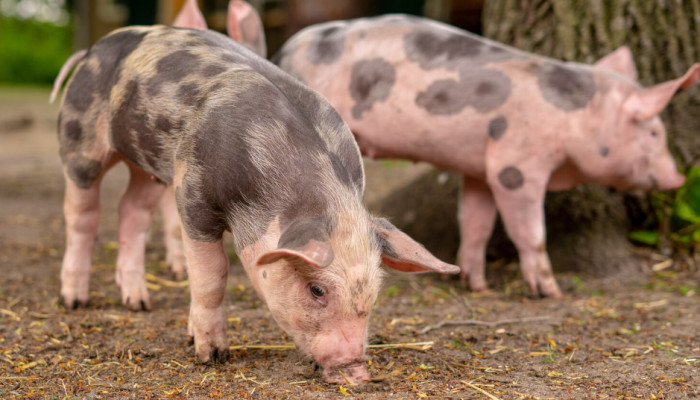
When you notice how pigs use their snouts to lift soil and search for food, it’s hard not to think their curiosity is doing the driving, not just hunger.
How Pigs Think and Communicate
- Pigs learn routes, routines, objects, and simple tasks quickly. Research has even trained pigs to control a joystick for rewards.
- Strong memory helps a pig remember food locations, companions, and previous handling experiences.
- Pigs form social groups with stable relationships. They often sleep in close physical contact with preferred companions.
- The species produces many vocalizations, including grunts, squeals, barks, and nursing calls. Different sounds carry different social information.
- Piglets recognize their mother’s calls. A sow uses rhythmic grunts while nursing to coordinate milk release and feeding.
- Play includes running, pivoting, pushing objects, carrying materials, and mock fighting. Young pigs need room and enrichment to express it.
- Pigs can bond with animals outside their species. A pig raised with rescue dogs began copying household routines and resting with the group.
- Cross-species attachment also appears in stories of a piglet and kitten sharing warmth and companionship.
Pig Food, Families, and Natural Behavior
- Pigs are omnivores. Wild and free-ranging animals eat roots, plants, fruit, seeds, insects, eggs, carrion, and small animals.
- Rooting is a core behavior, not simple destructiveness. A pig denied any chance to investigate with its snout may become frustrated.
- Before giving birth, a sow searches for a nest site and gathers plant material. Nest building begins even when food and shelter are already available.
- Newborn piglets compete for regular positions along the udder. Stable teat order can reduce conflict during nursing.
- Wild boar piglets often have pale horizontal stripes that break up their outline. The pattern fades as they mature.
- A pregnant domestic pig can still show powerful nesting instincts. One sow escaped a farm to give birth in woodland.
- Kunekune pigs are especially effective grazers and can obtain a substantial part of their diet from pasture when conditions are suitable.
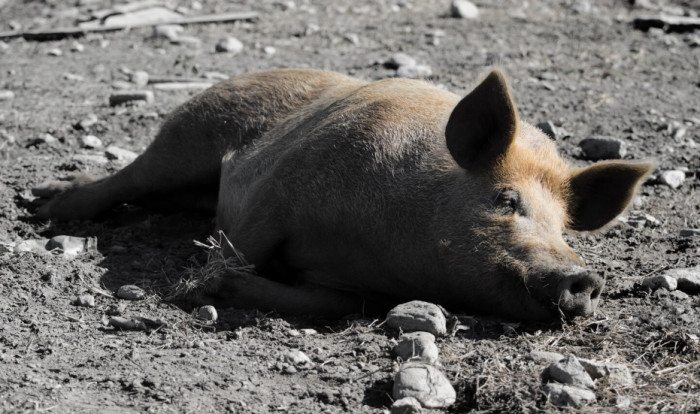
Then the story gets messier in the best way, mud is split from sleeping areas, and all that wallowing is basically pig logistics.
Foxes rely on sharp hearing and flexible diets, kind of like how they move from snow pounces to city streets.
Once you factor in that piglets recognize their mother’s calls and that pigs can even be trained to control a joystick for rewards, the grunts and squeals start sounding like real information.
Pigs, People, and Persistent Myths
- Pigs can live peacefully with horses on some properties, but feeding, fencing, parasite control, and introductions require separate planning.
- Like cats and dogs, pigs can learn names, anticipate schedules, and seek attention from familiar people.
- Wild pigs and coyotes may share habitat, although adult feral hogs can be dangerous prey and strong competitors.
- “Sweating like a pig” is biologically misleading. Pigs have limited functional sweat glands and rely on behavior to stay cool.
- Pigs are used in medical research because several organs and developmental processes share useful similarities with humans.
- Pet pigs can become large, strong, and demanding. A story about a pig disrupting a wedding is comic, but it also shows why public settings need planning.
- Wild pigs sometimes encounter pollutants and toxins while foraging. Reports of fluorescent blue tissue in feral pigs prompted warnings about contaminated bait.
What These Facts Reveal
Pig intelligence is not useful only because it makes good trivia. An animal that remembers, anticipates, forms preferences, and builds social relationships also experiences poor handling and barren environments more acutely. Curiosity needs an outlet, and rooting cannot be replaced by standing beside an empty floor.
Their behavior also corrects the dirty-pig stereotype. Given enough space, pigs organize areas for sleep, feeding, elimination, and cooling. Mud is a tool. Rooting is investigation. Vocalization is communication.
Reading those actions accurately gives a more realistic picture than judging the animal by farmyard language. Smart animals need workable environments.
That point applies to pets, farm animals, and feral populations alike. Intelligence does not make every pig easy to manage, but it does make boredom, fear, and poor handling more consequential.
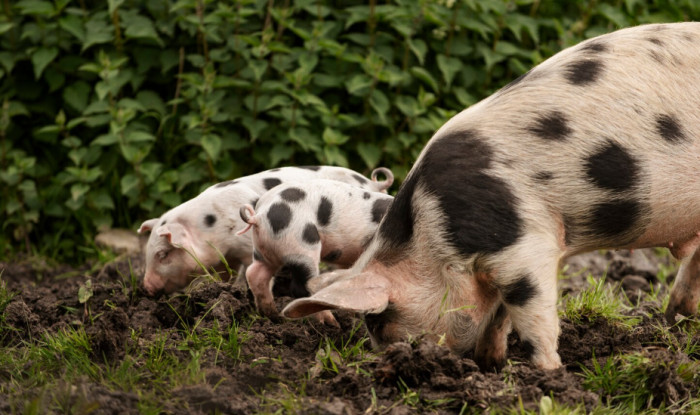
And when a pig raised with rescue dogs starts copying household routines and resting with the group, you realize the social circle is bigger than anyone expected.
Common Questions About Pigs
Do pigs sweat?
Only to a limited degree. They depend much more on shade, water, airflow, and wallowing to control body temperature.
Are pigs intelligent?
Yes. They learn tasks, remember locations and companions, solve problems, and adapt behavior from previous experience.
Why do pigs roll in mud?
Mud cools the body, protects the skin from sun, and discourages insects. It is practical behavior rather than a preference for filth.
Those grunts were never “just noise,” they were the soundtrack to a pig brain that remembers, learns, and sticks close to its people.
Want more animal brains, check out how horses sleep standing and remember everything.
Share this article:





