
Yak vs Bison: 7 Differences in Build, Habitat, and Use

It starts with a simple “close enough,” the kind of mistake that happens when you see a shaggy, humped-looking bovine from far away and your brain decides it’s the familiar one. But yak and bison do not play the same role in the landscape, and their bodies are built for totally different extremes.
Picture someone trying to ID them while scrolling through zoo photos and high-altitude images, comparing silhouettes, hair length, and that shoulder area that either rises dramatically or stays more evenly balanced. Then you realize the confusion gets worse fast, because both can look humped, both can be fluffy, and both can trick you until you notice the details that actually matter.
Here’s how to spot the difference before your next “wait, is that a yak?” moment.
Quick comparison
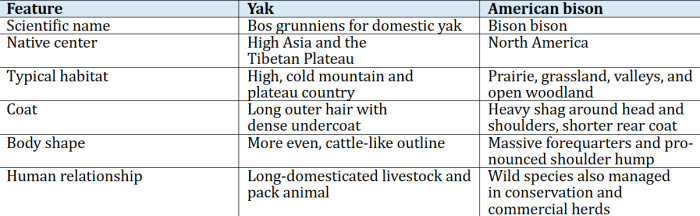
What is the main difference between a yak and a bison?
The clearest difference is adaptation and body plan. The Food and Agriculture Organization describes yak as animals centered on the Qinghai-Tibetan Plateau and commonly found at elevations of about 2,000 to 5,000 meters. Their long coat and compact build fit cold, high-altitude conditions.
The Smithsonian National Zoo describes American bison as North America’s largest terrestrial animals, with a pronounced hump over the front shoulders, a massive head, thick hair on the front of the body, and slimmer hindquarters.
Seven ways to tell yaks and bison apart
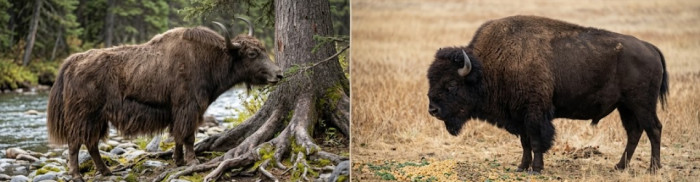
That shoulder hump is the first thing people latch onto, especially when the bison silhouette looks like it’s doing all the heavy lifting.
1. Bison have a much more dramatic shoulder hump
The bison silhouette rises sharply over the shoulders because powerful muscles support the large head and neck. The back then slopes toward noticeably lighter hindquarters.
Yaks can look humped at the withers, but their body is more evenly balanced from front to rear. Long hair can make the outline look lower and wider than it really is.
The same silhouette-first approach helps with moose vs elk, where antlers are useful but body shape still matters when they are absent.
2. Yak hair hangs much lower
Domestic yaks have a dense undercoat and long outer hair. The hair can form a skirt along the belly and legs, sometimes hanging close to the ground. Their tails are also long and heavily haired.
Bison are shaggy too, but the distribution is different. The thickest hair concentrates around the head, beard, shoulders, and front legs. The rear half is much shorter-coated, especially outside winter.
Long hair alone can still fool the eye. Fluffy Highland cattle and baby Highland cows show why coat length cannot identify a bovine without the rest of the body shape.
Then the hair throws a curveball, because yak coats can hang low like a furry skirt, while bison hair clusters up front and keeps the back tighter.
3. Their native ranges are on different continents
Yak history centers on the Tibetan Plateau and neighboring highlands of Asia. Domestic herds spread across the Himalayan region, Mongolia, and adjoining mountain areas.
American bison evolved in North America. Their historic range was far larger than the fragmented conservation range seen today.
A wild-looking shaggy bovine in Wyoming is not a native yak. One on a high Tibetan pasture is not an American bison.
This build-and-habitat contrast is like moose versus elk, where a broad muzzle and paddle antlers separate them from branching antlers.
4. Yak are high-altitude specialists
Cold, wind, thin air, and rough forage shape yak biology. FAO material describes the species as unusually well suited to environments where other bovines may not thrive, with a compact body and dense insulating coat.
Bison are cold-tolerant too. Their adaptations fit open North American landscapes rather than the same extreme high-altitude niche.
Different cold. Different solution.

After that, the location story clicks in, since yaks are built for the Qinghai-Tibetan Plateau and bison are all about North America’s open spaces.
5. Their horns usually create different profiles
Yak horns, when present, tend to project outward and curve upward, often creating a wider span around the head. Domestic breeds can also be hornless.
American bison have shorter, sharply pointed horns that curve outward and up from the sides of the head. Both sexes carry horns.
Horn shape helps, but the shoulder line and coat distribution are easier to see at distance.
6. Yaks are a long-domesticated working animal
People have raised domestic yaks for centuries for transport, milk, meat, hides, fiber, and fuel from dried dung. Their role is closely tied to high-altitude pastoral systems.
Bison can be raised commercially, but American bison remain a wild species with a major conservation history. Commercial management does not make them equivalent to domestic cattle or yaks.
A blind bison living at a sanctuary can adapt to managed care, but an individual rescue story should not be used as a shortcut for species-level handling expectations.

7. “Buffalo” creates an extra naming problem
In North America, people often call American bison buffalo. True buffalo, such as water buffalo and African buffalo, belong to different groups. So yak vs buffalo can mean something different from yak vs bison.
Pupperish has covered a cow that escaped from bison and a bison living with a cow, two stories that make the shared bovine outline obvious without making the animals interchangeable.
Are yaks related to bison?
Yes. Both belong to the cattle family Bovidae and are close enough that historical animal-breeding literature records hybrids. That does not make them the same species, and hybrid breeding is not a useful identification rule.
The meaningful differences remain range, body structure, coat, adaptation, and domestication history.
A bison confronting a lion highlights the animal’s massive forequarters. The same mass distribution is one of the quickest visual differences from a yak.
Which is bigger, a yak or a bison?
American bison are generally the heavier-looking animal, especially through the head and shoulders. Wild yaks can also become extremely large, and domestic yak size varies by breed, sex, nutrition, and region.
Use proportions instead of a single weight estimate. A bison looks front-loaded. A yak looks more evenly cattle-like beneath long hair.
That approach is also useful in jaguar vs leopard, where apparent size in a photograph can be less reliable than build and geography.

And once you connect build, coat, and habitat, the “they look similar” argument stops holding up, fast.</p>
Yak vs bison FAQs
Is a yak a type of bison?
No. Domestic yak are Bos grunniens. American bison are Bison bison. They are related bovids, not the same animal.
Is a bison a buffalo?
American bison are commonly called buffalo in North America, but true buffalo are different bovines. The traditional name is widespread even though “bison” is more precise biologically.
Can yaks and bison live in the same climate?
Both tolerate cold, but yak are especially adapted to high-altitude conditions. Climate suitability depends on heat, elevation, shelter, forage, and the exact management system.
Do yaks and bison have the same coat?
No. Yak hair tends to hang long along much of the body, while bison carry their heaviest shag on the head and forequarters with a shorter rear coat.
The quickest identification rule
Look at the shoulder line first. A towering front hump, massive head, and shorter-coated hindquarters point to bison. A more cattle-like body wrapped in long hanging hair points to yak.
Then check geography and horns. Those clues should agree before you settle on the name.
Nobody wants to keep mixing up the one with the dramatic hump and the one whose hair basically drags the ground.
Confused about “buffalo” versus American bison? See how “cow vs buffalo” clears it up.
Share this article:





